Australian organisations are investing more in training, but most L&D teams still report what's quickest to collect: completions, attendance and satisfaction scores. Behaviour change takes weeks or months to observe. The fix is to define the observable behaviour upfront, set a baseline, and measure practised performance against it.
Why does L&D keep reporting attendance instead of behaviour?
Because attendance data arrives the same day. Karstens, an Australian training provider, points out that knowledge can be assessed immediately, while behaviour and workplace outcomes may take weeks or months to show up. When one metric is instant and the other is slow, the instant one becomes the default.
That's an inference from a provider blog, not a surveyed finding. It's still a persuasive one. Most practitioners will recognise the pattern: the board pack is due Friday, and the behaviour data won't exist until next quarter.
Two other forces push the same way:
- Budget justification. Learning Elements says many organisations track whether employees complete training, but far fewer track whether it changes behaviour, performance or risk. It links measurement to justifying learning budgets and demonstrating compliance.
- Compliance records. Reporting that needs proof training happened rewards a completion record. A completion record says nothing about what people do afterwards.
What does the Australian evidence actually say?
Honestly, it's thinner than the confident commentary suggests. No recent Australian survey we found quantifies how many organisations measure behaviour change. Most local claims come from provider blogs, which are useful but not primary data.
What we do have points in one direction.
Spend is rising, but strategy is loosely connected
AHRI's Quarterly Work Outlook (March 2026) says organisations remain strongly committed to skills development, and training investment continues to rise. Yet only 20 per cent of Australian workplaces said their training plans and strategic workforce plans were integrated to a large extent.
That matters for measurement. If training isn't tied to a workforce goal, there's no obvious behaviour to measure, so teams fall back on activity.
Yarno adds that employer-sponsored training is above long-term averages post-pandemic. More money means leaders want to see what it produced.
Short-term indicators still dominate
AIM (April 2026) reports that most organisations still rely on short-term indicators such as employee feedback and engagement scores. It also sees a growing shift towards tracking behavioural outcomes and retention. The underlying research isn't clearly identified, so treat it as a directional signal.
The best numbers are international
The strongest quantitative evidence of the gap is global. The Blanchard 2026 HR & L&D Trends Survey (808 respondents) found only 24% report strong application of new learning. A secondary summary from EduFellowship says only 29% believe their measurement practices clearly demonstrate L&D's value. That second figure is secondhand, so we'd quote it cautiously.
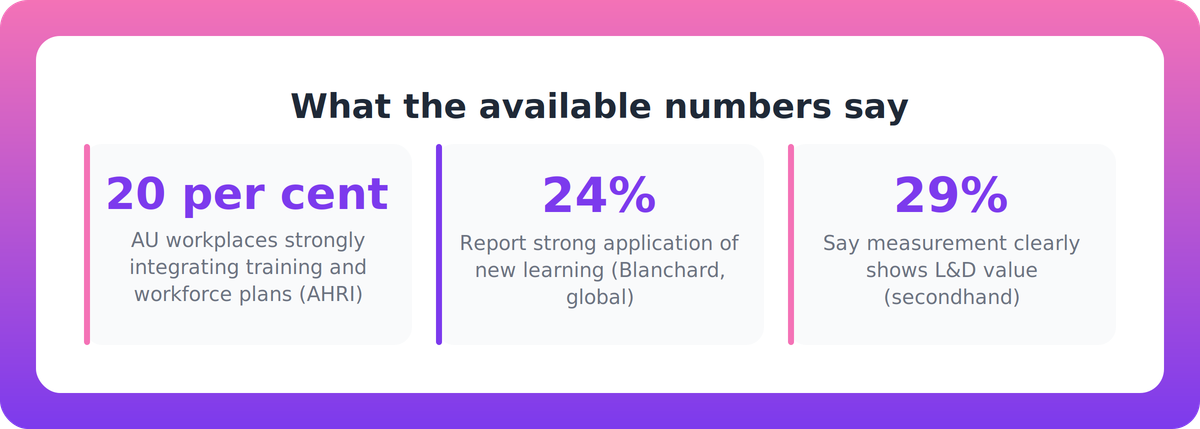
Neither is an Australian number. Together they suggest the problem isn't unique to us.
Is the bar actually rising?
Probably, yes. AIM argues that moving beyond vanity metrics such as total course hours or participant satisfaction is crucial for credibility at executive and board level.
The profession's own bodies are heading the same way. The AITD Excellence Awards category 'Best Learning Impact or Measurement Strategy' looks for:
- success measures defined upfront
- baseline data
- efforts to isolate the effect of learning from external variables
The 2026 AITD Conference in Brisbane, with around 350 delegates, reportedly focused on learning that changes behaviour, not just learning that informs. Awards and conference themes aren't proof of practice. They do show where the profession wants to be seen.
What would behaviour change evidence look like?
The useful shift is from "did they attend?" to "can we see them do it?" That means evidence from practice, not from a post-course survey.
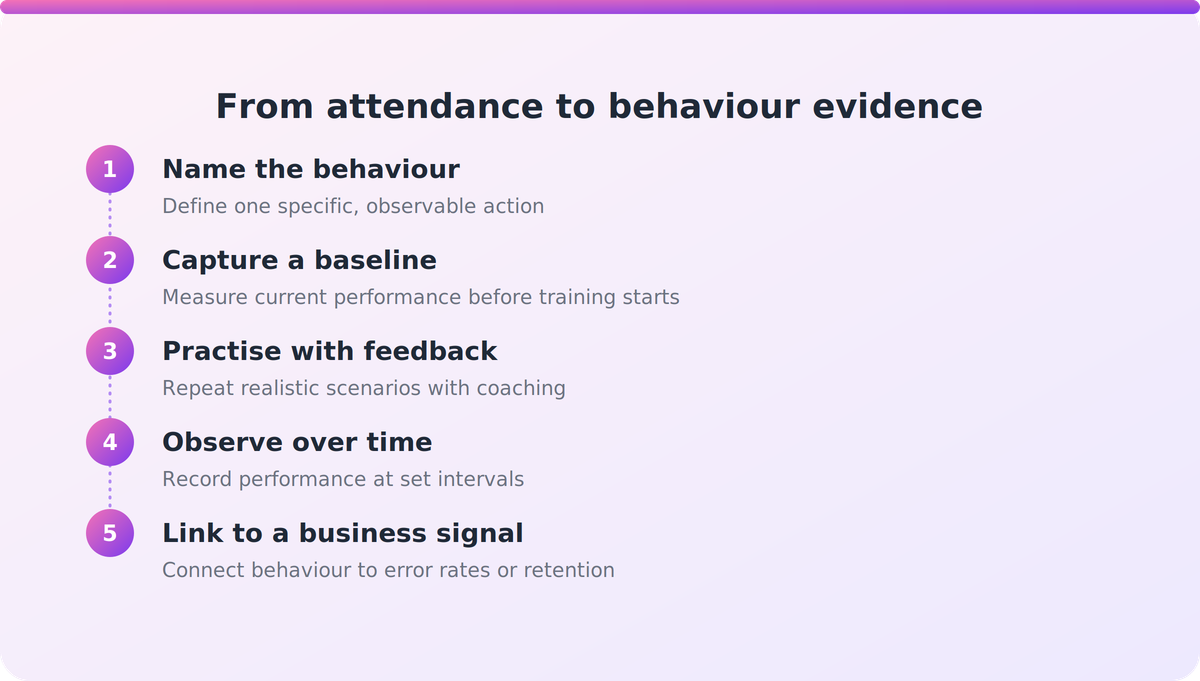
A workable approach:
- Name the behaviour. "Handles a pricing objection without discounting" beats "improves sales skills."
- Capture a baseline before the program starts.
- Practise in realistic conditions with feedback, not a single workshop.
- Record observable performance at intervals, such as week two, week eight and quarter end.
- Isolate the effect where you can, using comparison groups or timing against other changes.
- Link the behaviour to a business signal such as error rates, retention or customer outcomes.
The practice step is where most programs run thin. Role plays and simulations with coaching are expensive to staff, so teams ration them. That's one reason the idea of AI-generated, coached practice scenarios is interesting. Every repetition leaves a record of what someone actually did, and that's a much better evidence trail than a completion tick.
It's worth asking whether your current reporting could survive a board member asking, "And did anyone change how they work?"
Key takeaways
- Australian training investment is rising, but the evidence reported is still mostly completions, attendance and satisfaction.
- Timing is a likely driver: attendance data is instant, behaviour data takes weeks or months. This is an inference from provider commentary.
- AHRI found only 20 per cent of workplaces strongly integrate training plans with workforce planning, which leaves outcomes without a clear target.
- The firmest numbers are global (Blanchard: 24% report strong application of learning), and no recent Australian survey quantifies behaviour measurement.
- Better evidence means a named behaviour, a baseline, repeated practice and observation over time.
Our take
The measurement gap is less a skills problem than a design problem. Teams track attendance because the program was never built to produce anything else. If you want behaviour evidence, build practice into the program, because practised, observable performance is the only thing worth measuring. Until the evidence base improves, we'd be wary of anyone, including us, quoting a precise Australian figure for how big the gap is.
FAQ
Why do Australian organisations measure completions instead of behaviour change?
Completion and satisfaction data is available the same day, while behaviour can take weeks or months to observe. Compliance and budget reporting also tend to reward completion records. This explanation comes from provider commentary such as Karstens and Learning Elements, not a formal Australian survey.
How many Australian workplaces link training to workforce planning?
AHRI's Quarterly Work Outlook (March 2026) found only 20 per cent of Australian workplaces said their training plans and strategic workforce plans were integrated to a large extent. That makes it hard to define which outcomes training should be measured against.
Is there Australian data on how many organisations measure behaviour change?
Not that we found. The strongest quantitative figures are international, such as the Blanchard 2026 HR & L&D Trends Survey of 808 respondents, where 24% reported strong application of new learning. AIM says most Australian organisations still rely on short-term indicators, but its underlying research isn't clearly identified.
What should behaviour change training in Australia measure instead?
Start with a specific, observable behaviour and capture a baseline before training. Then record performance at intervals after repeated, coached practice. Where possible, isolate the effect of learning from other variables. This mirrors what the AITD Excellence Awards measurement category looks for.
Why does executive scrutiny of training matter now?
AIM argues that metrics like total course hours or participant satisfaction no longer earn credibility at board level. Yarno notes employer-sponsored training is above long-term averages post-pandemic, so leaders increasingly want to see what the investment produces.