The FMA's test for CoFI fair conduct training in NZ is whether your Fair Conduct Programme works on the front line, not whether it exists on paper. Its 2025 insights report asks for evidence that staff understood their training. A PDF policy plus a completion tick-box is the weakest evidence you can offer.
What is the FMA actually testing under CoFI?
The Conduct of Financial Institutions (CoFI) regime has been in effect since 31 March 2025. The early messaging was about education. The FMA has said it will use supervision and monitoring to assess whether insurers' Fair Conduct Programmes are operating effectively.
That word, *effectively*, is the whole game. A programme can be well drafted, approved and filed, and still fail the test if people on the phones and in branches don't act on it.
DLA Piper reported that the FMA signalled a "set-and-forget" approach won't suffice. It also said the regulator intended an "educative and collaborative" approach in the early years. Read that as a grace period, and grace periods end.
What does the FMA say good training looks like?
The FMA's Fair Conduct Programme Insights Report (April 2025) is specific. In summary:
- Training must be relevant, proportionate and tailored to the business.
- Its main purpose is for employees to understand the fair conduct principle and what they must do to treat customers fairly.
- Firms should have controls to confirm staff completed *and understood* the training.
- There should be a way to evidence that, such as a training register.
Notice what's not on the list: a longer policy, or a bigger slide deck. The measure is understanding, and the proof has to be something you can show.
Why do policies and practice drift apart?
Because policies describe intent, and the front line deals with pressure, ambiguity and incentives. The FMA's own findings show the pattern.
Its Financial Conduct Report found that in 2025/26 advice monitoring, complaints policies and registers were generally in place. But advisers' understanding and application were inconsistent. Advisers had limited understanding of what counts as a complaint, and some registers were blank or underused. That is advice-sector evidence, so it applies to banks and insurers only by analogy. It's still a clear picture of what "policy exists, behaviour doesn't follow" looks like.
Incentives show the same drift. The FMA found gaps in how some insurers govern and monitor non-monetary benefits and short-duration sales campaigns offered to intermediaries. It chose a targeted information campaign on incentives rather than rewriting its guidance (Investment News NZ). A sales campaign can pull behaviour away from written policy in a week.
The regulator has also tested behaviour through people before. The 2018 FMA and RBNZ bank conduct and culture review involved 391 interviews with more than 500 bank staff, including frontline workers.
Why is a completion tick-box weak evidence?
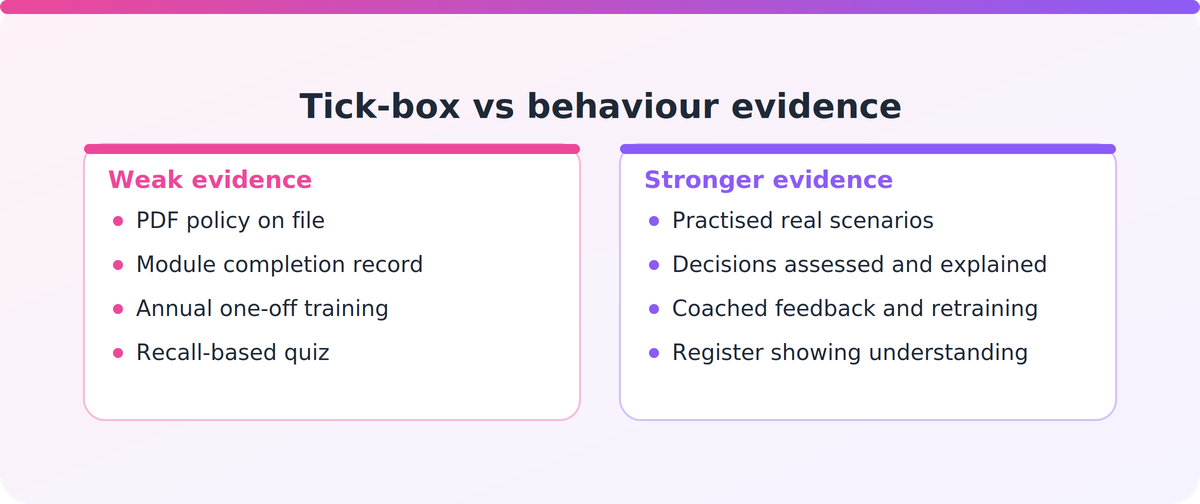
A completion record answers one question: did the person open the module? It says nothing about whether they could spot a complaint, handle a vulnerable customer, or push back on a sales target that cuts across fair treatment.
The legal exposure sits there. MinterEllison notes the FMA could allege a programme isn't "effective" by pointing to deficiencies in processes, policies, systems and controls. The key risk arises when consumers are harmed and the FMA then reviews whether the programme was effective. At that point, "100% completion" is a thin defence if staff couldn't apply what they'd been taught.
What stronger evidence of fair conduct training looks like
The FMA hasn't published a template for proving behaviour change, and we haven't seen an NZ publication specifically on CoFI training effectiveness. So treat the following as a practical reading of the FMA's stated expectations, not a regulatory checklist.
- Practise the real moments. Build scenarios around the situations your own staff face: a borderline complaint, a customer in financial hardship, an incentive that tempts a shortcut.
- Test understanding, not recall. Ask people to make a decision and explain it. Multiple-choice on policy wording tells you who can read.
- Give feedback on the spot. Behaviour changes with repeated, coached practice. A one-off annual module rarely moves it.
- Keep a register that shows understanding. Record completion, but also what was assessed, how people performed, and what you did about the gaps.
- Retrain when conditions change. A new sales campaign or incentive is a trigger for fresh practice, not a footnote.
This is where role plays and simulations earn their keep. They've traditionally been expensive to run, which is why many firms default to static content. AI-generated scenarios and coached practice are changing that cost, and they produce exactly the kind of performance record the FMA's language points to.
What about the proposed legislative changes?
Proposed amendments may reduce prescription around training, supervision and monitoring. The Royal assent and commencement dates are unconfirmed in our research, so check legislation.govt.nz before you plan around them.
Either way, less prescription doesn't remove the duty that the programme be effective. If anything, it puts more weight on you to show that it is. The FMA also became NZ's single conduct regulator on 1 July 2026, absorbing consumer credit oversight from the Commerce Commission. Expect that to sharpen its focus on conduct in practice.
Key takeaways
- The FMA's test is whether your Fair Conduct Programme operates effectively in practice, not whether it exists.
- Its insights report wants controls confirming staff completed *and understood* training, with evidence such as a training register.
- The FMA's monitoring found policies in place but inconsistent frontline understanding, and incentives can pull behaviour off-policy.
- Completion records alone are weak evidence if harm occurs and the FMA reviews effectiveness.
- Possible amendments may reduce prescription, but they don't remove the effectiveness duty.
Our take
Most firms will treat CoFI training as a documentation exercise right up until someone is harmed. That's the wrong moment to discover that nobody can show staff knew what to do. We think the sensible bet is to assume the effectiveness test stays, however the rules around training are trimmed, and to build evidence of real behaviour now. Practised decisions beat signed acknowledgements every time.
If you're reviewing how your training evidence would stand up, it's worth asking one blunt question: could we show a regulator a person handling a hard moment well? Some teams are exploring how AI-built practice scenarios can answer that, and you can see one approach at supahuman.com.
FAQ
What does the FMA expect from CoFI fair conduct training?
The FMA's April 2025 insights report says training should be relevant, proportionate and tailored to the business. Its main purpose is for employees to understand the fair conduct principle and what they must do to treat customers fairly. It also recommends controls to confirm staff completed and understood training.
Is a training completion record enough to evidence CoFI compliance?
It's the weakest form of evidence. The FMA's insights report points to confirming that staff understood their training, with a way to evidence it such as a training register. Completion alone doesn't show understanding or behaviour.
Has the FMA taken enforcement action over frontline training failures under CoFI?
We found no FMA enforcement action turned on frontline training failure. The FMA has said it will use supervision and monitoring to assess whether Fair Conduct Programmes operate effectively, and early-years messaging was educative and collaborative. That approach is not expected to last forever.
Will proposed changes to CoFI remove training requirements?
Proposed amendments may reduce prescription on training, supervision and monitoring. The Royal assent and commencement dates are unconfirmed, so check legislation.govt.nz. Less prescription doesn't remove the duty that a Fair Conduct Programme be effective.
Does the FMA's advice-sector finding apply to banks and insurers?
Only by analogy. The Financial Conduct Report's finding about inconsistent understanding of complaints policies came from advice monitoring. It still shows how policies can exist while frontline application varies.