Under NZQA's integrated Quality Assurance Framework (iQAF), audit-readiness is a year-round job, and the standards underneath it keep moving. If every document review and evidence question still routes through one compliance manager, that desk is your provider's single point of failure. The fix isn't working harder. It's distributing ownership and making evidence traceable.
Why this lands on your desk
You're probably the person who has to stand behind the annual self-review summary report. Under iQAF, providers submit that report to NZQA and then meet NZQA to discuss the improvement plan. You can't evidence it by gathering files once a year. The evidence has to already exist, in a place you can find it, with a clear owner.
Then there's the rewrite. The 2026 NZQA Rules took effect from 19 January 2026. The PTE Rules 2026 replace the PTE Registration Rules 2025 and the PTE Enrolment and Academic Records Rules 2022. The Programme Approval, Recognition and Accreditation Rules 2026 replace references to EER with self-review and monitoring. Someone has to check every policy, process and programme document against the new wording. In most organisations, that someone is you.
Most compliance managers we hear from describe the same pattern. Nobody decided you'd be the bottleneck. It happened because you're the one person who knows what "good" looks like, so everything gets sent to you "just to check".
What iQAF changed
The facts are worth stating plainly:
- iQAF went live on 15 January 2026. From 1 January, NZQA stopped starting new EER processes and consistency reviews. Reviews already underway will be completed.
- Providers submit an annual self-review summary report and meet NZQA to discuss the improvement plan.
- The PTE Rules 2026 also remove the annual fee. Non-funded PTEs provide financial returns biennially unless NZQA says otherwise.
The EER model let you build toward an event. You could run a push, fix gaps, and exhale afterwards. iQAF removes the event. The regulator's question becomes "how do you know, all year, that you're doing what you say?" That's a question about systems, not about how well one person prepares.
Standards that won't sit still
Industry Skills Boards (ISBs) were formally established from 1 January 2026. They lead standard-setting, and they also endorse programmes and moderate assessments. The system is moving progressively from unit standards to skill standards. The Manufacturing and Engineering ISB, for example, is reported to have developed around 1,200 skill standards.
For you, that means the definition of "current" is a moving target. Every change can mean another programme document, assessment tool or moderation record to re-check. If each of those checks needs your eyes, your throughput caps the speed at which your provider can adapt.
The sector's turbulence makes it worse. Te Pūkenga functions transferred to regional polytechnics from 1 January 2026. ISBs can't enrol, manage or assess learners after 31 December 2027, after which new apprenticeship and traineeship programmes will be offered by industry-led private providers, polytechnics and Wānanga. Reported job losses across the polytechnic sector mean fewer people to share the load, at exactly the moment the load grows.
A graded judgement would expose fragile systems
NZQA consulted on replacing the compliant or non-compliant outcome with three descriptors: Highly Effective, Effective and Not Effective. These would be assessed against four weighted criteria: programme and micro-credential design, education delivery, assessment practice, and quality management systems. Consultation closed on 7 September 2026. We found no final decision, so treat it as pending.
Even so, the direction matters. A binary outcome lets a patchy system scrape through. A graded one makes the quality of your quality management system visible. A process that works only because one person remembers everything is hard to describe as "Highly Effective".
Moving from gatekeeper to assurance owner
There's a real difference between owning assurance and performing every check. Here's what we'd try this quarter.
1. Separate deciding from reviewing
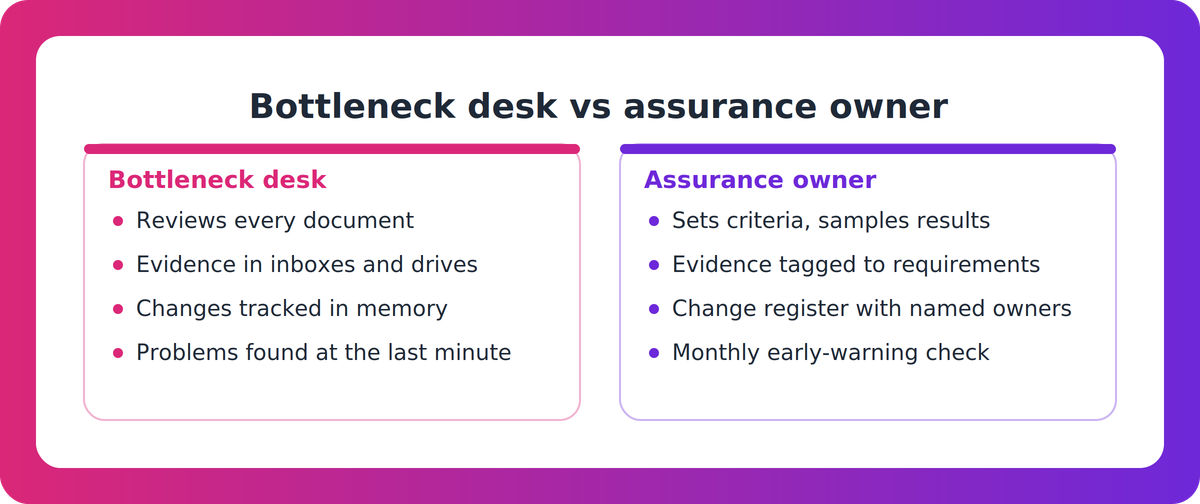
List the recurring compliance decisions: policy changes, assessment tool sign-off, programme changes, complaint handling. For each, name who decides, who evidences and who reviews. Many of these can be decided by the person who owns the work, with you setting the criteria and sampling the results.
2. Tie evidence to the requirement at the point of creation
Evidence scattered across drives, inboxes and spreadsheets is the root of most rectification scrambles. When a document or record is created, tag it to the rule, standard or Code obligation it supports. Then, when you need to show how you meet a requirement, you're retrieving rather than reconstructing.
3. Keep a change register for standards and rules
When an ISB publishes a skill standard or NZQA changes a rule, log it, list which documents and programmes it touches, and assign each a named owner and a date. That turns "I think this is affected" into a traceable action.
4. Build your own early warning
A monthly look at overdue document reviews, open improvement actions and unresolved complaints tells you where risk is building before NZQA does. It's also the raw material for a credible self-review.
5. Triage what reaches you
Route high-risk items to yourself, such as programme changes and assessment decisions that carry regulatory weight. Give routine updates to a trained peer reviewer with a clear checklist. You'll see less, but what you see will matter more.
Key takeaways
- iQAF, live since 15 January 2026, replaced EER with an annual self-review summary report and an improvement-plan conversation with NZQA, so audit-readiness is now continuous.
- The 2026 NZQA Rules, ISB standard-setting and the move to skill standards keep changing what "current" means, and that checking tends to land on one desk.
- A graded judgement (Highly Effective, Effective, Not Effective) is still pending, but it signals that quality management systems will face sharper scrutiny.
- Being the single reviewer is a risk to the provider, not proof of rigour. Distribute decisions, tag evidence to requirements, and keep a change register.
- Your role shifts from checking everything to owning the assurance that the system works.
Our take
The compliance manager as chief checker is a model built for periodic audits. It made sense when the event was the thing. It makes much less sense when the regulator expects a provider to know, continuously, how well it's doing.
We'd go further: if the whole system depends on one person's memory and judgement, you haven't built compliance, you've built a dependency. Distributing ownership isn't a loss of control. It's the only way the control survives a resignation, a restructure or a busy fortnight.
A useful first step: pick the last three documents that waited on you for sign-off. For each one, ask whether someone else could have decided it with the right criteria. The answer tells you where to start.
FAQ
What replaced EER for NZ providers?
NZQA's integrated Quality Assurance Framework (iQAF) went live on 15 January 2026. Providers submit an annual self-review summary report to NZQA and meet NZQA to discuss the improvement plan. From 1 January, NZQA stopped starting new EER processes and consistency reviews. Reviews already underway will be completed.
Which NZQA Rules changed in 2026?
Updated NZQA Rules took effect from 19 January 2026. The PTE Rules 2026 replace the PTE Registration Rules 2025 and the PTE Enrolment and Academic Records Rules 2022, and remove the annual fee. The Programme Approval, Recognition and Accreditation Rules 2026 replace EER references with self-review and monitoring. They also remove the need for ISB endorsement for Type 2 programme changes.
Is the Highly Effective / Effective / Not Effective judgement in force?
Not as far as we can confirm. NZQA consulted on the three descriptors, assessed against four weighted criteria, and consultation closed on 7 September 2026. We found no final decision, so treat it as pending and check NZQA's site for updates.
How can a compliance manager share the load without losing accountability?
Keep accountability for the assurance system, and share the decisions. Set clear criteria, assign named owners for evidence and recurring decisions, and sample the results rather than reviewing everything. Reserve your own review for high-risk changes, such as programme and assessment decisions with regulatory weight.