Enrolment demand is rarely what limits an RTO's growth. The limit sits at the assessment bench: how fast assessment gets built, how many assessors stay productive, and how cleanly evidence becomes a reportable outcome. Push volume past that ceiling and you strain the team. You also start to resemble what ASQA says it is watching for.
Why this hits your desk
You own the machinery that turns an enrolment into a completed, reportable, auditable assessment. If that stage runs on individuals' heads and manual effort, headcount ends up scaling in step with enrolments. That is the RTO scaling bottleneck in its plainest form, and it is an operating-model problem, not a sales problem.
The 2025 Standards for RTOs came into effect on 1 July 2025. They have three elements: the Outcome Standards, the Compliance Standards (including the Fit and Proper Person Requirements) and the Credential Policy. ASQA expects providers to show compliance against the Standards in effect when a decision is made. Your processes have to stand up when someone looks at them, not just on a good week.
Where the ceiling actually sits
Three places tend to set throughput. None of them show up on the enrolment dashboard.
Assessment build
If each unit of competency is assembled largely by hand, by whoever knows how, then build time becomes your queue. New intakes, new industry contexts and new delivery modes all join that queue. The work isn't hard. It's just serial, and it depends on a few people.
Assessor and trainer capacity
A qualified assessor is a scarce, expensive resource. Every hour spent reformatting evidence, chasing missing documents or re-explaining a house process is an hour not spent assessing. Utilisation is the number to watch, not headcount.
Evidence handling and re-keying
Where does the same fact get typed twice? Assessment outcome in one place, student record in another, a spreadsheet for the board report in a third. Each hand-off adds delay and a chance of error. This is also where process knowledge hides: the one person who knows which export feeds which report.
Growth that ASQA will believe
Here is the catch. Faster is not automatically better, and ASQA says so.
Its 2025–26 risk priorities call issuing qualifications through RPL without appropriate assessment an enduring and growing risk. They describe "RPL mills" that use high-volume, low-quality assessment models. Its 2026–27 priority areas include provider governance, market conduct and non-genuine operations, the quality sufficiency and fitness-for-purpose of training, and the integrity of qualifications and competency outcomes.
So a sharp rise in completions per assessor is a number you need to be able to explain. Throughput gains should be repeatable, documented and tied to assessment that demonstrably covers the unit. If you can't show how capacity grew, the growth itself becomes a question.
Reporting turns disconnected records into a cost
The reporting side is moving too. All RTOs report Total VET activity to NCVER at least annually. The VET Information Standard rolls out progressively from 2026. API-based data flows (STARS) between student management systems, state training authority systems and NCVER replace manual NAT file extraction. All RTOs must report under it by January 2029, and the last AVETMISS submission is due in February 2029. The amended Data Provision Requirements Instrument 2020 took effect on 1 October 2026.
NCVER describes the shift as moving from point-in-time, outcome-code reporting to status-based reporting, where each change is reported. Every change. That raises the cost of re-keying and of records that don't agree with each other.
One practical note: NCVER's AVETMISS Compliant Software Register is the place to check system readiness. I couldn't find an authoritative vendor readiness list, so treat any vendor's own claim with normal scepticism.
Demand is flat, so capacity should go where it counts
NCVER reports 5.1 million students enrolled in nationally recognised VET in 2025. Qualification enrolments fell by more than 5%, and government-funded program enrolments fell 9.2%. Growth was concentrated among younger students (including those in school) and among regional and remote, disability and First Nations students.
The next point is my inference, not an NCVER finding. Those growth pockets likely call for varied delivery contexts. In a flat market, the winners may be the RTOs that can adapt assessment to different cohorts without rebuilding from scratch each time.
Three questions to ask this quarter
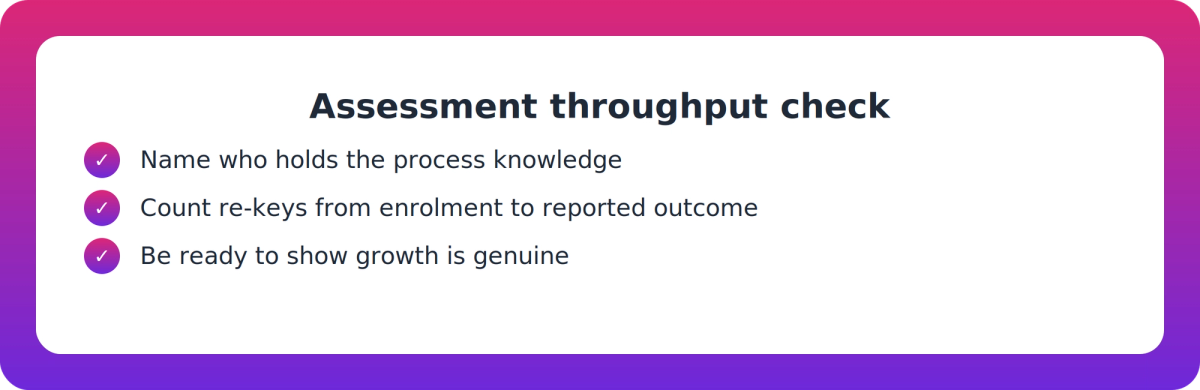
- Where does process knowledge sit? Name the people whose absence would stall assessment build or reporting.
- Where does work get re-keyed? Trace one learner from enrolment to reported outcome and count the touches.
- Could you show the growth is genuine? If ASQA asked how you raised throughput, what would you hand over?
Read before you change how assessment is produced
ASQA's newsroom lists a revised Regulatory Assessment and Monitoring Approach (25 August 2026), Principles for the Responsible Use of AI in VET and the 2026–27 Regulatory Risk Priorities. Read them before you change how assessment is made.
A secondary source is worth noting, labelled as such. A provider's notes from ASQA's March 2026 Brisbane workshop say ASQA cautioned against buying off-the-shelf policies or continuous-improvement systems without adapting them to context. ASQA wants evidence of active implementation, and the RTO remains fully responsible. That applies equally to any process or tool that changes how assessments are built.
Key takeaways
- The assessment bench, not enrolment demand, often sets an RTO's growth ceiling.
- ASQA flags high-volume, low-quality assessment as a risk, so throughput gains must be repeatable and evidenced.
- The VET Information Standard (all RTOs by January 2029) makes disconnected records and re-keying more expensive.
- With qualification enrolments down more than 5%, capacity is best spent on existing enrolments and the growth pockets.
- Whatever changes how you produce assessment, you stay fully responsible for it.
Our take
Most operations teams treat throughput as a staffing question: hire another assessor, add another coordinator. We think it is a knowledge-and-flow question first. If the way you build assessment lives in a few heads and your records are keyed by hand in three places, hiring just copies the problem.
The good version of growth is boring. It is a documented, repeatable way to produce assessment, with coverage you can show and records that agree with each other. That is what holds up with ASQA, and it is what the VET Information Standard will quietly reward.
A first step you can take this week: pick one unit and trace it from request to reported outcome. Mark every hand-off, every re-key and every person who is the only one who knows. That map is your real capacity plan.
FAQ
What is the RTO scaling bottleneck?
It is the point where an RTO can't grow completions without adding people in step, usually because assessment build, assessor time and evidence handling depend on manual effort and individual knowledge rather than repeatable process.
Does ASQA treat fast growth as a problem?
Not by itself. But ASQA's 2025–26 risk priorities describe high-volume, low-quality assessment models, including "RPL mills", as a growing risk. Rapid volume growth should be backed by evidence that assessment is genuine and covers the unit.
When do RTOs have to report under the VET Information Standard?
It rolls out progressively from 2026. All RTOs must report under it by January 2029, and the last AVETMISS submission is due in February 2029, according to NCVER.
How do I check whether my systems are ready for the new reporting?
Start with NCVER's AVETMISS Compliant Software Register. No authoritative vendor readiness list was found, so also test whether your assessment and student records connect without manual re-keying.