NZQA has swapped a periodic audit event for a standing annual cycle, so compliance is now a set of recurring jobs rather than a one-off performance. If those jobs have no named owners, you become the owner by default. An NZQA compliance responsibility matrix is how you stop being the bottleneck.
Why this lands on your desk
NZQA announced on 15 January 2026 that its integrated Quality Assurance Framework (iQAF) was live. From 1 January it is not beginning any new external evaluation and review (EER) processes or consistency reviews. Those already under way will finish, and the EER category rating system will cease.
The Quality Assurance of Tertiary Education Providers Rules 2026 took effect on 19 January 2026 and replace the Quality Assurance (including EER) Rules 2022. They require an up-to-date quality management system, annual self-reviews, and reporting on and discussion of the self-review with NZQA.
You are probably the person asked to prove all three are in place, and to say who is responsible for each. There is no longer a single event to rally the building around. A gap in ownership now shows up every year, not once a cycle.
Start with the three fixed annual tasks
NZQA's own framing gives you the first three rows of your matrix:
- An up-to-date quality management system. Who decides it is current, and who signs that off?
- The annual self-review summary report. Who gathers the evidence, who writes it, who approves it before it goes to NZQA?
- The meeting with NZQA about the improvement plan. Who attends, who prepares, and who tracks the actions afterwards?
Each needs a named owner, a due date and a place where its evidence lives. "The leadership team" is not an owner. Nor is "quality".
The one-off clean-up: old names and moved rules
The reforms changed names and rule locations, and every controlled document that cites the old ones is a task.
- Workforce Development Councils (WDCs) were disestablished on 31 December 2025. Eight Industry Skills Boards (ISBs) took over standard-setting from 1 January 2026, and NZQA's rules now refer to ISBs. Any policy or procedure citing WDCs or EER needs a one-off update.
- The sub-contracting rule has moved into the new Quality Assurance Rules under the Programme Approval, Recognition and Accreditation Rules 2026. Check that whoever owns sub-contracting oversight is working from where the rule now sits.
- The same 2026 approval rules remove the need for ISB endorsement for Type 2 changes, and reduce approval requirements for qualifications consisting entirely of skill standards.
- For PTEs, the PTE Rules 2026 move the annual financial return to biennial unless NZQA notifies a particular PTE that it must file annually. They fold in the enrolment and academic records rules (the 2022 Enrolment and Academic Records Rules are revoked) and remove the annual fee.
That last point matters for the map. Record each PTE's actual reporting cadence rather than assuming the old one.
Build the matrix: what each row needs
Keep it to a single page. The test is whether someone other than you can answer "who owns this, and where is the proof?" in under a minute.
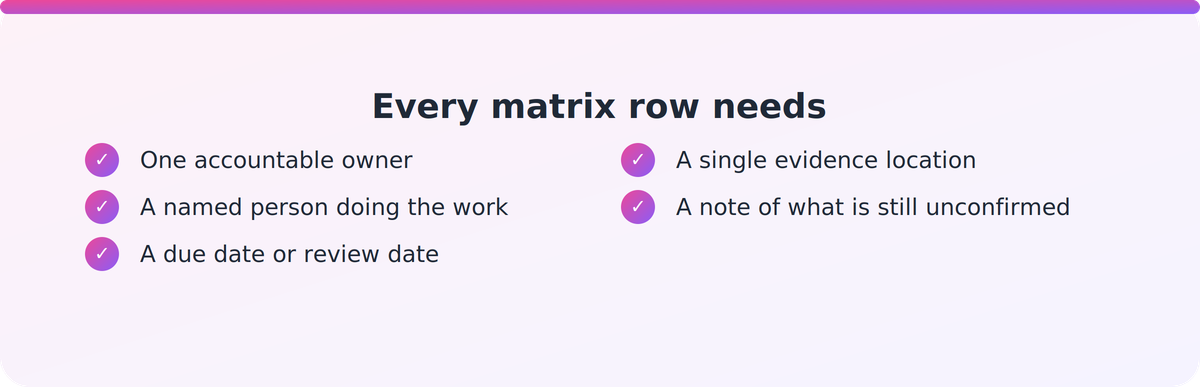
| Task | Accountable owner | Does the work | Due | Evidence location | |---|---|---|---|---| | Quality management system currency | Senior leader | Quality/programme leads | Set review date | One named folder | | Annual self-review summary | CEO or academic head | Department leads | Per NZQA schedule | Self-review file | | Improvement-plan meeting with NZQA | CEO or academic head | You, with leads | Per NZQA schedule | Meeting pack and actions | | Sub-contracting oversight | Delivery manager | Programme coordinators | Per agreement | Sub-contractor file | | WDC/EER terminology clean-up | You (project), document owners (edits) | Document owners | One-off deadline | Document register | | Financial return and reporting cadence | Finance lead | Finance team | As confirmed for your PTE | Finance records |
Two disciplines make it work. Separate *accountable* from *does the work*, because one name per task is clearer than five. And put a review date on the matrix itself.
Treat Code of Practice evidence as part of the same file
The Pastoral Care Code of Practice 2021 remains the operative code, with NZQA as administrator. NZQA's iQAF design paper says monitoring of learner safety and wellbeing will be integrated with other quality assurance activities. NZQA also says quality assurance activity will be informed by risk assessments.
My inference, not NZQA's statement, is that Code evidence, programme evidence and self-review evidence may increasingly be read together. If so, unclear ownership of pastoral care records becomes a visible risk, not a back-office one. Give those records a row.
What to leave open
Some things aren't settled, and the matrix should say so rather than guess:
- Self-review templates and schedules. I haven't found confirmed versions.
- The outcome of NZQA's consultation on describing tertiary education provider quality under iQAF. The consultation has closed, but I haven't found a published outcome, so I won't speculate.
- ISB fees. The TEC has said ISBs have a lower level of government funding, and an archived post from a former WDC says ISBs will likely charge providers for some quality assurance functions. No fee schedule has been published that I could find. Treat it as something to watch, not a confirmed cost.
- Immigration NZ will keep using existing EER ratings for 12 months from early 2026 while NZQA transitions. Note who tracks that window if you enrol international learners.
Add an "open items" strip at the bottom of the matrix with an owner for watching each one.
Key takeaways
- iQAF and the 2026 Rules replace the EER cycle with annual obligations: a current quality management system, an annual self-review summary, and an improvement-plan meeting with NZQA.
- Give each recurring task a named owner, a due date and an evidence location.
- Treat the WDC-to-ISB, EER and sub-contracting updates as a one-off project with a document register.
- Record your PTE's actual reporting cadence. Don't assume the old annual one.
- Keep the matrix adaptable, because templates, schedules, consultation outcomes and ISB fees are still open.
Our take
A responsibility matrix that lists you against every row hasn't fixed anything. It has just written down the bottleneck.
Your job is to own the map and the assurance that it's working, not the tasks. Accountability for the self-review belongs with the people who run the programmes and the organisation. You make it visible when a due date is slipping or an evidence folder is empty.
This week, list the recurring NZQA obligations in one table and fill in only the owner column. Wherever the answer is your name or a blank, you have found your first conversation.
FAQ
What is an NZQA compliance responsibility matrix?
It is a one-page map that assigns each recurring NZQA obligation a named owner, a due date and an evidence location. It covers the quality management system, the annual self-review summary, the improvement-plan meeting, sub-contracting and document updates.
Why do I need one now that EER has been replaced?
NZQA is no longer starting new EER processes or consistency reviews, and the EER category rating system will cease. The 2026 Rules instead require annual self-review and reporting and discussion of it with NZQA. Those recurring obligations need owners all year, not just before a review.
Which documents need updating after the 2026 changes?
Any policy or procedure that cites WDCs or EER. WDCs were disestablished on 31 December 2025 and NZQA's rules now refer to ISBs. Check sub-contracting documents too, because that rule now sits in the Quality Assurance Rules.
Do ISBs charge providers fees?
That isn't confirmed. The TEC has said ISBs have a lower level of government funding, and a former WDC's archived post says ISBs will likely charge for some quality assurance functions. No fee schedule has been found, so watch for NZQA and ISB announcements.