Enrolments scale with a marketing budget. Practical delivery scales with people who can supervise, judge and sign off competence, and there are only so many of them. In 2026, with work-based funding cut and the sector mid-restructure, adding trainers in step with learners is the quickest way to lose your margin.
Why this lands on your desk
You own capacity and utilisation. When delivery cost climbs roughly in line with enrolments, margin disappears, and the 2026 settings leave less room to absorb it.
You also answer for reporting and quality. Every hour a senior trainer spends on admin or rework is an hour not spent on practical delivery. And the sector around you is moving. Work-based training is shifting to providers, and you may be asked to build capacity before the operating model has settled.
The funding arithmetic has changed
TEC's 2026 funding rates show a 2% increase for targeted VET areas and a 10% decrease for all work-based delivery. After the 3% Budget 2025 uplift for targeted priority provision, TEC's worked examples net work-based delivery down 7% in one case and 10% in another. Check which rate row applies to each of your programmes, because the answer differs by programme.
Revenue per learner is also tightly bounded. Budget 2025 provided $212.5m over four years for the 3% subsidy lift from 1 January 2026, and funded the Student Loan Scheme so providers can raise fees by up to 6% in 2026. That is not much headroom if your cost per practical learner rises with every enrolment.
The structural moves you are planning around
The VET system changed on 1 January 2026: eight Industry Skills Boards, 10 stand-alone polytechnics, and two work-based learning providers moving into independent PTEs. Te Pūkenga continues until its disestablishment on 31 December 2026.
The Industry Skills Boards manage existing work-based training for a two-year transition while polytechnics, PTEs and wānanga develop new arrangements. TEC published requirements and criteria for TEOs proposing to deliver work-based learning on 9 February 2026.
That is a real growth option. But growth that adds trainers one for one meets the funding squeeze head on.
No benchmark exists, so build your own
We looked for an authoritative New Zealand source on trainer-to-learner ratios, trainer workforce supply or utilisation benchmarks for practical delivery. We didn't find one. Treat any figure that claims to be "the industry ratio" with suspicion.
That gap is a reason to measure, not to guess. Your own data is the only benchmark that reflects your programmes, your sites and your learners. Start with three questions:
- How many hours of a trainer's week are spent in direct supervision or observation of learners?
- How many go to assessment judgement and sign-off?
- How many go to everything else: scheduling, chasing evidence, re-keying data, re-explaining the same thing to different cohorts?
Most providers can answer the first one roughly. Few can answer the third.
Separate scarce trainer time from repeatable work
The question is no longer "how many trainers per learner?" It is which parts of a trainer's week are genuinely scarce.
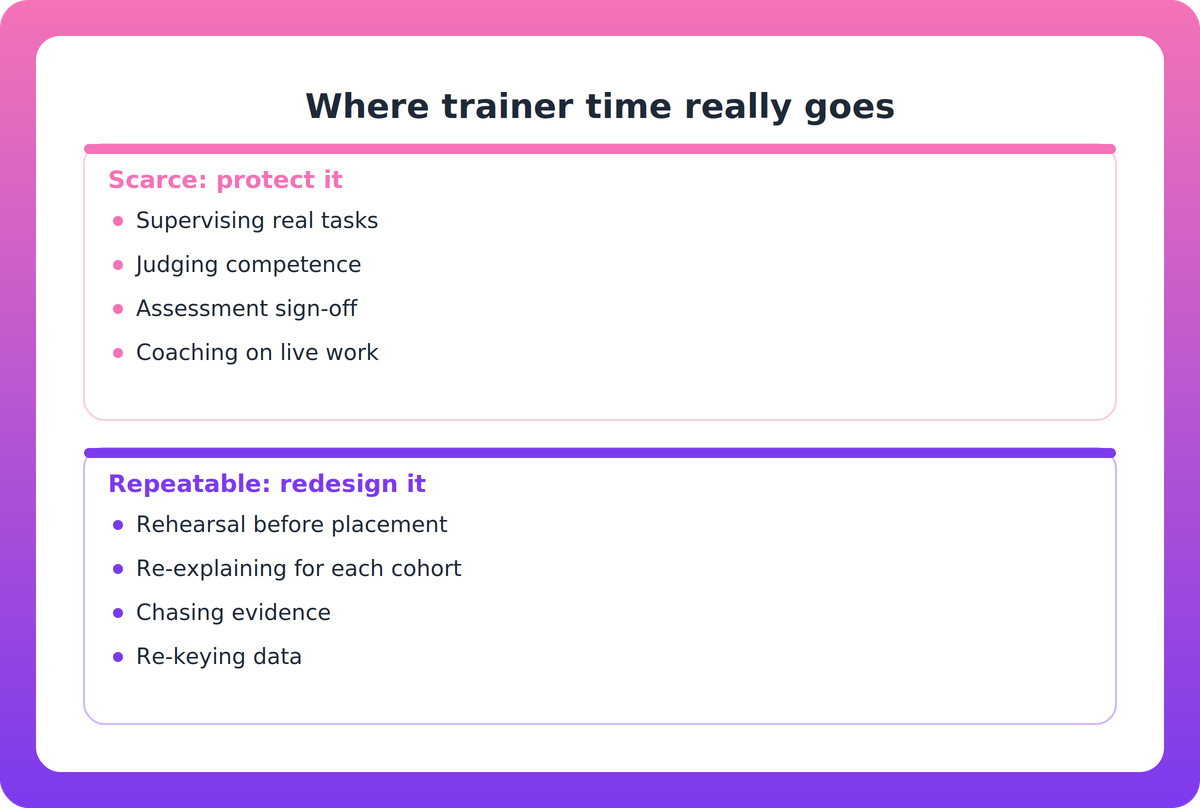
Scarce time is judgement. It covers watching a learner handle a real task, deciding whether it meets the standard, supervising something that could go wrong, and signing off a unit standard or qualification outcome. That cannot be shortcut, and you shouldn't try.
Repeatable work only *looks* like it needs a trainer. Rehearsing a customer conversation before the first placement, walking through a procedure for the fifth cohort, or practising a difficult feedback scenario are examples. So is the admin around all of it. This is where redesign pays off: recorded demonstrations, structured self-practice, simulated scenarios and coached rehearsal can carry some of the load, so trainer time is spent where it is irreplaceable.
The test is simple. If a task would be done identically regardless of which trainer delivered it, it's a candidate for redesign. If the trainer's judgement changes the outcome, protect it.
Reporting and quality load compete for the same hours
Reporting stays heavy. TEOs with TEC funding, or students with loans and allowances, must complete the Single Data Return. All confirmed enrolments, including non-funded students, must be reported. Registered PTEs must also keep learner records under NZQA rules.
Funded PTEs receiving more than $50,000 must supply financial statements within five months of balance date. These are reviewed by an independent Chartered Accountant under $5m in funding, and audited at $5m or more.
Quality assurance leans on your own systems too. NZQA's PTE Rules 2026, in force from 19 January 2026, require a quality management system. External evaluation and review has been replaced by self-review and monitoring. That favours providers with documented, repeatable processes over those where the knowledge sits in a few senior heads.
A risk worth flagging, clearly labelled as inference
The Spinoff, citing Official Information Act documents, reported that Te Pūkenga lost over $80m in funding and one in 10 staff ahead of the split. What follows is our inference, not a sourced finding: competitors are probably in restructure mode, and experienced trainers may be more mobile than usual.
If your assessment practice lives in the heads of three or four people, that is an operating risk now, not a theoretical one. Capture how they moderate, what "competent" looks like in your context, and how they coach, before someone else makes them an offer.
Key takeaways
- Practical delivery is the part of your operation least able to scale in step with enrolments.
- TEC's 2026 rates cut work-based delivery funding by 10% while targeted areas get 2% (plus the 3% Budget 2025 uplift), so check the rate row for each programme.
- No public NZ benchmark for trainer ratios or utilisation exists. Build yours from your own data.
- Split trainer time into scarce (supervision, judgement, sign-off) and repeatable (rehearsal, explanation, admin), and redesign only the second.
- NZQA's PTE Rules 2026 reward documented, repeatable processes over knowledge held by individuals.
Our take
The tempting response to a squeezed 2026 is to treat trainer capacity as a headcount problem, or to wait until the work-based model settles. We think both are mistakes.
The providers that cope best will know, down to the programme, how much trainer time is truly scarce, and will have stopped spending it on anything else. That is an operations job, not a teaching-quality compromise. Protecting judgement is the whole point.
This week, pick one practical programme and ask three trainers to log their time for five days, split into the three buckets above. You won't have a benchmark, but you'll have something better: your own number.
FAQ
Is there an official trainer-to-learner ratio for NZ PTEs?
We found no authoritative public NZ source on trainer-to-learner ratios or utilisation benchmarks for practical delivery. Providers need to derive their own from programme, site and learner data rather than rely on a quoted industry figure.
How much has funding for work-based delivery changed in 2026?
TEC's 2026 rates show a 10% decrease for all work-based delivery and a 2% increase for targeted VET areas. After the 3% Budget 2025 uplift, work-based delivery nets a 7% decrease in some of TEC's examples and 10% in another. Check the rate row for each programme.
Does the new NZQA framework change what a COO needs to document?
NZQA's PTE Rules 2026, in force from 19 January 2026, require a quality management system, and external evaluation and review has been replaced by self-review and monitoring. That puts more weight on documented, repeatable processes you can show you review.
Should we build capacity for the new work-based learning model now?
It is a potential growth area. Industry Skills Boards manage existing work-based training for a two-year transition, and TEC published requirements for TEOs proposing to deliver on 9 February 2026. Because funding is tight, plan for growth that doesn't add trainers linearly.