Your back-office headcount may not be tracking enrolments at all. It may be tracking obligations: four SDR windows, new PTE Rules, annual self-review and financial viability checks. None of those shrink when a cohort does. No NZ data proves this, so treat it as a hypothesis and test it against your own numbers.
Why this lands on your desk
You own the process and systems layer behind enrolment records, SDR submissions, board reporting and NZQA obligations. When a new requirement arrives, it rarely arrives with a budget. It lands on the same small team.
The funding backdrop makes that harder. TEC's 2026 Plan Guidance tells providers to plan on the basis that additional Vote Tertiary Education funding will not be available. Decisions on 2027 Investment Plans are due from November 2026, with first payments in January 2027.
So you'll be asked to show capacity without growing the cost base. You may also be asked to show resilience. TEC's 2026 funding conditions require PTEs to take part in a financial viability assessment when asked. A provider assessed as high risk must supply an acceptable action plan by TEC's deadline.
A straight line from enrolments to headcount is the wrong model to defend in that room.
Where the fixed load comes from
Some of your workload scales with learners. A lot of it doesn't. It scales with the number of rules, files, rounds and checkpoints. Here's what the sources show is stacking up:
- SDR rounds. The 2026 windows are the March IND (1–6 March), April SDR (16–29 April), August SDR (8–21 August) and December SDR (1–31 January the following year). The files are Learner, Course Enrolment and Course Register, plus Course Completion and Qualification Completion in the April, August and December rounds.
- PTE Rules 2026. They replace the PTE Registration Rules 2025 and the PTE Enrolment and Academic Records Rules 2022, and remove the annual fee. Enrolment records must be kept current: name, contact details, national student number where held, domestic or international status, programme, and start and finish dates. Data quality is now a compliance matter, not just a reporting one.
- Self-review. EER is being replaced. A secondary source, Technical Institute (a PTE's blog, not NZQA), reports an annual self-review from July 2026. It includes a quality improvement plan of three to ten priority actions, each with a problem, action, completion date, expected outcomes and success measures. Confirm the detail on NZQA's site before you build around it.
- Financial scrutiny. Plan Guidance also asks PTEs for information so TEC can assess the Prudential Financial Standards for PTEs.
- Sector restructuring. Industry Skills Boards, formally established from 1 January 2026, endorse vocational programmes before NZQA approval. A programme won't be funded without that endorsement. Work-based learning divisions are moving to polytechnics, wānanga or PTEs across 2026 and 2027.
Every item adds a checkpoint. None of them care how many learners you enrolled.
Three places headcount hides fixed complexity
If the hypothesis holds, the extra people won't be doing visibly extra work. They'll be absorbing friction. Look in three places.
Duplicate entry between systems
Where does a learner's start date get typed? If it's entered in the student system, again in a spreadsheet for the SDR, and again for a board report, you're paying for the same fact three times. Each new rule makes that multiplier bite harder.
Know-how held in individual heads
Every PTE has one person who knows why the Course Register file fails validation, or which learners need a manual fix before the window closes. That person is a single point of failure. They're also the reason you hire a second person rather than fix the process.
Reporting cycles that eat weeks
If a submission window means pulling people off other work, the cost isn't only the hours. It's the improvement work that never happens. That's the firefighting trap: the same crunch, four times a year, with nobody free to change it.
Measure it before you argue it
Here's the honest bit. We found no authoritative NZ source on PTE back-office headcount, cost ratios, or time spent on SDR or board reporting. Nobody can hand you a benchmark, so build your own.
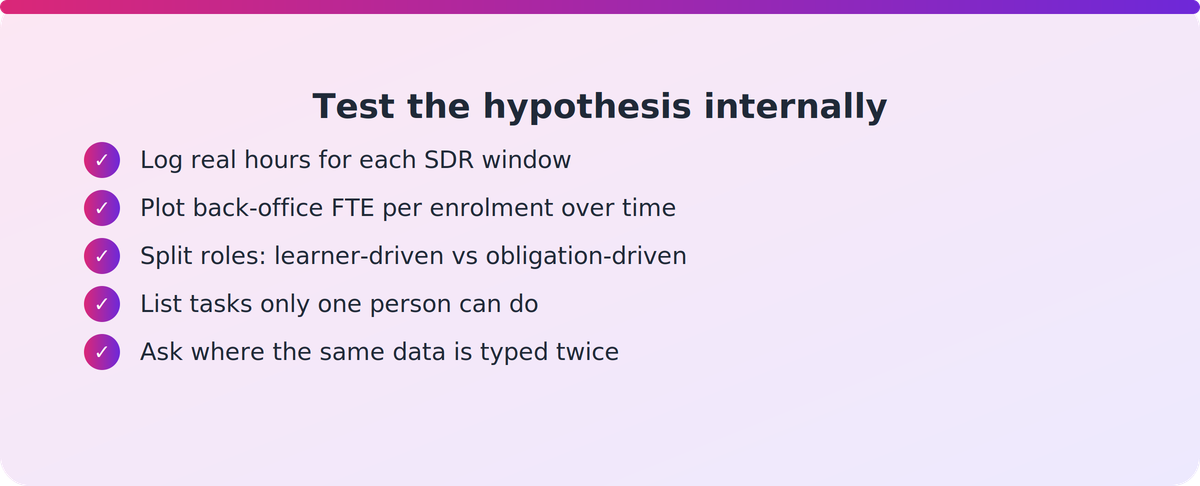
Start with three measures:
- Hours per reporting cycle. Track actual hours for each SDR window, the board pack and any TEC or NZQA information request. Use real timesheets or a short staff survey, not estimates.
- Back-office FTE per enrolment, over time. Plot it across several years. Then split the roles into those that move with learner numbers (enrolment support, for example) and those that move with obligations (reporting, quality, data).
- Single-person dependencies. List every task only one person can do. Mark each one.
If the obligation-driven line is rising while enrolments are flat, your hypothesis has a number behind it. If it isn't, good. You've ruled out a risk and can say so to your board.
Can the system carry more of the load?
TEC documents an API route for SDR submission, with an API portal for integrating systems and submission through the Data Exchange Platform (DXP). We found no public data on how many PTEs use it, so we won't call it a trend.
It's a fair question for your own shop, though. Is your SDR still assembled by hand and uploaded? Or could your student system produce a clean submission with less rework? Even if you never adopt the API, asking the question shows you where the manual effort sits.
The same logic applies to enrolment records under PTE Rules 2026. If data is captured once, correctly, at the point of enrolment, every downstream report gets cheaper.
Our take
Hiring is the default response to compliance load because it's quick and visible. But it prices a fixed process problem as a variable cost. Each new person makes the next obligation feel easier to absorb, and the underlying duplication stays put.
With no extra funding expected, we think the stronger position for a COO is to treat reporting and records as a process to redesign, not a team to grow. Don't ask "how many people do we need for the next rule?" Ask "how many times do we touch the same data?"
We could be wrong for your organisation. That's why the measurement comes first.
Key takeaways
- Back-office headcount outgrowing enrolments is a hypothesis, not a documented NZ sector fact. Test it internally.
- Much of the load is driven by fixed obligations: four SDR windows, PTE Rules 2026, annual self-review, financial viability checks and ISB endorsement.
- TEC's 2026 Plan Guidance says to plan without additional funding, so headcount growth is hard to defend.
- Look for duplicate entry, single-person knowledge and manual reporting cycles to find where people are absorbing process complexity.
- Track hours per reporting cycle and back-office FTE per enrolment, then ask whether systems, including TEC's API route, can carry more.
FAQ
Is there NZ data showing PTE back-office costs growing faster than enrolments?
No. We found no authoritative NZ source on PTE back-office headcount, cost ratios or time spent on SDR or board reporting. Treat the idea as a hypothesis and test it with your own data.
How many SDR submission windows should a PTE plan for in 2026?
Four: the March IND (1–6 March), April SDR (16–29 April), August SDR (8–21 August) and December SDR (1–31 January the following year), according to TEC. The Learner, Course Enrolment and Course Register files go in every round. Course Completion and Qualification Completion are added in April, August and December.
What do PTE Rules 2026 mean for enrolment data?
They replace the 2025 registration rules and the 2022 enrolment and academic records rules. They require enrolment records to be current, covering name, contact details, national student number where held, domestic or international status, programme, and start and finish dates (NZQA).
Does TEC allow SDR submission by API?
Yes. TEC documents API-based submission through its data tooling and an API portal for integrating systems, with submission via the Data Exchange Platform. We found no public data on how many PTEs use it.
Pick one reporting window this year and log every hour it takes, by person. What you find will tell you whether you're growing a team or just carrying a process.