Two trainers marking the same evidence differently is not a trainer-quality problem. It is a system-design problem, and from 2026 it is yours to find first. With external evaluation and review replaced and consistency reviews discontinued, your own post-assessment moderation is the earliest signal of inconsistency that you control.
Why this lands on your desk
You own the trainers, the assessment strategy and the quality of judgement across both. NZQA expects internal moderation to be embedded in the quality management system of every tertiary education organisation. That covers pre-assessment moderation of materials and post-assessment moderation of learner work. If two trainers diverge, you are the person who should hear about it first.
The 2026 approval rules sharpen this. Programme criterion 6 requires an effective system for moderation of assessment materials and decisions. It also requires assessment methodology that is fair, valid, consistent and appropriate for the stated learning outcomes. "Consistent" is the word you now have to be able to evidence, not just assert.
The clock matters too. Providers without a compliant quality management system on 1 January 2026 need one in place before 1 January 2027. The time to design a moderation process that works is this year.
What actually changed in 2026
The Private Training Establishment Rules 2026 and the Quality Assurance of Tertiary Education Providers Rules 2026 both came into force on 19 January 2026. The QA Rules list assessment and moderation among the areas a quality management system must cover.
NZQA's explanatory note on the Programme Approval, Recognition and Accreditation Rules 2026 says references to external evaluation and review were removed after its replacement with self-review and monitoring. References to consistency reviews were removed because they were discontinued from 1 January 2026.
Read that carefully. Scrutiny has not gone away. What has shifted is where the assurance work sits: more of it now rests on the provider's own processes. That makes your internal moderation the main evidence you hold.
Pre-assessment moderation fixes the task, not the judgement
Many providers moderate well before assessment. Someone checks the task, the marking guide and the alignment to the standard. That is necessary, and it catches real problems. It cannot tell you whether two trainers will read the same learner evidence the same way.
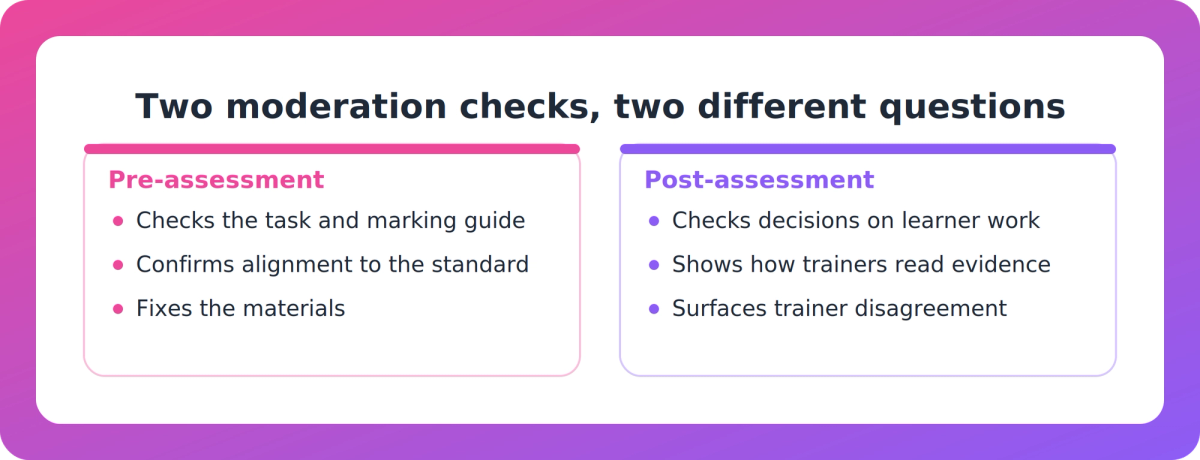
Only post-assessment moderation of learner work shows that. A well-designed task can still produce two different decisions on the same portfolio, because each trainer reads "sufficient" through their own experience of the trade. That gap is the blind spot.
Don't count on the moderating body to catch it
NZQA's external moderation application lets you manage moderation plans, submit materials online at any time through the year, access reports, query or appeal a report, and track progress on a dashboard. Consent to assess also brings an obligation to take part in the national external moderation system that applies to you.
But an external report is a lagging signal. It tells you what was wrong after the decisions were made and the learners have moved on.
The moderating landscape is also shifting. The Workforce Development Councils were disestablished on 31 December 2025. Eight Industry Skills Boards (ISBs) now set and maintain standards, endorse programmes and moderate assessments. TEC said ISBs would have a strong standards-setting focus with lower government funding, and the Services ISB describes its remit as narrower and its resourcing as more constrained.
I wouldn't assume the moderating body has spare capacity to spot inconsistency for you. Check which ISB moderates each standard you assess. The Manufacturing and Engineering ISB, for example, requires all new or modified material to go through pre-assessment moderation. It also expects providers to keep their own internal systems and take part in its national external moderation.
There is a stakes point as well. Ministry of Education data show provider-based qualification completions rose 8% in 2025, with PTEs up 12% domestically. The data do not link that rise to moderation quality, and nobody should claim they do. But when completions rise, being able to show that results reflect consistent judgements matters more.
Making post-assessment moderation a habit this quarter
Moderation competes with delivery for trainer time, so spend the hours where they protect most. A workable approach:
- Map your standards to their moderating ISB. Know who expects what, and when.
- Rank by risk. Start with new or recently modified standards, high-volume standards, and anything assessed by a newer trainer.
- Re-mark blind. Have a second trainer judge a small set of completed evidence without seeing the first decision.
- Record the disagreements, not just the pass rate. Where did they diverge, and what did each trainer see in the evidence?
- Close the loop fast. Run a short calibration conversation, then update the marking guide or exemplars so the difference doesn't recur.
- Run it all year. Because the external app accepts submissions through the year, there's no reason your internal rhythm should be annual.
The point is to treat moderation as a regular look at how your trainers judge evidence. A yearly compliance exercise won't show you that.
Key takeaways
- Inconsistent marking is a system-design issue, and criterion 6 asks you to evidence "consistent".
- External evaluation and review was replaced by self-review and monitoring, and consistency reviews were discontinued from 1 January 2026. Assurance has shifted toward your own processes.
- Pre-assessment moderation fixes the task. Only post-assessment moderation shows whether trainers judge evidence the same way.
- External moderation reports lag, and ISB resourcing is described as more constrained, so internal moderation carries more of the load.
- A compliant quality management system is due by 1 January 2027 if you lacked one on 1 January 2026.
Our take
Most moderation processes are built to satisfy an external body. Few are built to answer the question a Head of Training actually has: do my trainers agree? We think the honest measure of a moderation system is how many disagreements it surfaces and how quickly they get resolved. A system that never finds any is probably not looking hard enough.
That means treating a divergence between two trainers as useful information, not a performance issue. Trainers will only bring their borderline judgements into the open if doing so is safe. Build that culture first, and the process follows.
FAQ
Does the end of external evaluation and review mean less scrutiny?
No. NZQA's explanatory note says references to external evaluation and review were removed after it was replaced with self-review and monitoring. That shifts more responsibility to the provider's own processes. National external moderation still applies where you hold consent to assess.
What is the difference between pre- and post-assessment moderation?
NZQA describes internal moderation as pre-assessment moderation of materials plus post-assessment moderation of learner work. The first checks the task and marking guide. The second checks whether assessment decisions on actual learner evidence are sound and consistent.
Which body moderates our standards now?
The Workforce Development Councils were disestablished on 31 December 2025, and eight Industry Skills Boards now set standards, endorse programmes and moderate assessments. Check which ISB covers each standard you assess, because expectations differ between boards.
When must our quality management system be compliant?
Providers without a compliant quality management system on 1 January 2026 must have created one before 1 January 2027. The QA Rules list assessment and moderation among the areas it must cover.
A first step for this week: pick one standard, have a second trainer blind re-mark five pieces of finished evidence, and see what you learn.