AI for Australian Manufacturing: Why Purpose-Built Wins
Australian manufacturers are moving towards purpose-built AI less because of hype and more because of exposure. Unclear ROI, stalled pilots, weak links to legacy and operational technology (OT) systems, and ARM Hub's warning that AI readiness is a security exercise make narrow, measurable, human-supervised tools look like the safer bet.
Key takeaways
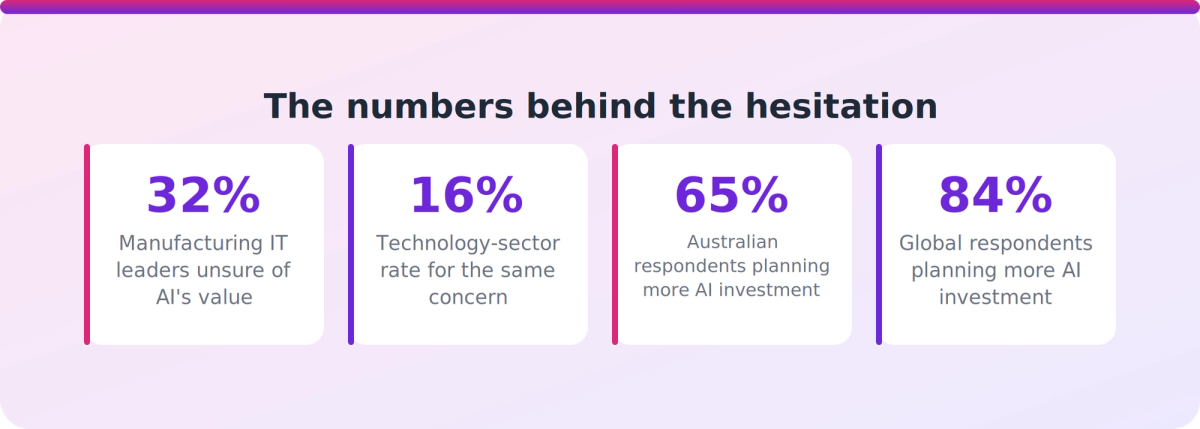
- Unclear value is the biggest brake. 32% of manufacturing IT decision-makers cite uncertainty about AI's business impact, double the technology-sector rate of 16%.
- Security is the newest trigger. ARM Hub says legacy software and connected equipment can leave factories exposed, so AI readiness now includes an audit of the industrial stack.
- A good use case has a defined metric, connects to existing data and OT, and keeps a human in the loop.
- Policy leans local, but compliance sits with existing laws. There is no dedicated AI Act, so the workflow decides your obligations.
- Treat "purpose-built beats generic" as an emerging trend. Most of the claim comes from vendors, not independent comparison.
Why are manufacturers rethinking generic software now?
Because pilots are not turning into production. AMTIL asks whether manufacturers can turn isolated AI pilots into repeatable capability. It says the biggest gains will go to those who pair AI with better data, stronger skills, trusted governance and practical problem-solving.
Notice what is missing from that list: a bigger general-purpose tool. The gap is between a clever demo and a workflow someone owns.
Manufacturing has also been slower to adopt AI than financial services and eCommerce, according to IT Brief Australia. The same report says it sees greater impact where data and systems are connected across the organisation. IT and OT are converging, and enterprise AI is being considered for production environments.
Is unclear ROI the real barrier?
It is the one that shows up most in the data. A TeamViewer and Sapio Research survey (April–May 2026, 4,200 respondents across nine markets including Australia), reported by Australian Manufacturing, found 32% of manufacturing IT decision-makers cite uncertainty about AI's value or business impact. The technology-sector figure was 16%.
A use case tied to one defined metric answers that doubt directly. "Improve efficiency" does not. "Cut unplanned stoppages on one line" does.
Why does security change the buying decision?
Security turns replacement from a nice-to-have into a risk decision. ARM Hub, the AI Adopt Centre for manufacturing, warned in late October 2026 that AI readiness is now a security check. Legacy software and connected equipment can leave businesses exposed to emerging cyber threats (Australian Manufacturing).
ARM Hub also notes that the Australian Signals Directorate recommends replacing software that no longer receives security updates. It points to AI for security tasks, with human oversight (IT Brief).
That reframes the question. A generic tool bolted onto an ageing, poorly mapped stack adds another thing to defend. A scoped tool with known inputs and outputs is easier to reason about.
What does "purpose-built" actually mean on the factory floor?
It means fitting one workflow, not owning a model. Based on the evidence above, four traits matter:
- A defined metric. One number the plant already tracks, agreed before build starts.
- Connected data. It reads from the systems that matter, including OT and legacy sources, rather than asking staff to re-key data.
- Human oversight by design. The TeamViewer findings show manufacturers prefer human oversight where AI could affect sensitive areas.
- A named owner. Someone responsible for maintaining it after the pilot ends.
Does policy favour locally built AI?
It helps, though it is not a mandate. The National AI Plan (2 December 2025) governs AI through existing laws and sector regulators rather than a dedicated AI Act, as Austrade's summary and Bird & Bird's analysis describe. Your obligations depend on what the workflow touches, such as personal information or safety. That favours systems built around a specific job.
The Plan also supports commercialising Australian-made AI through an "AI Accelerator" CRC funding round. It brings the $17 million AI Adopt Programme under National AI Centre oversight and aligns with Future Made in Australia, per The AI Insider.
Investment appetite is mixed. Deloitte's State of AI in the Enterprise (Australian perspective) says only 65% of Australian respondents plan to raise AI investment next year, against 84% globally. It also says 57% are already deploying physical AI such as robots and automated machinery. That data is not manufacturing-specific.
How do you scope a purpose-built use case?
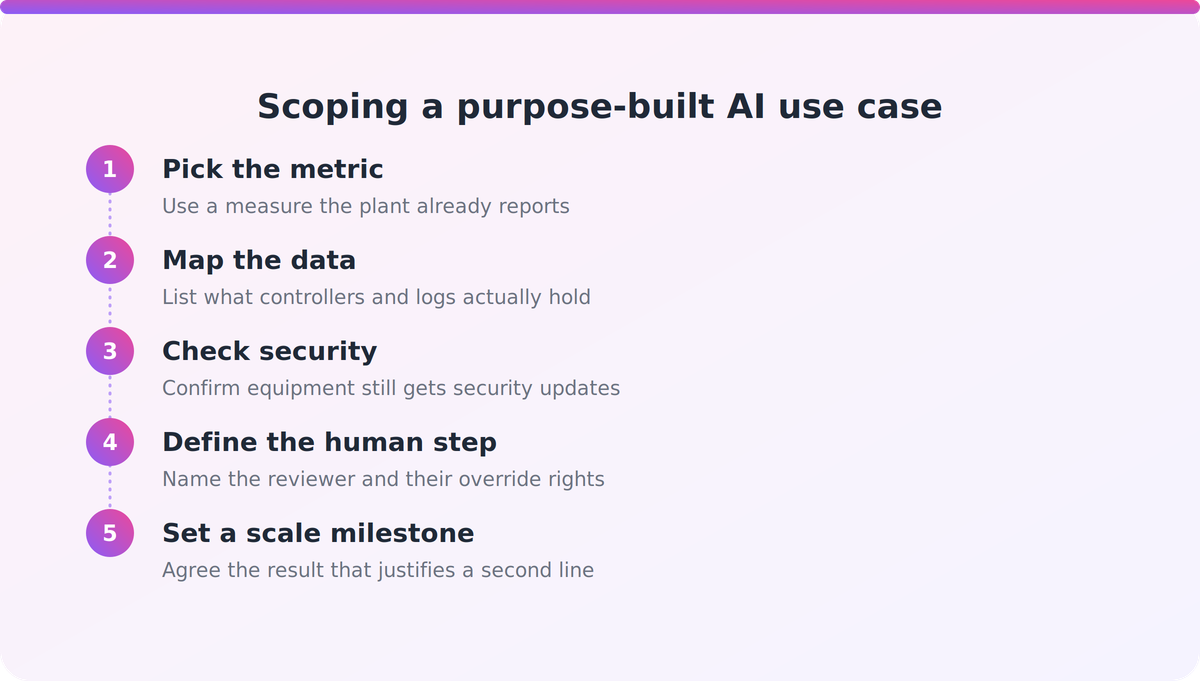
Start small and make it testable. Here is an illustrative example, not a customer result: a plant wants to reduce unplanned stoppages on one legacy line.
- Pick the metric. Choose the stoppage measure the plant already reports.
- Map the data. List what the line's controllers, maintenance logs and operator notes actually hold, and where.
- Check the security position. Confirm the connected equipment still receives security updates. If not, plan the replacement first.
- Define the human step. Decide who reviews each alert and what they can override.
- Set a stop-or-scale milestone. Agree in advance what result justifies rolling it out to a second line.
What is still unproven?
The "purpose-built beats generic" argument comes mostly from vendors, including Q3 Tech and Trusenta. We found no independent, manufacturing-specific study comparing off-the-shelf and bespoke outcomes. What the evidence does support is narrower: unclear ROI, integration gaps and cyber exposure are real, and they are easier to manage with a scoped, supervised tool.
Our take
The smartest reason to go purpose-built is not that bespoke is better. It is that a narrow tool is easier to measure, secure and supervise, which is what a sceptical board or plant manager needs. We think the winners will be manufacturers who fix the stack and pick one measurable problem first, then choose the tool. Buying AI to find a use case is how pilots stall.
FAQ
Why are Australian manufacturers moving to purpose-built AI?
The main drivers are unclear ROI, pilots that never reach production, integration gaps with legacy and OT systems, and cyber exposure. Narrow tools tied to a defined metric and human oversight address these more directly. The trend is vendor-led, so treat it as emerging rather than proven.
What did ARM Hub say about AI and cyber security?
ARM Hub warned that legacy software and connected equipment can leave manufacturers exposed to emerging cyber threats. It framed AI readiness as a security exercise as much as a productivity one. It noted the Australian Signals Directorate recommends replacing software that no longer receives security updates.
Does Australia have an AI Act for manufacturers?
No. The National AI Plan (2 December 2025) relies on existing laws and sector regulators rather than a dedicated AI Act. Compliance obligations therefore depend on the specific workflow and the data it handles.
Is there proof that custom AI outperforms off-the-shelf tools in manufacturing?
Not yet. The claim comes mainly from vendors, and we found no independent, manufacturing-specific comparison. The stronger evidence is about the barriers, such as the 32% of manufacturing IT decision-makers uncertain about AI's value.
Next step
Take one stalled AI pilot in your business and run it through the five scoping steps above. If you can't name the metric, the data source or the human reviewer, that is where to start.