AI Integration for NZ Manufacturing: The Bolt-On Cost
The real cost of bolt-on AI is that nobody can see it. Only 15% of NZ businesses have a formal AI strategy and 61% have no dedicated AI budget, so tools added on top of existing systems rarely come with a way to measure return. The bill tends to arrive later, in integration work.
Key takeaways
- Strategy drives measurability. NZ firms with a formal AI strategy were nearly twice as likely to say they can measure ROI (63% vs 34%).
- Integration, not the AI model, is where vendors say the money goes. Their figures are directional, not independent, and mostly not NZ-specific.
- Smaller manufacturers look most exposed. The one manufacturing-flavoured NZ data point, from a vendor ebook, suggests an SME gap.
- Plan before you buy. Define the workflow, the baseline and the measure of success first.
- Government co-funding for planning exists through the AI Advisory Pilot. Confirm current terms with MBIE before relying on them.
Why is the cost of bolt-on AI so hard to see?
Because most firms haven't set up the measurement that would reveal it. AWS-commissioned research, reported by IT Brief NZ, found only 34% of NZ businesses are confident they can measure AI return on investment. It also found that 61% have no dedicated AI budget.
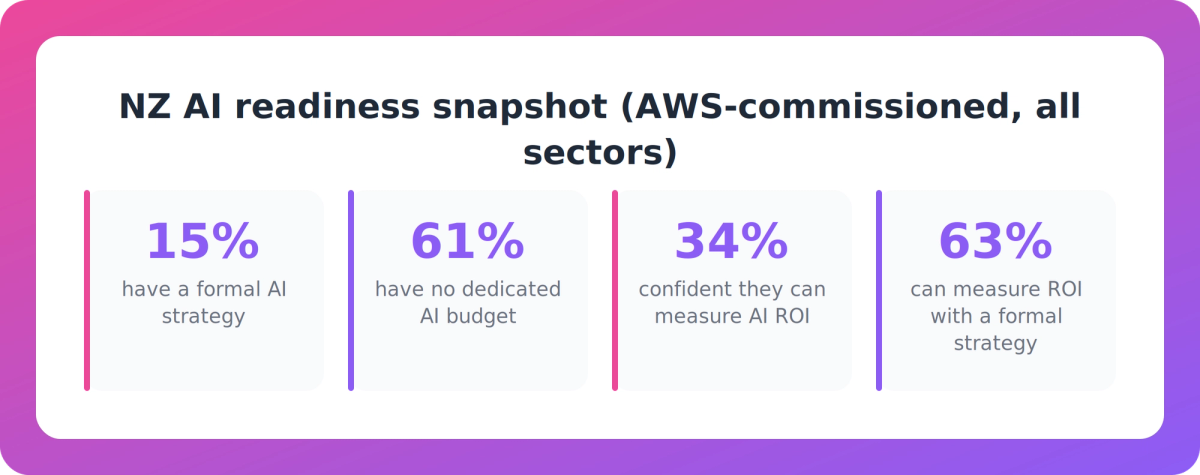
The same research points to a fix. Firms with a formal strategy were nearly twice as likely to say they can measure ROI, 63% against 34%. That is the strongest NZ-specific support for the idea that tools adopted without a plan are hard to evaluate.
Two caveats. The research covers all sectors, not just manufacturing, and it was commissioned by a vendor. Read it as a signal, not a verdict.
Where does the money actually go?
Vendors say it goes into connecting the AI to the systems you already run. A bolt-on tool still has to talk to your ERP, your machines and your people's daily routines. That is where cost tends to accumulate.
The published estimates are vendor-sourced, in mixed currencies, and should be treated as ballparks:
- Pixelbrainy puts a single-asset pilot at US$40,000–$115,000 and a full single line at US$130,000–$360,000. It says integration complexity matters far more than the AI algorithms.
- 7T lists legacy-system integration at US$30,000–$200,000+, based on a US study.
- Techanic Infotech NZ quotes NZ$8,000 to NZ$90,000+ for legacy modernisation.
- Pertama Partners says OT/IT integration typically takes 35–50% of project cost, and hidden expenses can inflate total cost of ownership by 30–50%. That piece is older than the others, so weigh it accordingly.
The ranges are wide and none comes from an independent NZ study. No independent NZ research we've found quantifies the rework or integration cost of bolt-on AI specifically. Anyone quoting a precise figure should show their working.
Is there an SME gap in NZ manufacturing?
The evidence hints at one. An ECI Solutions manufacturing trends ebook reports that 68% of NZ SMBs have no plans to evaluate or invest in AI. It also reports that about 67% of larger NZ enterprises are actively using AI, and that 40% of NZ manufacturers were implementing Industry 4.0 in 2025.
The ebook is vendor-produced, so check the underlying survey before quoting it. Still, the direction is consistent with the AWS data: larger firms are moving, smaller ones are waiting or guessing.
Waiting isn't free either. Smaller manufacturers can't absorb a failed pilot as easily, which makes planning more valuable, not less.
How should a manufacturer plan AI before buying?
Start with the workflow, not the tool. Market commentary, such as Digital Island's view via IT Brief NZ, is shifting from standalone tools towards embedding software in daily staff workflows. It's a vendor opinion, but it matches what practitioners see on the floor.
A pre-purchase checklist
Here is an illustrative sequence. It isn't a case study, and the example is hypothetical.
- Name one bottleneck. For example, a planner re-keying production data between two systems every morning.
- Set a baseline. Record how long it takes now, and how often it goes wrong.
- Map the systems it touches. List every ERP, spreadsheet, machine interface and person involved.
- Define success before you buy. Agree the measure and the date you'll check it.
- Cost the integration, not just the licence. Ask suppliers to itemise connection, data clean-up and support.
- Plan for your people. Decide who will use, own and maintain the tool, and what training they need. Your industry training providers, including PTEs and Workforce Development Councils, are a sensible place to ask.
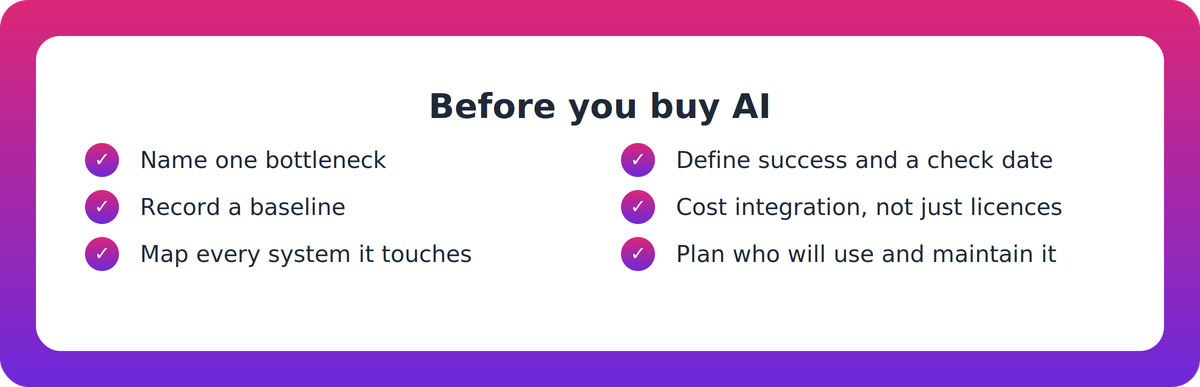
If you can't complete steps 1 to 4, that's useful information. It tells you the strategy gap is the problem, not the technology.
Can government co-funding help with the planning stage?
Possibly, yes. MBIE's 2025/26 annual report cites NZ's first National AI Strategy, backed by up to $70 million. It also cites the expansion of the Regional Business Partner Network AI Advisory Pilot from 51 to 150 SMEs. The strategy is framed around practical adoption rather than high-end development.
The pilot was announced by the Beehive. A secondary source, 99 Francs, reports it has been extended to 30 June 2027 with 120 more businesses. It says the pilot co-funds up to 50% of expert AI support, capped at NZ$15,000 per business.
Two cautions. Confirm the current terms on the Beehive or MBIE site before relying on them. And the same source notes it isn't publicly clear which suppliers can deliver the implementation stage after the advice.
Our take
Bolt-on AI isn't wrong; unmeasured AI is. A tool that sits beside your systems can be a perfectly good first step, but only if you've written down what it should change and how you'll know. We think the NZ numbers say less about technology reluctance and more about missing planning habits, and that is cheaper to fix than any integration project. Use the planning support while it's co-funded.
FAQ
What does "bolt-on AI" mean in a manufacturing context?
It means adding a standalone AI tool on top of existing systems without redesigning the workflow around it. The tool may work in isolation, but staff still copy data between systems and nobody measures the result.
How much does AI integration cost for NZ manufacturers?
There's no independent NZ figure. Vendor estimates range widely, from NZ$8,000 to NZ$90,000+ for legacy modernisation (Techanic Infotech NZ) to US$130,000–$360,000 for a full single line (Pixelbrainy). Treat them as directional and ask suppliers to itemise.
What share of NZ businesses have an AI strategy?
AWS-commissioned research reported by IT Brief NZ found 15% have a formal AI strategy and 61% have no dedicated AI budget. It covers all sectors, not only manufacturing.
What is the AI Advisory Pilot?
It's a government co-funded programme through the Regional Business Partner Network that helps SMEs plan AI use. It reportedly co-funds up to 50% of expert support, capped at NZ$15,000 per business. Verify current terms with MBIE.
Next step
Before your next AI conversation with a supplier, pick one bottleneck and write down its baseline and your success measure on a single page. If you'd like to see how this plays out on the shop floor, our piece on predictive maintenance AI in NZ manufacturing is a good companion read.