Compliance Manager's Document Review Process for NZ PTEs
If every document in your PTE has to cross your desk before it counts as compliant, you haven't built a quality system. You've built a queue. As NZQA shifts PTEs from external evaluation and review to self-review and monitoring, the credible model is one where evidence owners carry their own accountability and you govern the rules, risk signals and exceptions.
Key takeaways
- Under the Private Training Establishment Rules 2026, a provider's own quality management system is something it must show it is running continuously, not something it assembles for a review.
- A single-reviewer model concentrates risk: evidence is created by many teams, but accountability for reviewing it collapses onto one inbox.
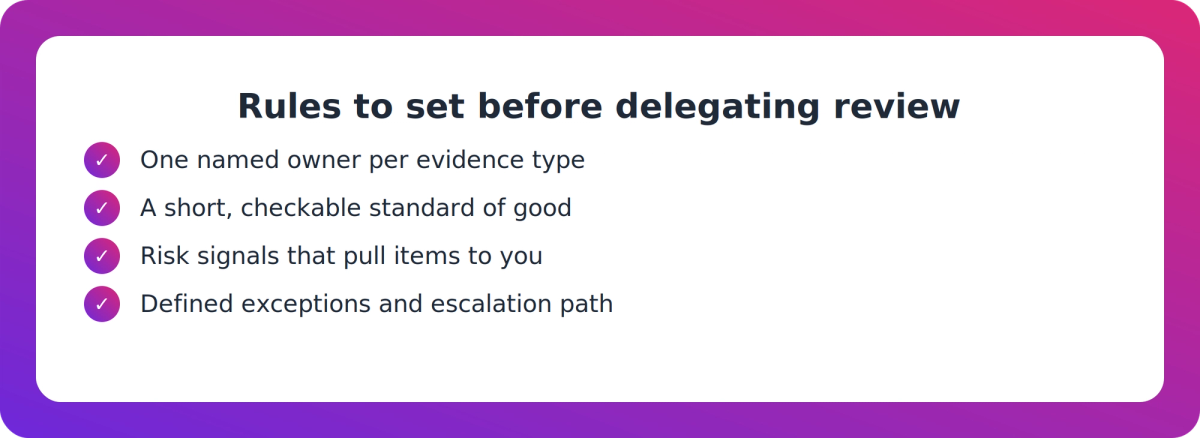
- Your leverage is in four decisions: who owns each evidence type, what good looks like, which signals trigger your attention, and how exceptions escalate.
- Several details on the self-review cycle and the 1 January 2027 date come from secondary sources. Verify them on NZQA's site before you plan around them.
- You can start this week by choosing one evidence type and writing down its owner, its review criteria and its trigger.
Why this lands on your desk
The Private Training Establishment Rules 2026 came into force on 19 January 2026. NZQA says they replace the PTE Registration Rules 2025 and the PTE Enrolment and Academic Records Rules 2022. They were re-issued to adjust terminology after EER was removed as a quality assurance mechanism and replaced with self-review and monitoring.
Registration applications must now include the PTE's quality management system required under the Quality Assurance of Tertiary Education Providers Rules 2026. You answer for that system being credible and current. Registration matters beyond compliance, too: a provider that isn't a university, polytechnic or wānanga needs PTE registration to be eligible for TEC funding, per the TEC FAQ.
The rhythm has changed too. Technical Institute, a secondary source, describes a yearly self-review summary report submitted via MyNZQA, followed by a meeting with NZQA about your improvement plan, with Code of Practice self-review reported in the same submission. If that holds, audit-readiness is spread across twelve months rather than concentrated before a panel visit.
Why one reviewer is the weak point
The Pastoral Care Code 2021 still applies, and NZQA administers and monitors it. The evidence for it lives with student support, enrolment and teaching teams, not with you. You are accountable for material you didn't create and can't continuously watch.
A gatekeeper model fails in two predictable ways. Reviews bunch up when you're away or stretched, so approvals lag behind practice. And your sign-off starts to stand in for the owner's own judgement. People stop asking "is this right?" and start asking "has it been through compliance?"
Shifting expectations make this worse. Secondary sources report that NZQA consulted on overall quality descriptors, and that the thematic question for July 2026 to July 2027 is the use of generative AI in delivery and assessment. Treat that as reported until you've checked NZQA's own consultation page. Either way, a system that depends on one person re-reading everything each time expectations move won't keep up.
From gatekeeper to system designer
The shift is simple to state. You stop reviewing documents and start reviewing the rules by which documents are reviewed. Your calendar fills with design and exception work instead of approvals.
Four rules to write before you delegate anything
- Ownership. Every evidence type has one named owner, in the team that creates it. Not "student services", a person or role.
- Standard of good. Write a short, checkable description of what acceptable evidence looks like, so owners can self-check without asking you.
- Risk signals. Decide in advance what pulls the item to you: a missed review date, a complaint, a change in a standard, a rise in incidents, an owner leaving. Our own note on non-compliance risk indicators goes deeper on which signals are worth tracking.
- Exceptions. Define what counts as an exception, who decides it and how it's recorded. This is where your judgement is actually needed.
An illustrative example
This is a hypothetical, not a customer story. Say your pastoral care incident records are currently reviewed by you each month. Under a designed system, the student support lead owns the records and checks them against a one-page standard of good. You see only the exceptions: an incident with no follow-up logged within the agreed window, or an unusual spike in a single programme.
Your review time moves from reading forty records to examining three and asking why they stalled. The records still get checked. The difference is that the person closest to them is responsible for the first check. For more on assigning that responsibility, see this guide on compliance evidence ownership.
Plan around the fixed dates
A distributed review system works best when it anchors to dates that don't move. The Rules extract references an Annual Information Return due 30 June, and notes that TEC-funded PTEs aren't required to submit the annual financial statements the Rules describe. Confirm how that applies to your provider against the Rules PDF.
Then there's the date to verify. One secondary source reports that providers without a quality management system meeting Rule 4(2) must build one before 1 January 2027 and produce it to NZQA on request. Treat it as reported, not confirmed. If NZQA's pages bear it out, settling review ownership now is a deadline issue, not a theoretical one.
What to verify on NZQA's site
Before you restructure anything, check the primary source for each of these:
- The current text of Rule 4(2) and any transition date for the quality management system.
- How the annual self-review summary report and the follow-up meeting with NZQA actually work. Secondary sources describe the iQAF cycle, but NZQA is the authority.
- Whether Code of Practice self-review is reported within the same annual submission.
- The status of the consultation on quality descriptors and any thematic focus for the current period.
Our take
Most compliance managers we'd describe as excellent became the bottleneck because they were good at the job. They caught things, so more things were routed to them. That instinct made sense when a periodic external review rewarded one person's deep familiarity with everything.
Self-review rewards something different: a system that still works when you're on leave, and that a regulator can examine without needing you in the room. Our position is that your best work is now the quality of the rules, not the volume of documents you personally clear. Giving ownership away isn't giving up control. It's the only version of control that scales.
FAQ
Do the PTE Rules 2026 require a compliance manager to review every document?
No requirement to that effect appears in the brief's NZQA material. The Rules focus on the provider holding a quality management system. How you structure review inside it is a design choice, so check the Rules for anything specific to your registration.
What replaced EER for PTEs?
NZQA says EER was removed as a quality assurance mechanism and replaced with self-review and monitoring. Secondary sources describe an annual self-review summary report via MyNZQA and a meeting with NZQA about the improvement plan. Verify the mechanics on NZQA's site.
Is the 1 January 2027 quality management system date confirmed?
Not in the primary material supplied. A secondary source reports that providers without a system meeting Rule 4(2) must build one before that date. Check Rule 4(2) on NZQA's site before treating it as firm.
Does the Pastoral Care Code still apply?
Yes. The Ministry of Education says NZQA administers the Code of Practice 2021, supports providers to meet their obligations and monitors compliance. Evidence for it sits across student support, enrolment and teaching teams.
Your first step
Pick one evidence type this week, such as pastoral care incident records. Write down its owner, a five-line standard of good, and one signal that would pull it to your attention. If you can't name the owner in under a minute, you've found where your bottleneck starts.