Most RTO operations leaders still run the week as a string of firefights: a funding query on Monday, a spreadsheet reconciliation midweek, an annual reporting scramble every February. ASQA and NCVER are now both pushing against that rhythm. Effective RTO operations management means data that is clean at source and a week spent forecasting, not reconciling.
Key takeaways
- Reporting is moving from minimum annual AVETMISS submissions to status-based VET Information Standard reporting with a minimum of quarterly submissions, so a single yearly clean-up no longer fits.
- ASQA reportedly wants evidence of active implementation under the 2025 Standards, not fixes made only when something goes wrong. Firefighting is a compliance risk as well as a habit.
- Enrolments are shifting to shorter and more numerous units, so administration that scales with enrolment volume will outgrow your headcount.
- Process knowledge held in a few heads is a continuity risk in an ageing, highly casualised VET workforce.
- No public benchmark exists for RTO admin cost per enrolment. Measure your own baseline before you redesign anything.
Why this lands on your desk
You own the student management system (SMS) and everything that flows out of it. NCVER's guide to preparing for VET Information Standard reporting tells RTOs to confirm their SMS can support the new standard and that staff know the new requirements. That is an operations decision with a deadline attached.
The rhythm is changing too. NCVER's comparison describes a move from outcome code-based, point-in-time reporting to status-based reporting where each change is reported, and from minimum annual to minimum quarterly submissions. There are also new validation rules under a unified national standard, including state fields. You answer for accuracy, on-time submission and the staff hours consumed.
The margin for error is thin. NCVER's September 2026 Data Support Bulletin lists the 2026 annual window as 1 January to 28 February 2027, with no extensions and data accurate as at 31 December 2026. For fee-for-service RTOs reporting directly to NCVER, the Q3 2026 window was 1–16 November 2026. Sixteen days is not a window for reconciling a year's mess.
What ASQA is reportedly looking for
The 2025 Standards for RTOs took effect on 1 July 2025. They have three elements: the Outcome Standards, the Compliance Standards (including the Fit and Proper Person Requirements) and the Credential Policy. The 23 Outcome Standards sit across four quality areas, including VET student support and governance.
Notes from a March 2026 sector workshop, published by Skills Education, say ASQA often sees reactive systems where improvement action is taken only when something goes wrong. They say ASQA wants evidence of active implementation. That is a provider's account, not an ASQA publication, so treat it as indicative.
Even so, it matches the direction of the Standards. If your improvement activity is a pile of last-minute fixes before an audit, you have no evidence of continuous improvement, only evidence of recovery.
The volume problem nobody has priced
NCVER's Total VET students and courses 2025 reports over 5.1 million students in nationally recognised VET. Qualification enrolments fell by 108,360, while short courses and stand-alone subjects rose.
More, smaller enrolments mean more records and more status changes, and under the new reporting model each change is reported. The sources do not quantify what that does to administrative cost, and I could not find an authoritative public benchmark for cost per enrolment or admin hours.
That makes it your question to answer. Pull the last twelve months and work out how many staff hours sit between an enrolment and a clean submission. Do it before someone asks you to justify headcount.
What a redesigned week looks like
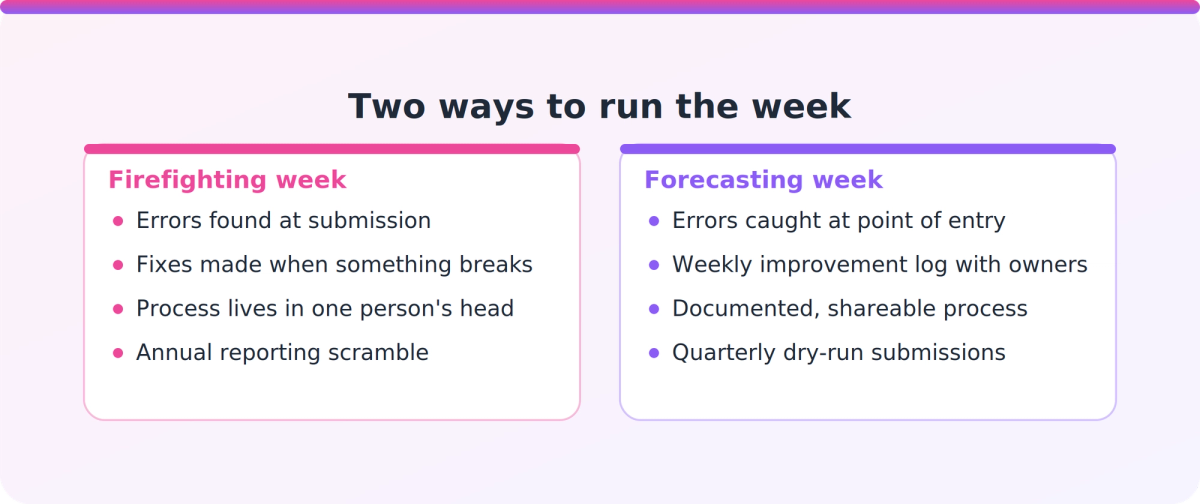
Here is an illustrative week, not a customer story or a measured result. The principle is that every recurring task moves earlier in the chain, to where the data is created.
- Monday, forward view (30 minutes): enrolment pipeline, trainer and assessor load, upcoming completions and withdrawals. This is capacity forecasting.
- Midweek, exceptions only: review validation errors and missing fields as they arise, not at submission time. If the same error recurs, fix the intake step that creates it.
- Friday, improvement log: one issue, one owner, one documented change, one check that it worked. Over a quarter, that is your evidence of active implementation.
- Each quarter, a rehearsal: run a full dry submission two weeks before the window, so the real one is routine.
Document the process, not just the person
The JSA VET Workforce Study (October 2024) describes a workforce that is older, lacking diversity and highly casualised. If your reporting process lives in one long-serving administrator's head, you are carrying a continuity risk. Write down the steps, the checks and the decision rules, then have someone else run them once.
Check the SMS before the deadline checks you
The VET Information Standard is provided through new technology that connects directly to the SMS. NCVER's timeline lists the last AVETMISS submission as due in February 2029, so you will run both models for a while. Ask your SMS vendor specifically how it will support status-based reporting.
One vendor blog claims separate AVETMISS 8.1 changes, including a new Specific Funding Identifier, take effect on 1 January 2027. I could not verify that, so confirm with NCVER or your SMS vendor before planning around it.
Our take
Most RTO operations leaders treat compliance and reporting as work that interrupts the real job. The new rules make them the real job, because the quarterly rhythm turns data quality into a daily operating discipline.
We think the best response is dull: fewer manual touches, fixes made at the point of entry, a written process anyone can run, and a standing weekly hour for improvement. Automation, including AI, can help with the repetitive parts. ASQA has published an item asking whether an RTO's use of AI is compliant with the 2025 Standards (we have only seen the headline). So govern any automation as carefully as you would a new staff member: define what it does, who checks it and where the evidence sits.
FAQ
What is changing in RTO reporting?
Reporting is moving from AVETMISS to the VET Information Standard under the VET Data Streamlining Program. NCVER describes a shift to status-based reporting, where each change is reported, and to a minimum of quarterly rather than annual submissions. ASQA says the amended Data Provision Requirements Instrument 2020 came into effect on 1 October 2026.
Do the 2026 reporting deadlines have any flexibility?
NCVER's September 2026 Data Support Bulletin says the annual window runs from 1 January to 28 February 2027, with no extensions available. Data must be accurate as at 31 December 2026. Confirm your own window with NCVER or ASQA, as it depends on how you report.
How does ASQA's interest in continuous improvement affect operations?
ASQA reportedly said at a March 2026 workshop that it often sees reactive systems and wants evidence of active implementation. That account comes from a provider's notes, not ASQA itself. Either way, a dated improvement log showing issues found, changes made and results checked is a practical way to show it.
Can I use public benchmarks to size my admin workload?
Not reliably. I found no authoritative public benchmarks for RTO administration cost per enrolment or admin time. Measure staff hours from enrolment to clean submission internally, and track them as your enrolment mix shifts.
One thing to do this week
List every manual touch between a student enrolling and a record being submitted, with the person and the minutes beside each. Circle the steps where the same data is entered twice. That list is your baseline, your redesign brief and your first piece of improvement evidence.