Your RTO's reading of the 2025 Standards is a decision, made on a date, with the guidance available then. ASQA's guidance, risk priorities and expectations keep moving. The gap between the two is what I'll call interpretation drift, and a dated, evidenced record of each reading is the cheapest way to catch it before an auditor does.
Key takeaways
- "Interpretation drift" is not an ASQA term. It is a practical label for the gap between what your RTO decided a standard meant and what current guidance expects.
- More flexibility in how you demonstrate compliance makes your documented reasoning more important, not less.
- Record each reading of an Outcome Standard or Compliance Requirement with its evidence, owner, date and next review trigger.
- Treat early readings of newer Outcome Standards as provisional, because ASQA itself says providers will take time to become proficient.
- Check your register against ASQA's primary sources, not vendor summaries, whenever the Practice Guides or risk priorities change.
Why this lands on your desk
You own the RTO's reading of the Standards. The 2025 Standards commenced on 1 July 2025 and ASQA said then that its processes had shifted to match the outcomes focus. That gives providers more flexibility in how they demonstrate they meet them, and ASQA signalled more regulatory engagement.
Flexibility cuts both ways. There is more room to interpret, and more room to be wrong.
Then there is the paperwork behind the readings. ASQA's Standards for RTOs page lists a second version of the Practice Guides supporting the 2025 Standards. The research behind this article did not show what changed between versions. Someone has to compare them against your policies, TAS and evidence, and that someone is you.
What interpretation drift is, and what it isn't
No regulator uses the phrase. I'm using it as shorthand for a quiet failure: your policy says one thing, current guidance implies another, and nobody noticed because nothing forced a comparison.
It is not a claim that ASQA is moving the goalposts. It is a claim that a reading made in mid-2025 deserves a second look when the surrounding material changes. The conditions for drift are in the public record:
- an outcomes-based framework with more provider flexibility
- a second version of the Practice Guides
- newer Outcome Standards that ASQA said, in its 2025 Standards information webinar, providers will take time to become proficient in (it named wellbeing and diversity and inclusion)
- a regulator whose Corporate Plan 2026-27 names embedding the 2025 Standards as its most significant regulatory priority
ASQA also committed to maturing its approach to provider risk through targeted, risk-based strategies and differentiated supervision. Your early interpretations were reasonable guesses. Treat them as provisional until you've tested them.
Build an interpretation register
The fix is unglamorous. Keep one record per Outcome Standard and Compliance Requirement that says how you read it and why. ASQA said in the webinar that providers should demonstrate systems for all aspects of the 2025 Standards, so the register should cover the whole set, not just the parts that feel risky.
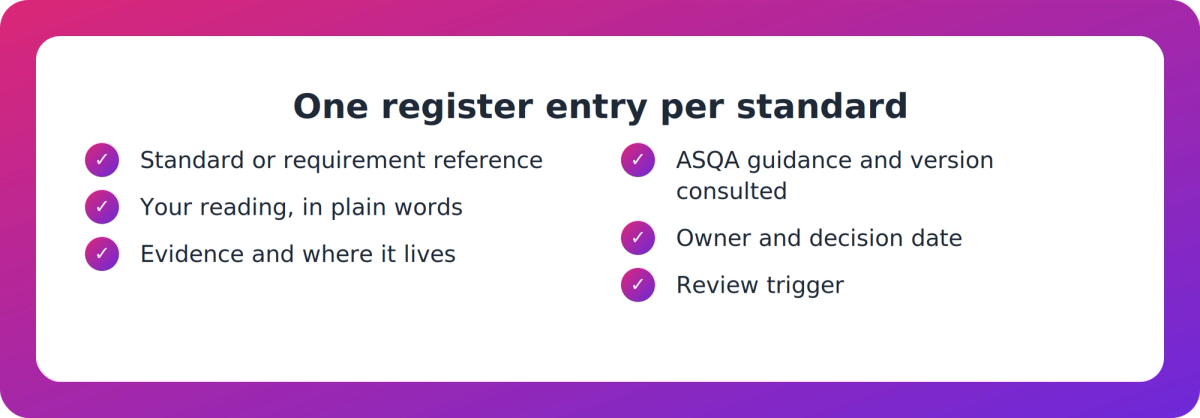
Each entry needs:
- The reference. Which Outcome Standard or Compliance Requirement, in your own words and the official wording.
- Your reading. What you decided it requires of your RTO, in two or three sentences.
- The evidence. What demonstrates it, and where it actually lives.
- The guidance consulted. Which ASQA source, at which version, you relied on.
- Owner and date. Who made the call and when.
- Review trigger. What would make you re-read it: a new Practice Guide version, a risk priorities release, a regulatory expectations statement.
A worked example (illustrative)
Say your RTO decided, in July 2025, that a particular learner support arrangement satisfied a newer Outcome Standard. The register entry records that reading, the survey and case-note evidence behind it, the guidance you checked and a six-month review date.
When ASQA publishes something new, you don't reconstruct the decision from memory or inboxes. You open the entry, see what you relied on, and judge whether it still holds. If it doesn't, you've found the gap yourself, with a dated record of how it opened.
Check against primary sources, on a schedule
Vendor and consultant summaries are useful for orientation. Your register should cite ASQA. The pages worth putting in a recurring diary entry are the Practice Guides on the Standards for RTOs page, ASQA's latest news and its risk priorities. The research pointed to a statement of regulatory expectations of RTOs (25 August 2026) and an October 2026 ASQA IQ special edition on 2026-27 regulatory risk priorities. I haven't seen their contents, so read them directly.
Because the research did not show the change list between Practice Guide versions, do the comparison yourself. Put the two versions side by side and mark every passage that touches an existing register entry. Don't rely on someone else's account of what changed.
Start where scrutiny is likely to land
Implementing, monitoring and evaluating training and assessment appears among the most common areas of non-compliance in ASQA's 2023-24 and 2024-25 annual reports. The extracts I could see were truncated, so check the full lists. I also couldn't find audit statistics under the 2025 Standards yet.
That pattern is still a sensible place to begin. It is where your reading of "what good looks like" meets real assessment practice. Your CEO's Annual Declaration on Compliance sits on top of this evidence, so a thin register entry here becomes a thin foundation for their signature.
Our take
Most compliance anxiety comes from reconstruction. A change lands, and you spend a week working out what you decided last year and why. Flexible, outcomes-based standards make that worse, because the rationale is the only thing that can't be copied from a template.
So be wary of treating the 2025 Standards as a one-off migration project. The work doesn't finish at implementation. The regulator says it is still embedding them, and you should assume your reading is still settling too. A register that records uncertainty honestly ("we read it this way; we'll revisit when X is published") is a stronger position than a confident policy nobody has tested.
FAQ
Is "interpretation drift" an ASQA term?
No. The research found no ASQA or other authority use of the phrase. It is a practical framing for the gap between an RTO's documented reading of a standard and what current guidance and regulatory practice expect.
What should an interpretation record contain?
The standard or requirement, your reading of it, the supporting evidence and its location, the ASQA guidance and version you consulted, the owner and date, and a review trigger such as a new Practice Guide version.
How do I find what changed in the second version of the Practice Guides?
The research did not show a change list. Download both versions from ASQA's Standards for RTOs page, compare them yourself, and flag passages that touch existing register entries.
Why would early interpretations be provisional?
ASQA said in its webinar that providers will take time to become proficient in newer Outcome Standards, such as wellbeing and diversity and inclusion. Its Corporate Plan 2026-27 also says embedding the Standards remains its top regulatory priority.
Next step
Pick one Outcome Standard you interpreted in 2025 and write the register entry for it this week. If you can't say where the evidence lives, or which guidance you relied on, you've found your first drift risk.