Yes. An RTO can use AI to draft learner guides, assessment tools and session plans, but the RTO and its credentialed trainers and assessors stay accountable for the content, the judgements and the compliance. ASQA's guidance expects you to see and manage staff AI use. So test any tool on human sign-off, records and traceability, not on speed.
Key takeaways
- Drafting with AI is a recognised use, but accountability stays with the RTO and its named, credentialed trainers and assessors.
- ASQA expects visibility of staff AI use where it may affect content, assessment evidence, feedback or judgements.
- Judge a tool on named sign-off, a record of what the AI wrote versus what a person changed, contextualisation, and traceable unit mapping.
- We found no ASQA approval or certification for any AI drafting tool. Trace any vendor claim of approval to its source.
- Time-saving figures are vendor-reported unless you can speak to a named Australian customer.
Can an RTO use AI to draft training resources, and who stays accountable?
An RTO can, and accountability does not move. The Sector's summary of ASQA's guidance says AI can help a provider develop resources, adapt learning materials and support students. The provider still owns the result.
The regulatory frame is the 2025 Standards. DEWR says ASQA-regulated RTOs must meet the Outcome Standards Instrument 2025, the Compliance Standards Instrument 2025 and the Credential Policy. Per this guide, the Outcome Standards apply from 1 July 2025.
One caveat. Some RTOs are regulated by state bodies rather than ASQA. We haven't verified that point, so check which regulator applies to you.
Does AI-drafted content change who makes assessment judgements?
No. Under the Credential Policy (Standard 3.2, as summarised), training and assessment are delivered only by people holding the appropriate credentials. Anyone working under direction must not make assessment judgements.
AI is not a credentialed person. It can produce a draft assessment tool, but a qualified human decides whether it is fit to use. The same goes for judgements on student evidence and for validating the tool before use.
What does ASQA expect you to be able to show?
The closest authoritative statement is the Trainer and Assessor Competencies Practice Guide. It asks how staff understand and apply AI policies. That includes keeping visibility of trainers' and assessors' AI use where it may affect content, assessment evidence, feedback or judgements.
It also asks how staff recognise AI output that is incomplete, inaccurate or not fit for purpose. And it expects professional development to build AI literacy where relevant.
Two other practice guides touch your resources:
- The Assessment Practice Guide flags reliance on purchased assessment tools that aren't contextualised to the cohort, learning environment or training product as a risk. It lists confirming that AI in assessments matches real workplace expectations as good practice. It also asks how you validate the authenticity of student evidence.
- The Information Practice Guide expects enrolment information to state clearly how AI tools may be used in training or assessment, if relevant, and what that means for students.
Secondary sources such as RTOBase report that ASQA's responsible AI principles add no new requirements and apply existing obligations. They also report that ASQA sees AI-drafted documents with generic wording and leftover drafting prompts. The same risk applies to resources nobody properly reviewed. Confirm the principles' exact wording and dates on asqa.gov.au.
How do you evaluate an AI training resource development tool?
Start from the evidence you'd need to hand an auditor, then work backwards. Ten criteria cover it:
- Human sign-off: does the tool require a named trainer or assessor to approve content before release, and record who did?
- Records of AI use: is there version history showing what the AI generated and what a person changed?
- Contextualisation: can output be adapted to your cohort, delivery context, workplace requirements and scope, or is it generic?
- Fit with the training product: is content mapped to the unit of competency, the principles of assessment and the rules of evidence? Does it keep up when training.gov.au units are superseded?
- Support for validation: can mapping and version history be exported for pre-use validation and as audit evidence?
- Accountability terms: do the contract and product documents say plainly that the RTO remains accountable to its regulator?
- Governance support: does it help with your AI policy, a register of AI use and disclosure to students?
- Privacy and data handling: where is data hosted, what are the vendor's data terms, and what do your Privacy Act obligations require? Verify this separately.
- Evidence over claims: are time-saving claims backed by named Australian customers?
- Staff capability: will your people get the AI literacy to spot weak output?
What should you ask a vendor?
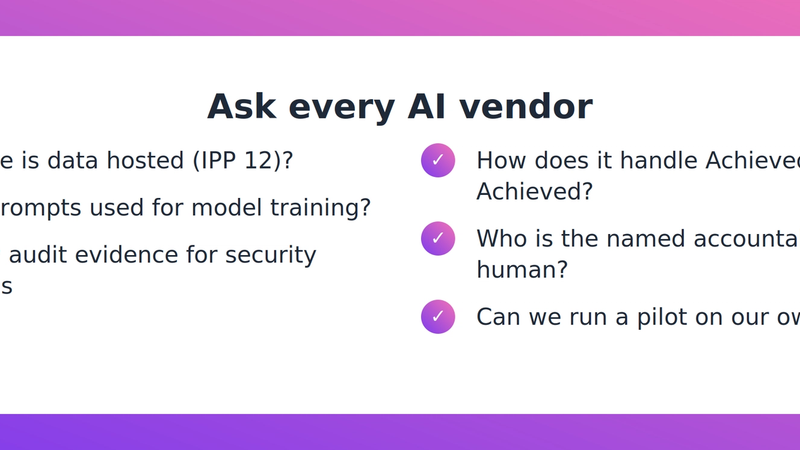
Put these to every vendor, in writing where you can:
- Show me the record for one resource: who prompted it, what the AI produced, who edited it and who approved it.
- Show me how a unit's requirements trace through to each assessment task.
- Has any regulator approved or certified this tool? Where is that stated?
- What do your terms say about who is accountable if a resource is non-compliant?
- Which Australian customers will talk to me about outcomes?
On question 3, the answer should be no. We found no ASQA statement approving any AI drafting tool. A vendor claiming independent benchmarking should be able to show it.
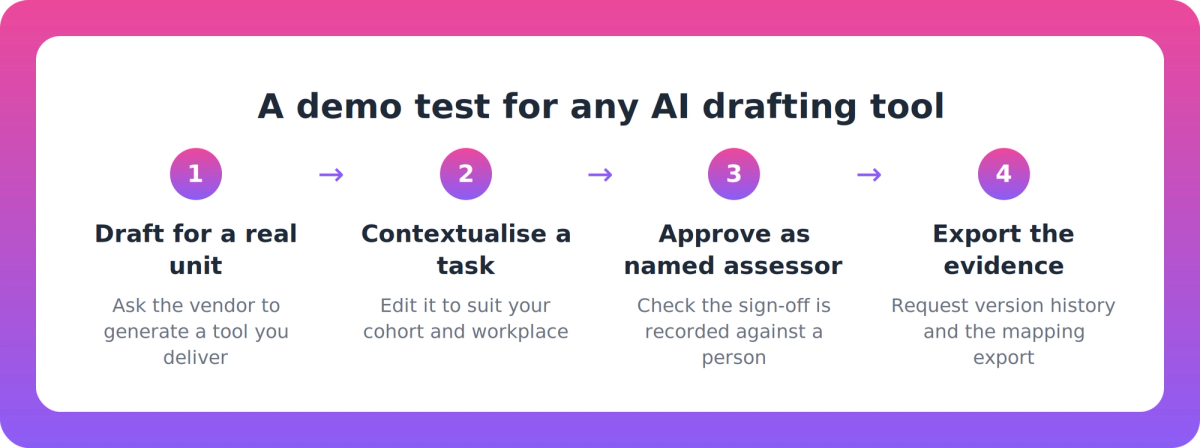
A quick test for any demo (illustrative)
Ask the vendor to draft an assessment tool for a unit you actually deliver. Then change a task to suit your workplace context and approve it as a named assessor. Finally, ask for the version history and the mapping export. If you can't produce an audit trail in a few minutes, the tool will struggle at validation time too.
Where does VETos fit?
VETos, from Supahuman, is one fair option in this category. Its site describes resource development software that generates assessment tools, learner guides, session plans, mapping documents and assessor guides aligned to the principles of assessment and rules of evidence. The stated aim is that people review rather than write.
Its materials describe mapping back to units using live training.gov.au data, an exportable mapping matrix for pre-use validation, version history as an evidence trail, and audit trails of generation activity. The product schedule says a qualified person still validates and signs off, and that the registered training provider keeps sole accountability to its regulator. It also describes the service as a support tool.
These are the vendor's own descriptions. Test them in a demo against the criteria above. The only content-drafting case study in the material we reviewed comes from outside Australia, and we saw no named Australian customer outcomes. So treat time-saving figures as unproven for your context.
Our take
Buy for defensibility first and speed second. A tool that halves drafting time but can't show who approved what hasn't saved you anything, because the saving comes back at audit. We'd also say the best AI drafting setup makes the trainer's judgement more visible, not less. If a vendor's pitch is all about hours saved, ask about records instead.
FAQ
Can an RTO use AI to draft learner guides, assessment tools and session plans?
Yes. ASQA-aligned guidance recognises AI as a way to help develop resources and adapt learning materials. The RTO stays accountable, and credentialed trainers and assessors must review and own the content.
What does ASQA expect an RTO to show about staff AI use?
The Trainer and Assessor Competencies Practice Guide asks about visibility of AI use that may affect content, assessment evidence, feedback or judgements. It also asks how staff recognise unfit AI output and how professional development builds AI literacy.
Is there an approved or certified AI tool for training resources?
We found no ASQA approval or certification for any such tool. Trace any claim of approval or independent benchmarking to its source, and confirm current guidance on asqa.gov.au.
Does AI-drafted content change who validates assessment tools or makes judgements?
No. Assessment judgements stay with appropriately credentialed people, and anyone working under direction must not make them. AI output still needs human review, contextualisation and validation before use.
Next step
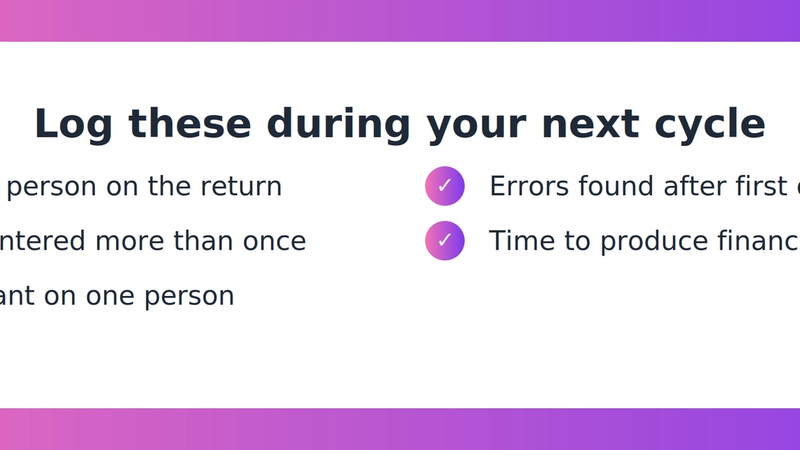
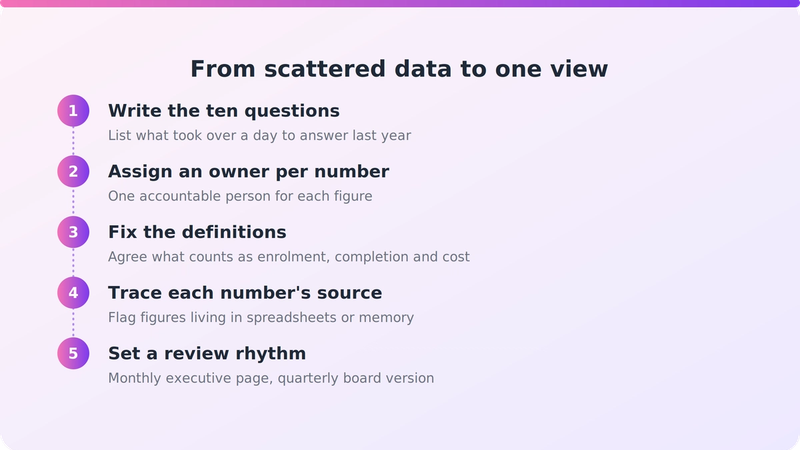
Before you book any demo, write your own ten-question version of the criteria above and score each vendor against it. If you'd like to see how VETos handles sign-off and mapping exports, you can explore Supahuman's VETos and test it against that list.