Most PTE chief executives can't answer "how are we really going?" in under a day, because the answer sits in a student management system, a finance package and a compliance manager's spreadsheets. In 2026 that is a strategic liability. Regulation, funding and VET reform now reward the CEO who can answer in minutes.
Key takeaways
- A single view of enrolments, delivery, compliance and cost per student is now a precondition for confident calls on margin, regulatory standing and growth.
- NZQA's move to continuous self-review and TEC's flat-funding stance both punish leaders who rebuild the picture by hand each time someone asks.
- The hard part is agreeing definitions and owners, not buying a tool. Start with the ten questions you can't currently answer quickly.
- Key-person risk is a data problem: if the real picture lives in one person's head, you carry the exposure.
- AI works on top of a trusted data foundation. It won't repair a fragmented one.
Why this lands on your desk
The Private Training Establishment Rules 2026 came into force on 19 January 2026. They replace the PTE Registration Rules 2025 and the PTE Enrolment and Academic Records Rules 2022, and they remove the annual fee. NZQA's rules update also moves the financial return to biennial unless NZQA tells a particular PTE to file annually. PTEs must keep student assessment materials for at least 12 months after completion, including materials held by sub-contractors.
There is also a shift in how quality is judged. One PTE's account, from Technical Institute, describes NZQA moving from External Evaluation and Review to an integrated Quality Assurance Framework. Providers send a yearly self-review summary and meet NZQA to discuss an improvement plan. That is a secondary source, so confirm the detail with NZQA. If it holds, the audit is no longer an event you prepare for every few years. It is a standing conversation, and you need current evidence for it.
Funding adds pressure from the other side. TEC's Plan Guidance says providers should plan on the basis that no additional funding will be available in 2026. PTEs must also show they meet TEC's Prudential Financial Standards. TEC's timeline indicates written notification of 2027 investment round decisions from November 2026.
Then there is growth. TEC says work-based learning is moving from Industry Skills Boards to existing PTEs, polytechnics or wānanga, or to new providers, during 2026 and 2027. Whether you bid, and how far, is your call.
What "one version of the truth" actually means
It means agreed numbers with a named owner and a known source, not a prettier screen. A PTE business performance dashboard in NZ is only as good as the definitions behind it. If finance, delivery and compliance each count a "completion" or a "student" differently, a dashboard will just display the disagreement faster.
A CEO's view needs to answer six things:
- Pipeline: enquiries, enrolments and starts against plan, by programme and funding source.
- Delivery: progress, completions and withdrawals, and where learners stall.
- Compliance: the state of assessment and moderation evidence, and open corrective actions.
- Cost: cost per student by programme, including the compliance and admin load.
- Learner welfare: pastoral care actions and, for international learners, Code obligations.
- Capacity: trainer and assessor load against what you've promised.
An illustrative decision: bidding for work-based learning
Suppose your PTE is listed for an industry area as work-based learning transfers. The board asks whether you can absorb more learners. (This is a hypothetical, not a customer story.)
With scattered data, the answer is a confident guess from the people who happen to know. With a single view, you can see current trainer load, real completion rates in adjacent programmes, and what a learner actually costs you to deliver. You can then say yes, yes with conditions, or not yet, and defend the reasoning. The opportunity rewards providers who know their own capacity and costs, as the TEC material implies.
Build it in five moves
You can start this quarter without buying anything.
- Write the ten questions. List what you or the board asked in the past year that took more than a day to answer.
- Assign an owner per number. One person is accountable for each figure, not a committee.
- Fix the definitions. Agree in writing what counts as an enrolment, a completion and a cost.
- Trace each number to its source. Mark every figure that lives in a spreadsheet or someone's memory. Those are your key-person risks.
- Set a rhythm. A one-page monthly executive review, and a quarterly version for the board.
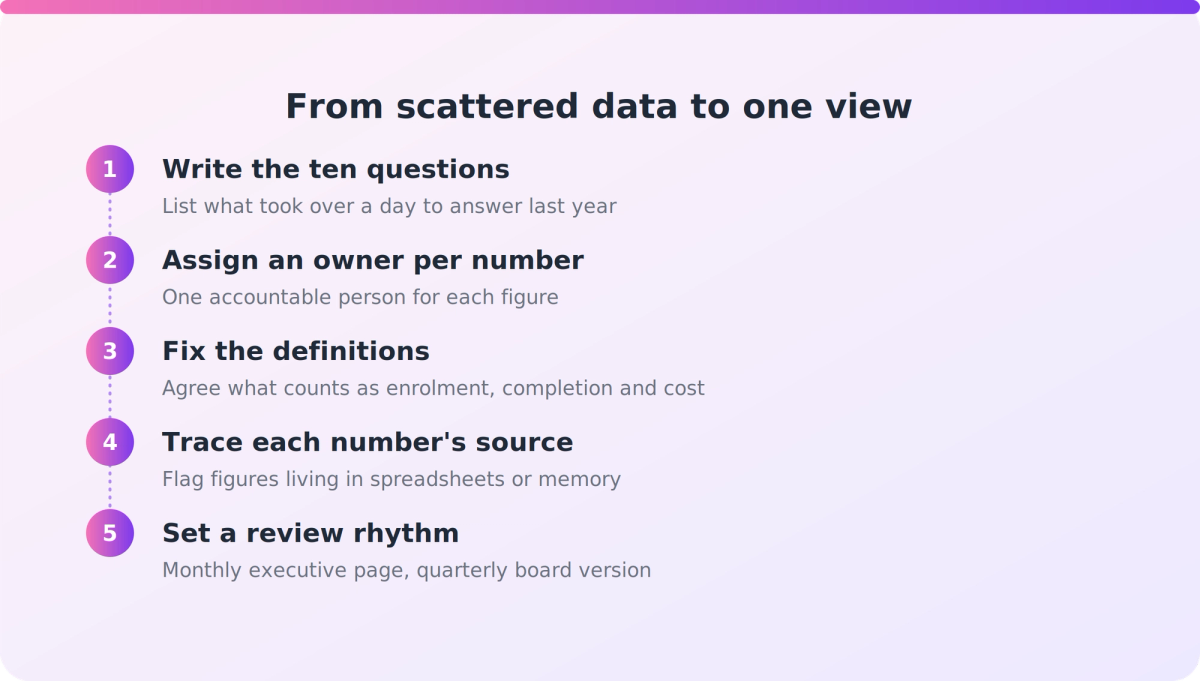
The tracing step is the revealing one. If your compliance picture only exists in one manager's files, you have found the exposure that lands on you when that person leaves or a review arrives.
Where AI fits, and where it doesn't
AI on top of unreconciled data produces confident-sounding noise. NZQA's academic integrity guidance is expectations-based, covering uphold, prevent, detect and respond, and the prevention element includes appropriate use of generative AI. Responsibility for governing it sits with you. You can't govern what you can't see.
The same goes for obligations like the Pastoral Care Code of Practice 2021. Enrolling international learners requires being a Code signatory, per Immigration New Zealand. Both add evidence and oversight demands that a fragmented picture makes harder to meet. For a P&L-first way to filter AI ideas, see this CEO-focused piece.
Our take
The sector talks about AI as the strategic question for 2026. We think the more useful question is whether you can trust your own numbers. A CEO who can see the whole business gets better at every decision on the desk: bid or hold, hire or wait, invest in compliance or in growth.
A unified view is also the best defence against key-person risk. It moves knowledge out of individuals and into the organisation, which is where a board expects it to be. We'd rather you fix definitions and ownership first, then choose tools to fit.
FAQ
What should a PTE business performance dashboard in NZ show a CEO?
At minimum: pipeline against plan, delivery and completions, compliance evidence status, cost per student by programme, learner welfare actions and trainer capacity. Each should have a named owner and an agreed definition.
Do the PTE Rules 2026 change what evidence I need to hold?
Yes, in part. NZQA's rules require PTEs to keep student assessment materials for at least 12 months after completion, including materials from sub-contractors. The financial return becomes biennial unless NZQA notifies you otherwise.
Is External Evaluation and Review really gone?
One PTE source says NZQA stopped starting new EER processes from 1 January 2026 in favour of the integrated Quality Assurance Framework, with a yearly self-review summary. That is a secondary source and some agencies were still using existing EER ratings during 2026, so confirm the current position with NZQA directly.
Should I adopt AI before sorting out my data?
We wouldn't. NZQA's guidance puts responsibility for governing AI on providers, and governing it needs a reliable picture of assessment, delivery and compliance. Fix the foundation first.
Your next step
This week, write down the five questions about your business that took longest to answer last quarter. For each, note who held the answer. That list is your starting brief for a single view.