Trainer burnout rarely announces itself in a resignation letter. It shows up first in the evidence trail: assessment records that arrive late and thin, judgements that drift between trainers, learners who go quiet. Under the Standards for RTOs 2025, that trail can be examined from outside your RTO, so the time to spot it is while it is still operational.
Key takeaways
- Treat trainer strain as a quality and compliance risk, not only a people issue. It shows in assessment records before it shows in completion figures.
- Watch three leading indicators: record timeliness and depth, consistency between trainers, and learner contact gaps.
- Assessment judgement stays with a small group of qualified people under the 2025 Standards, so overload concentrates on the same few trainers.
- The "curve" below is a practitioner framework built on documented regulatory facts. It is not a research finding on VET trainers.
- A monthly 30-minute review of a few operational signals beats an annual workload conversation.
Why this lands on your desk
You own trainer workload, timetables and the quality of delivery and assessment. A trainer's capacity limit therefore hits your results before anyone else notices it.
The regulatory direction has raised the stakes. The 2025 Standards for RTOs took effect on 1 July 2025. ASQA's revised Regulatory Assessment and Monitoring Approach, published on 26 June 2026, adds targeted activities such as site visits and independent student assessment validation. A judgement made in a rushed hour can now be tested by someone outside your moderation process.
There is also a long tail. ASQA's 2025 Standards FAQs (v3.0) say that any VET student who completes a training product on or after 1 July 2025 falls under the two-year evidence retention requirement. A thin record written in a bad week has to stand up two years later.
Completion is the metric you answer for. NCVER's four-year completion rate for 2020 commencers was 49.0%, up from 47.5% for 2019 starters. In a sector where about half of starters don't finish within four years, slippage in delivery quality is expensive.
A practitioner's curve, not a research finding
The research behind this piece contains no burnout data for Australian VET trainers. So treat what follows as a working model, built from how the regulatory and delivery pressures stack up. It is not a measured result. Test it against your own data.
Four stages to watch
- Stretch. Work still lands on time, but it costs more. Trainers are catching up on assessment outside timetabled hours and saying yes to every request.
- Compression. Records still arrive but get thinner. Feedback shrinks to a tick, evidence notes shorten, and marking bunches up before deadlines.
- Drift. Judgements start to diverge between trainers. Two people applying the same unit of competency reach different conclusions on similar evidence.
- Withdrawal. Learners go quiet because contact thins out. Absence, disengagement and resignations follow, and by now completion figures are moving.
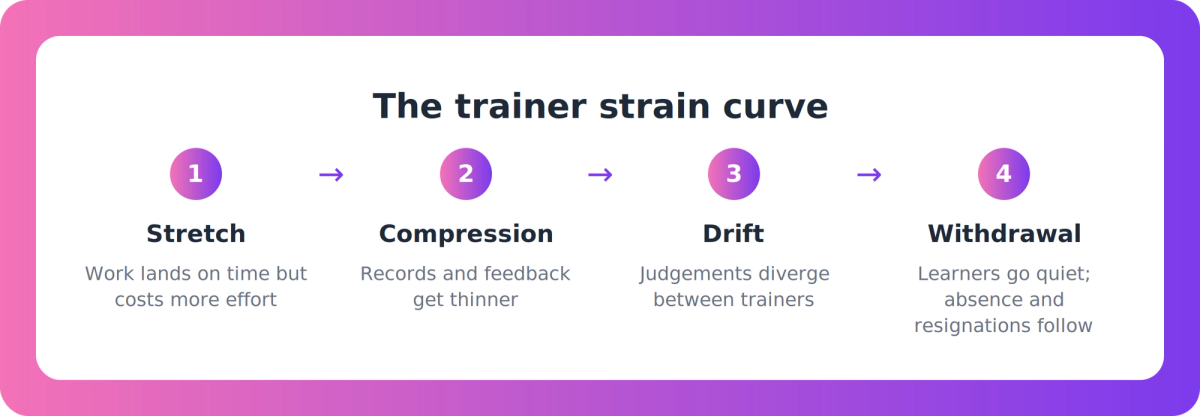
Most heads of training only see stage 4. The useful work happens at stages 1 to 3, where the signals are still in your own systems.
Leading indicators you can pull this week
You don't need a new survey. You need three views of data you probably already hold.
- Timeliness and depth of records. Look at the gap between an assessment being submitted and the decision being recorded. Then sample the written feedback and evidence notes for length and specificity. A shift in either, trainer by trainer, is a stage 1 or 2 signal.
- Consistency between trainers. Compare outcomes and comments on the same unit of competency across trainers. Widening differences, or a trainer whose results suddenly become uniform, are stage 3 signals worth a closer look in validation.
- Learner contact gaps. Track days since last trainer-to-learner contact, and learners with no recorded progress in a set window. Silence in the cohort often precedes silence from the trainer.
An illustrative example
Imagine a trainer with three cohorts whose turnaround moves from two days to nine over a term, while their written feedback drops from a few sentences to a word or two. Nothing has failed yet. A short conversation about load, perhaps handing off a cohort or protecting assessment time in the timetable, costs far less than re-assessing or re-validating later. This is a hypothetical, not a customer story.
Protect the small group who carry the judgement
The load tends to pool on a few people. ASQA's Trainer and Assessor Competencies Practice Guide for Standard 3.3 says that where industry experts are involved, the trainer or assessor directing them must be fully qualified, meet the Standards' thresholds and make the assessment judgement.
Industry expertise can widen your delivery capacity. It does not take the judgement off your qualified trainers. Look at who actually signs off, and how many hours of sign-off each person carries in a typical fortnight.
Administrative load matters here too. The Qualification Reform Design Group advised Ministers to reduce the overspecification that contributes to compliance overload. If policy-makers accept that overload is a quality problem, you can treat paperwork hours as workforce capacity in your own planning.
Our take
Most RTOs measure trainer wellbeing in the wrong place and at the wrong time: an annual survey, or an exit interview. By then the evidence trail has already been telling the story for months.
We think the better stance is to treat assessment records as a vital sign. If a trainer's records thin out, the first response is a workload conversation, not a performance one. That is kinder, and it is also better risk management, given what external validation and two-year retention now expose. Regulatory attention on quality isn't fading either. The Skills Minister said on 5 June 2026 that government is providing additional support for ASQA's crackdown on "bad apples", and the March 2026 Skills and Workforce Ministerial Council communiqué records an ASQA update on quality and integrity.
FAQ
Is there data on trainer burnout in Australian RTOs?
The research supporting this article found none. The four-stage curve here is a practitioner framework built on regulatory and sector facts. Validate it against your own timeliness, consistency and learner-contact data before relying on it.
Why does trainer burnout become an ASQA issue?
Because assessment quality can be checked from outside. ASQA's revised approach (26 June 2026) includes independent student assessment validation, and records for students completing from 1 July 2025 fall under a two-year evidence retention requirement.
Which signals show strain earliest?
In our model, late or thin assessment records, widening differences between trainers on the same unit of competency, and gaps in learner contact. All three can be drawn from systems you already use, well before completion figures move.
Can industry experts take pressure off qualified trainers?
Partly. ASQA's Practice Guide for Standard 3.3 says the trainer or assessor directing industry experts must be fully qualified, meet the thresholds and make the assessment judgement. The judgement workload stays with your qualified people.
Your next step
This week, pull the decision-recording gap and a handful of feedback samples for your three busiest trainers. If either has shifted over the last term, book the workload conversation before the next validation round does it for you.