NZQA no longer schedules your moment of scrutiny. With External Evaluation and Review gone, a PTE's exposure is not one bad audit day. It is months of small slippage (stale evidence, lapsing currency, unreported credits, vague ownership) that a risk-informed monitoring check can find without warning.
Key takeaways
- Self-review is now a regulatory touchpoint, not an internal exercise, so your evidence has to read as a continuous record.
- NZQA says monitoring may happen outside the annual cycle, so "audit-ready year-round" is the baseline.
- Drift concentrates in credit reporting, programme and moderation evidence, declarations and unclear ownership. Check those monthly.
- NZQA says it first works informally with a PTE on non-compliance. Finding gaps yourself keeps you in that conversation.
- Rapid enrolment growth is a risk factor NZQA uses to select programmes, so treat it as an internal alarm too.
Why this lands on your desk
You own the documents and declarations NZQA reads when it wants to know whether a PTE is sound. That includes the Annual Return Statutory Declaration, the Quarterly Student Fee Protection Attestation, the Annual Student Fee Protection Audit, and fit and proper person and conflict of interest declarations. A missed or stale item is yours to explain. NZQA's maintaining PTE registration page is the place to confirm what applies to you.
The 2026 reset adds a second job: mapping what changed. The PTE Rules 2026 replaced the PTE Registration Rules 2025 and the Enrolment and Academic Records Rules 2022. The Quality Assurance of Tertiary Education Providers Rules 2026 replaced the 2022 Quality Assurance (including EER) Rules. You are the person your CEO and board will ask whether policies and evidence still match.
What changed, and why it raises the stakes
NZQA announced on 15 January 2026 that updated Rules came into force on 19 January 2026. They reflect EER being replaced by self-review and monitoring, and they remove the annual fee.
The Quality Assurance Rules include reporting on your self-review to NZQA and discussing it with them. NZQA's iQAF design document describes a risk-informed approach. It says monitoring may occur outside the annual cycle and that overall frequency will be lower in future.
Fewer touchpoints means each one carries more weight and arrives with less warning. The question shifts from "is the file complete?" to "is the self-review genuine and traceable?" A tidy folder assembled in the fortnight before a visit does not answer that.
Where drift starts
Drift rarely looks like a breach. It looks like something that was true last year and nobody rechecked.
Credit reporting
Qualifications, micro-credentials and standards must be reported to NZQA within 3 months of completion. The extended credit fee applies to qualifications with a completion date on or after 19 January 2026, per NZQA's credit reporting fee page. The Qualification and Micro-credential Listing and Operational Rules also add an "expiring" status process for qualifications and micro-credentials not awarded or reviewed for a specified period. A programme nobody has delivered or reviewed in a while is a quiet liability.
Programme, moderation and growth signals
NZQA's programme monitoring approach is intelligence-led and risk-based. Selection factors include high growth rates or low fees. Activities can include a visit, moderation of learner samples, and monitoring of internal moderation systems and programme review.
So if enrolments in one programme jump, that is your cue to check moderation and review evidence for it now, not when NZQA asks.
Declarations and financial statements
Non-TEC-funded PTEs must submit annual financial statements within 5 months of financial year end. NZQA says they need only submit them every 2 years unless requested. Confirm which cycle applies to you in the PTE Rules 2026, then calendarise it.
Pastoral care and ownership
The Pastoral Care Code (2021) applies to all providers enrolling tertiary learners, and signatory status is required to enrol international learners (NZQA announcement). The research behind this piece found no 2026 amendment to the Code. Keep pastoral care evidence in the same early-warning view as everything else.
Underneath all four sits ownership. Every obligation needs a named person, a due date and a place where the evidence lives. Without those, the item is yours by default, and you become the bottleneck.
A monthly drift check you can run this quarter
This takes about an hour once set up. Use a spreadsheet if that is what you have.
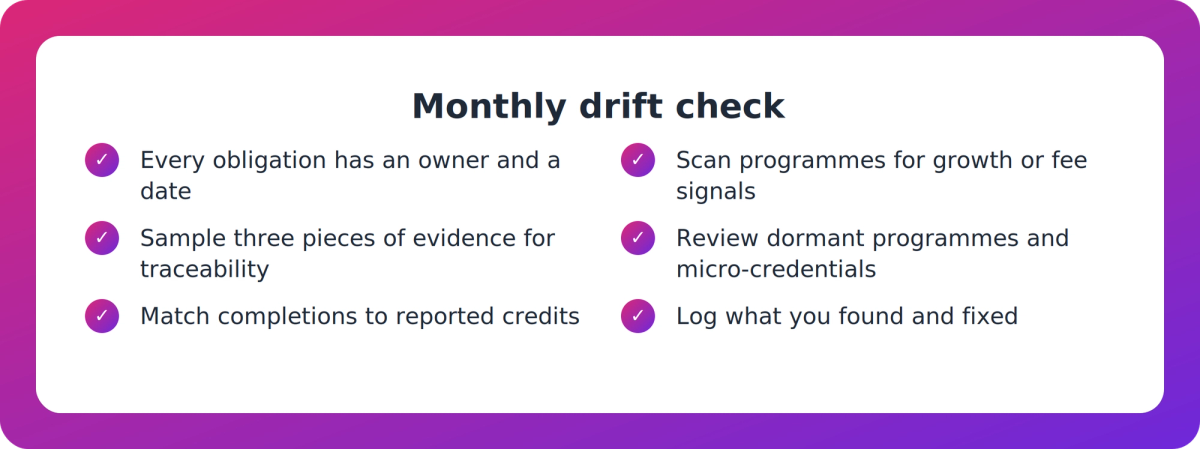
- List every obligation with an owner and a date. Flag any without both.
- Sample three pieces of evidence. Can someone other than the author trace each from policy to practice to outcome?
- Check credit reporting. Compare completions against reported credits, looking for anything nearing the 3-month mark.
- Scan growth and fee signals. Note any programme with unusual enrolment growth or fee positioning.
- Review dormant programmes and micro-credentials. Anything not awarded or reviewed recently is a candidate for the expiring process.
- Log what you found and what you fixed. That log is your self-review evidence.
Here is an illustrative example, not a real case. A PTE sees a short programme double its intake in one term. The monthly scan flags it, and the Compliance Manager finds the moderation sample plan was written for half the cohort. Fixing it takes a week. Found by NZQA's selection process, the same gap becomes a much harder conversation.
Our take
Most compliance anxiety comes from treating evidence as something you present. Under the 2026 settings it is something you accumulate. NZQA says it works informally with a PTE in the first instance and uses statutory approaches if that fails, or if the issue is more serious or poses immediate risk to students or the public (see Monitoring PTEs).
That rewards the PTE that finds its own gaps and can show it did. Your monthly log is the strongest thing you can hand NZQA. It is also the best defence against being the single point of failure.
One caution on dates. Technical Institute, a secondary source, reports a proposed quality descriptor scale ("Highly effective, Effective, Not effective") for around July 2027. It also reports that providers without a compliant quality management system on 1 January 2026 have until 1 January 2027 to build one (Technical Institute). Verify both with NZQA before planning around them.
FAQ
Can NZQA monitor a PTE outside the annual cycle?
Yes. NZQA's iQAF design describes risk-informed monitoring that may occur outside the annual cycle, with lower overall frequency in future. Plan for little notice.
What triggers programme monitoring?
NZQA describes an intelligence-led, risk-based approach. Selection factors include specific risk factors such as high growth rates or low fees. Activities can include a visit, learner sample moderation and review of internal moderation and programme review.
Is the annual self-review just an internal document?
No. The Quality Assurance of Tertiary Education Providers Rules 2026 include reporting on the self-review to NZQA and discussions about it with NZQA.
How soon must credits be reported?
Qualifications, micro-credentials and standards must be reported to NZQA within 3 months of completion. The extended credit fee applies to qualifications with a completion date on or after 19 January 2026.
Your next step
This week, pick one programme and trace a single piece of evidence from policy to learner outcome. If it takes you more than ten minutes, or only you can do it, that is your first drift finding.