The useful question is no longer what happens if your compliance manager resigns. It is whether your governing persons could show, the next morning, that they actively oversee compliance without that person in the room. Under the 2025 Standards for RTOs, reliance on one person is a governance exposure the board owns, not a retention issue for HR.
Key takeaways
- RTO key person risk is a governance question: can governing persons demonstrate active oversight of compliance if a key person leaves tomorrow?
- The 2025 Standards for RTOs have applied since 1 July 2025, and providers must show compliance against the Standards in effect when a regulatory decision is made.
- Secondary reports of an ASQA sector session point to concern about governing persons who are not actively overseeing compliance. Verify this at asqa.gov.au.
- No public statistic measures key-person risk in RTOs. The case rests on reasoning and on a workforce that is short, casualised and ageing.
- The practical test is whether knowledge and oversight are documented, shared and demonstrable, not whether you have a good retention plan.
Why this lands on your desk
You answer to the board or owners for regulatory standing and audit outcomes. If compliance knowledge lives in one person's head, that standing is only as secure as their notice period.
The workforce makes this a realistic scenario. Jobs and Skills Australia reports a VET workforce that is short of teachers, highly casualised and ageing, with almost 50% of the workforce over 50. That report is about two years old, so treat the detail as a direction, not a current count. Industry Skills Australia also notes that digital transformation is increasing the time and cost for trainers and assessors to maintain vocational currency.
Growth adds pressure. NCVER reports more than 5.1 million students in nationally recognised VET in 2025. Students in qualifications fell by 108,360 while short courses and stand-alone subjects grew. If your strategy shifts the delivery mix, the same few people who hold compliance and training management knowledge carry more of the load.
What the 2025 Standards change for the people at the top
The 2025 Standards comprise the Outcome Standards, the Compliance Standards and the Credential Policy. The Compliance Standards include the Fit and Proper Person Requirements. ASQA has also developed Practice Guides explaining its regulatory expectations.
Two details matter for timing. Providers must show compliance against the Standards in effect when a decision is made. ASQA notes that regulatory activity begun under the 2015 Standards and continuing past 1 July 2025 may need extra evidence against the new ones.
Some sector commentary, such as this guide from CloudAssess, says governance now has a dedicated Quality Area 4, replacing 2015 Standard 7. That is vendor and consultant commentary. We have not checked the wording against the legislative instrument, so read the instrument itself before you brief your board.
What ASQA appears to be watching
The closest public evidence for the governance framing is secondary. A Coastwide Training report from an ASQA sector session says the regulator is watching for governing persons who are not actively overseeing compliance. It also names decisions driven by enrolment growth over training outcomes.
Both land on the person who sets strategy and owns the P&L. The same source says ASQA is targeting third-party, offshore and partner-delivered arrangements where weak due diligence leaves the RTO unable to show it retains control.
That is the same dependency in a different form: relying on one person, or one partner, without a demonstrable line of control. ASQA's own current priorities were not retrieved for this piece, so confirm them at asqa.gov.au.
A five-question test you can run this quarter
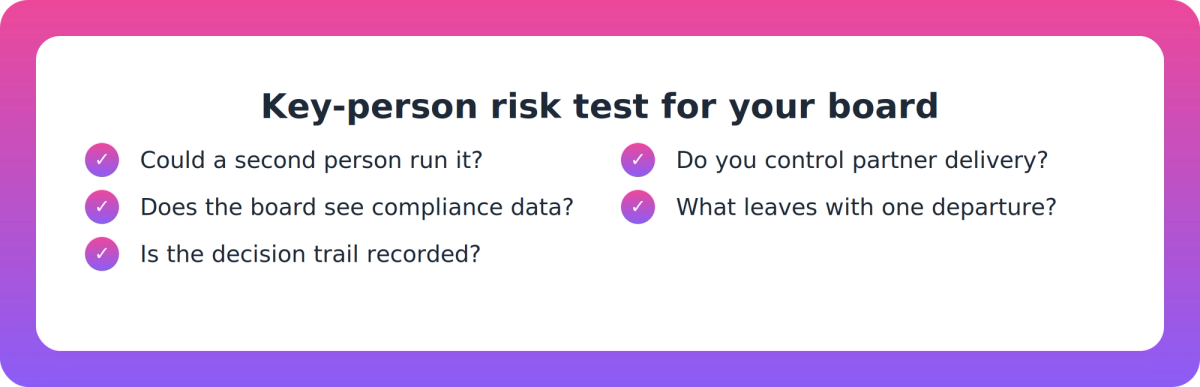
This is a reasoned test, not a measured benchmark. Ask it of your highest-risk roles first: the compliance lead, the head of training, and anyone who alone understands a funding or partner arrangement.
- Could someone else run it? Pick one compliance process, such as internal audit or validation. Could a named second person run it this month using only what is written down?
- Does the board see it? Do governing persons receive regular compliance and quality information in a form that prompts questions, or only a reassuring summary?
- Can you show a decision trail? When growth plans or delivery changes were approved, is there a record that training outcomes and compliance capacity were considered?
- Do you hold control over partners? For any third-party or partner delivery, can you show due diligence and how you retain control?
- What walks out the door? If one trainer, assessor or compliance lead left tomorrow, which evidence, relationships and judgement calls would leave with them?
An illustrative example: a mid-sized RTO's compliance manager is the only person who knows why an assessment tool was changed last year. The reasoning is in her head and a few emails. The risk is not that she leaves. It is that the board could not explain the decision if asked.
Why this is not an HR problem
Retention matters, but it is only half the picture. You can pay well, offer flexibility and still lose someone to illness, a better offer or retirement. HR can reduce the odds. Only the board and CEO can decide that oversight must not depend on one individual.
That shifts the ownership. Documented processes, shared knowledge and visible board engagement are governance choices. They also protect margin, because an unplanned departure in a compliance role tends to mean urgent cover and rework.
Our take
Most RTOs treat key-person risk as a staffing worry and review it when someone resigns. We think the 2025 Standards' focus on outcomes and governance makes that too late. The stronger position is to be able to show, on any given day, that oversight is shared and evidence is findable.
We cannot cite a prevalence figure, because none exists publicly. The argument rests on logic and on a workforce that is short, casualised and ageing. If your board can pass the five questions above, you are better placed whatever ASQA's priorities turn out to be.
FAQ
What is RTO key person risk?
It is the exposure that arises when compliance, training management or partner knowledge sits with one person, so their departure would leave the RTO unable to show it can operate and oversee compliance. No public statistic measures how common this is.
Do the 2025 Standards for RTOs mention key-person risk?
Not by that name, as far as this research found. The Standards include the Fit and Proper Person Requirements, and secondary reports say ASQA wants governing persons actively engaged in compliance oversight. Check the instrument and asqa.gov.au for exact wording.
Is governance really a separate area under the 2025 Standards?
Some sector commentary says governance now has its own Quality Area 4, replacing 2015 Standard 7. That wording is unverified here, so confirm it against the legislative text before relying on it.
What is the first step a CEO or GM should take?
Choose one compliance process and ask someone other than its usual owner to walk the board through it using only documented material. The gaps show you where the dependency is.
One step for this week
Put one agenda item on your next board meeting: "If [name] left tomorrow, what could we demonstrate?" Then assign someone other than that person to answer it.