Moderation tells you what went wrong in finished work. It can't tell you which learner stopped turning up in week four. With External Evaluation and Review gone and self-review now something your PTE must evidence itself, a Head of Training needs an early signal on learner progress. Week six is a sensible place to look for one.
Key takeaways
- NZQA's 2026 rules replace External Evaluation and Review with self-review and monitoring, so your PTE has to produce its own quality evidence. Learner progress data is some of the most useful evidence you hold.
- Post-assessment moderation is mandatory, but it samples finished work. It is a late signal about drift, not an early one.
- The sources prescribe no week-six checkpoint or tracking method. Early visibility is a sensible response to the rules, not a stated requirement.
- Uneven TEC funding rates and a Ministry briefing flagging possible completion effects make early drift a sustainability issue as well as a quality one.
- A light, repeatable checkpoint beats a heavy dashboard, especially when trainers are already stretched.
Why this lands on your desk
You own training and assessment quality. NZQA's Quality Assurance of Tertiary Education Providers Rules 2026 require an up-to-date quality management system and reporting to NZQA on self-review, including discussions with NZQA. Much of the learner-progress evidence behind that review is generated on your watch.
Completion is the number your leadership and TEC will ask about. TEC's 2026 Plan Guidance tracks course, qualification and programme completion. So a learner who quietly disengages in week four becomes a quality question, a funding question and a conversation with your board.
What the 2026 rules do and don't say
The Private Training Establishment Rules 2026 took effect on 19 January 2026. They replace the PTE Registration Rules 2025 and the PTE Enrolment and Academic Records Rules 2022.
Internal moderation must be embedded in every tertiary provider's quality management system. That covers pre-assessment moderation of materials and post-assessment moderation of learner work, as set out in NZQA's quality assurance system. Programme approval still requires assessment that is fair, valid, consistent and appropriate.
Consistency reviews have been discontinued from 1 January 2026, and the Programme Approval, Recognition and Accreditation Rules 2026 no longer refer to them. That puts more weight on your own internal evidence of consistency.
What the sources do not say matters just as much. NZQA hasn't told PTEs to track progress in any particular way, and nothing mandates a week-six checkpoint. That is our argument, not a rule.
Why look around week six
Post-assessment moderation is built to check whether a judgement was sound once the work exists. It is a good control for consistency. It is a poor early-warning system, because a learner who has stopped submitting produces nothing to moderate.
Week six is a judgement call. It is far enough in that first assessments, attendance patterns and trainer impressions exist. It is early enough that a phone call, a timetable adjustment or extra support can still change the outcome. For a shorter programme you might move it earlier, and for a longer one you might check twice.
The funding context raises the stakes. TEC's 2026 funding rates are not uniform. Foundational Funds rise by 3%, while TEC's worked examples show some categories falling, for instance from $7,563 to $7,287, a 3.65% decrease. A Ministry of Education briefing (redacted, in-confidence) says a funding change could affect completion rates over time, and that TEC's learner success expectations can mitigate this.
I wouldn't quote a PTE completion rate from any of this. The plan guidance figures aren't readable by category, so treat your own data as the only reliable baseline.
An illustrative week-six checkpoint
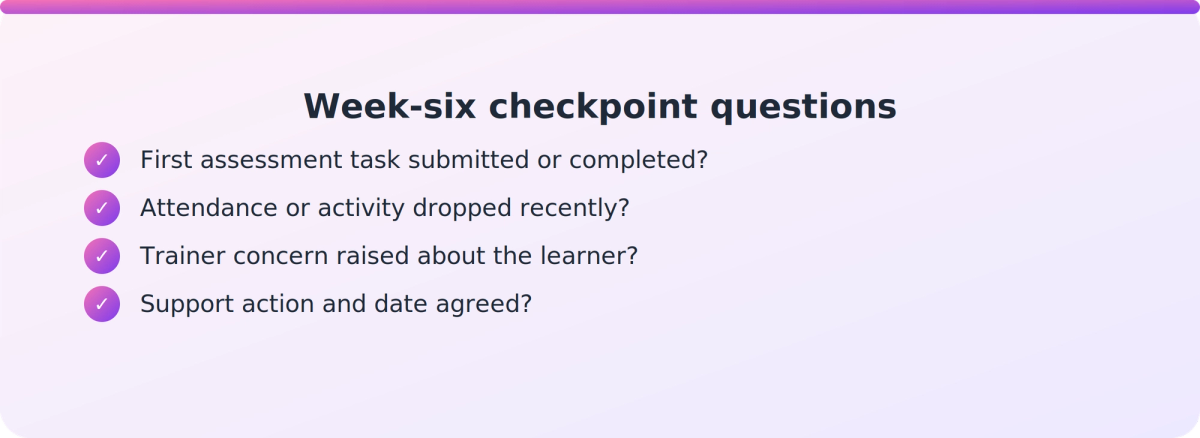
This is a hypothetical example, not a customer story. Picture a 16-week certificate with 20 learners and two trainers. At week six, each trainer answers the same four questions for every learner:
- Has the learner submitted or completed the first assessment task?
- Has attendance or online activity dropped in the last two weeks?
- Has the trainer raised any concern about workload, literacy, numeracy or personal circumstances?
- Is there a contact or support action already agreed?
The Head of Training reads one page, not twenty files. Learners with two or more flags get a named person and a date for follow-up. The same page becomes dated evidence for your self-review: you saw the pattern, acted, and can show what happened next.
What to do this quarter
- Pick the one programme with your weakest completion history. Run the checkpoint there first and don't roll it out everywhere.
- Agree the signals with your trainers. Three or four, defined in plain language, so two trainers would flag the same learner.
- Fix the cadence and the owner. A fifteen-minute review at the same point in each intake, with a named person accountable for follow-up.
- Record the action, not just the flag. A flag with no response is a liability in a self-review conversation.
- Feed it into moderation. Pre-assessment moderation can ask whether early tasks are surfacing difficulty. Post-assessment samples can include learners who were flagged. For consistency across trainers, see this guide on assessment consistency.
The test is whether this adds less work than it saves. If trainers are re-keying data into a second spreadsheet, you're adding to a workload already stretched by system restructuring. Industry Skills Boards have replaced the Workforce Development Councils and Te Pūkenga's programmes are moving to regional polytechnics, so keep the checkpoint small.
Our take
Most PTEs already know their completion rate. Few can say when each non-completing learner first started to slip. That gap is where quality management sits now.
NZQA has moved the burden of proof towards the provider. A PTE that spots drift in week six, acts, and can show the record has a stronger self-review story than one that explains a poor completion figure after the fact. We think early progress visibility belongs in the quality management system alongside moderation, not in a side spreadsheet. We'd also admit the evidence on what works best is thin, so test it on one programme before you commit.
FAQ
Does NZQA require PTEs to track learner progress at week six?
No. The sources reviewed do not prescribe a method or a week-six checkpoint. NZQA requires an up-to-date quality management system and reporting on self-review. An early checkpoint is a practical way to generate evidence for that, not a stated requirement.
How does internal moderation relate to early learner progress data?
Internal moderation must cover both pre-assessment materials and post-assessment learner work. It checks assessment quality and consistency, but it samples finished work. Early progress data covers a different gap: learners who are disengaging before there is any work to moderate.
Why does this matter more in 2026?
External Evaluation and Review has been replaced by self-review and monitoring, and consistency reviews were discontinued from 1 January 2026. Your own internal evidence therefore carries more weight. Uneven TEC funding rates and a Ministry briefing on possible completion effects add commercial pressure.
What should a Head of Training track first?
Start with three or four signals trainers can apply consistently, such as first assessment submitted, attendance change and trainer concern. Record the follow-up action as well as the flag. Pilot on one programme before extending.
Next step
Pull the last intake of your lowest-completing programme and ask your trainers when each non-completing learner first showed a sign of slipping. If nobody can say, you have found the gap your week-six checkpoint needs to close.