Your RTO's real operating manual probably isn't a document. It's the handful of people who know which spreadsheet to open, which export to trust and which funder rule to remember. That works until reporting becomes more frequent, or one of them resigns. Mapping where that knowledge lives is now an operations job, not a tidy-up.
Key takeaways
- ASQA's Practice Guides don't prescribe documented procedures, but their self-assurance questions assume you can explain and evidence how you operate.
- NCVER puts responsibility for the accuracy of reported data on the RTO, so you answer for the repeatability of the steps behind the data, not just last quarter's file.
- Quarterly, status-based reporting under the VET Information Standard is likely to expose spreadsheet-and-memory processes. That is our inference, not a sourced finding.
- The sector's workforce is ageing and highly casualised, so knowledge held by individuals is at risk of leaving with them.
- The first step is cheap: map who holds knowledge of each critical process before you design any fix.
Why this lands on your desk
You own the processes behind enrolment, delivery, reporting and finance. When something breaks, you rarely get to ask whose fault it was. You get asked why it wasn't repeatable.
NCVER says the RTO is responsible for the accuracy of reported data and for updating it promptly when a student identifies an issue (see NCVER's guide to preparing for VET Information Standard reporting). A correct file is one outcome. A reliable way of producing correct files is what you are really accountable for.
The uncomfortable test is simple. If your most experienced operations person were out for a month, what would stop?
What the regulator does and doesn't say
The 2025 Standards for RTOs took effect on 1 July 2025. ASQA's Standards for RTOs page is the primary reference. A third-party summary from CloudAssess describes them as split into Outcome Standards, Compliance Standards and a Credential Policy.
Here is the part to be careful about. Our research found no ASQA statement that specifically requires documented procedures, so don't tell your board there is one. Read the Outcome Standards text yourself for anything specific.
What ASQA does offer is Practice Guides. They are not prescriptive. They give examples of actions for demonstrating compliance, known risks to quality outcomes, and self-assurance questions. Those questions only work if you can describe your own practice and show evidence of it. "Ask Sam, she knows" is not an answer you can hand to an auditor.
There is a second signal. ASQA's Corporate Plan 2025–26 separates bad-faith operators from committed providers who, despite genuine intentions, may at times fall short in their capability to meet regulatory requirements. Everyday operational capability is a recognised risk category. It is separate from bad conduct, and it is yours to manage.
Reporting is about to get less forgiving
NCVER describes a shift from AVETMISS to the VET Information Standard under the VET Data Streamlining Program. It frames the change in two ways:
- Minimum annual reporting becomes minimum quarterly reporting, with complete and accurate declarations.
- Point-in-time outcome-code reporting becomes status-based reporting, where each change is reported.
ASQA's VET activity data reporting page records the amended Data Provision Requirements Instrument 2020 as taking effect on 1 October 2026. NCVER says all RTOs must report under the new standard by January 2029. One third-party source says 31 December 2028, so confirm the date directly with NCVER. NCVER's first transition action is to ensure your student management system can support the new reporting.
Now the inference, labelled as ours. More frequent, change-by-change reporting makes manual, spreadsheet-driven cycles and duplicate data entry harder to sustain. A once-a-year scramble can be survived on heroics. Four cycles a year, each reflecting every status change, tends to punish a process that exists only in one person's routine.
The people holding the knowledge are the people leaving
Jobs and Skills Australia reports there are not enough VET teachers, and many leave for better-paid roles in industry or higher education. It also reports that almost 50% of the VET workforce is over 50 and that the workforce is highly casualised. The CAQA summary of the JSA report is a useful starting point.
The Productivity Commission's Report on Government Services notes that in eight of nine reference years more VET teachers left than joined. It also flags limited data sources for measuring the VET workforce accurately.
That data is about teachers, not operations staff. The inference that casualisation and ageing raise the risk of process knowledge leaving with individuals is ours. But it's a reasonable one. If trainers and assessors hold the practical know-how on scheduling, evidence handling or student status changes, the churn lands on your processes.
A one-week audit of where knowledge lives
Our research found no authoritative data on how many RTOs have undocumented processes, how much time they spend on reporting, or typical staff-to-enrolment ratios. So don't borrow someone else's number. Run your own audit.
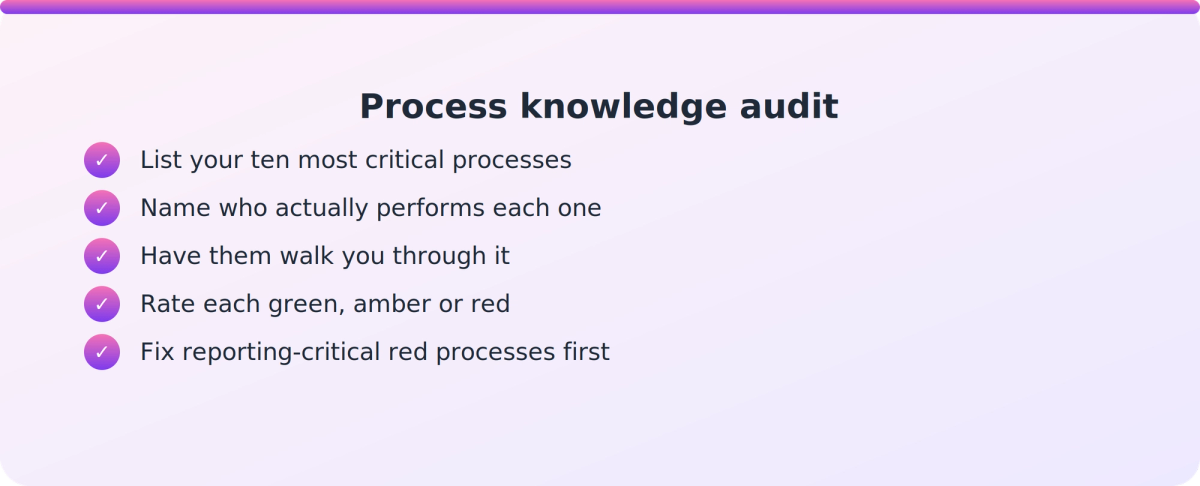
- List the ten processes that would hurt most if they failed: enrolment, USI checks, status changes, quarterly data submission, invoicing and so on.
- For each, name who actually performs it, not who is listed as owner.
- Ask that person to walk you through it. Note every spreadsheet, personal shortcut and manual re-key.
- Mark each process green, amber or red: documented and tested by someone else, documented but untested, or in one head.
- Start with the red processes that feed reporting.
The point isn't a 200-page manual. It's a short, accurate description someone else could follow on a bad day.
Our take
Most process documentation fails because it is treated as compliance housekeeping. It gets written once, filed and ignored, so it drifts away from what people really do. We think the better frame is operational resilience. A process is documented when someone who didn't build it can run it and get the same result.
That also changes the sequence. Before you buy, build or automate anything, you need to know what you are automating. Automating a process nobody has described just makes an undocumented process faster. Document first, fix the duplicate entry second, and only then decide what tooling earns its place.
FAQ
Does ASQA require RTOs to have documented procedures?
Our research found no ASQA statement that specifically requires documented procedures. ASQA's Practice Guides for the 2025 Standards offer self-assurance questions, which assume you can explain and evidence your practice. Check the Outcome Standards text for specific requirements.
What is changing in RTO data reporting?
NCVER describes a move from AVETMISS to the VET Information Standard. Minimum annual reporting becomes minimum quarterly reporting, and point-in-time outcome codes become status-based reporting where each change is reported. NCVER says all RTOs must report under the new standard by January 2029. Confirm the exact date with NCVER.
Who is responsible for the accuracy of reported data?
NCVER places that responsibility on the RTO. That includes updating records promptly when a student identifies an issue. In practice, the COO answers for whether the processes behind the data are repeatable.
Why is knowledge loss a bigger risk for RTOs now?
Jobs and Skills Australia reports a VET teacher shortage, a workforce almost 50% over 50 and high casualisation. The Productivity Commission notes that in eight of nine reference years more VET teachers left than joined. That people-to-process link is an inference, but a sensible one.
Your next step
This week, pick the one process that feeds your next data submission. Ask the person who runs it to talk you through it while someone else writes down every step. If you can't finish that exercise in an hour, you've found your first priority.