The compliance manager isn't the bottleneck because they're a perfectionist. They're the bottleneck because nobody else owns the evidence trail. When owners, links and warnings are missing, every document drifts to the one person accountable for registration, and review becomes a personal checkpoint instead of a system.
Key takeaways
- The RTO compliance manager bottleneck is structural: no defined document owners, no visible evidence trail and no early warning.
- Under the Standards for RTOs 2025, the question is whether you can show current, traceable evidence of practice. Well-written policy alone doesn't answer it.
- Reviewing everything yourself doesn't reduce risk. It concentrates risk in one person and one inbox.
- The shift to make is from approver of everything to designer of assurance. That means tiered review, named owners and exception-based sign-off.
- Treat AI-assisted checking, if you use it, as support for your accountability, never a substitute for it.
Why this lands on your desk
You answer for registration and audit outcomes. The Standards for RTOs 2025 commenced on 1 July 2025 and replaced the 2015 Standards for ASQA-regulated RTOs. They sit across Outcome Standards, Compliance Standards (including the Fit and Proper Person Requirements) and the Credential Policy, made through instruments F2025L00354 and F2025L00355 on the Federal Register of Legislation.
So every stale or unreviewed document is personal risk, and reviews default to you. Nobody decided that. It's what happens when accountability is clear and ownership isn't.
The stakes have also risen. ASQA's 2026 Environmental Scan identified four interconnected risks: provider governance and market conduct, quality and fitness-for-purpose of training delivery, integrity of qualifications and competency outcomes, and transparency and accountability in complex delivery models (ASQA IQ, October 2026). ASQA's recent legislative changes also list integrity amendments, including extended provisions on false and misleading conduct by an RTO. Anything signed off without a clear trail now carries more weight.
What evidence of practice means for review
Secondary commentary says audits test evidence of practice, not just written policy. One example given is a visible link between the training and assessment strategy (TAS) and the industry consultation log (Supahuman commentary on industry consultation). I couldn't retrieve ASQA's own wording on that specific link, so treat it as indicative and not as a stated requirement.
The principle still holds. A link between a TAS and a consultation record can't be built in a last-minute review. It's built when the consultation happens, or it isn't built.
The Annual Declaration on Compliance ran from 3 to 31 March 2026 (ASQA latest news). Secondary sources say self-monitoring evidence should underpin it and that RTOs could disclose non-compliance alongside rectification steps (Skiltrak). Again, indicative. Either way, once-a-year checking can't keep up with that expectation.
Three structural gaps that create the queue
No defined owners
If a document has no named owner, it has no one to chase when it ages. You become the default owner, then the default reviewer, then the default approver. That's three jobs, and only one of them is yours.
No visible evidence trail
Evidence scattered across drives, inboxes and spreadsheets forces you to re-verify everything personally, because you can't see what's been done. Reviewing is slow when the trail is invisible. Approving is risky when it is.
No early warning
Without a signal that a policy is overdue or a consultation record is missing, you find out at audit prep. That's where the rectification scramble comes from. The review isn't late. The warning was never there.
The workforce makes this harder. The JSA VET Workforce Study (October 2024) describes an older, highly casualised workforce. Casual trainers and assessors have little time or reason to own compliance tasks informally, so work flows upward to the central role.
Redesigning review: a worked example
This is illustrative, not a case study. Say a TAS needs updating after industry consultation. The old pattern is that the trainer edits it, emails you, and you check the lot.
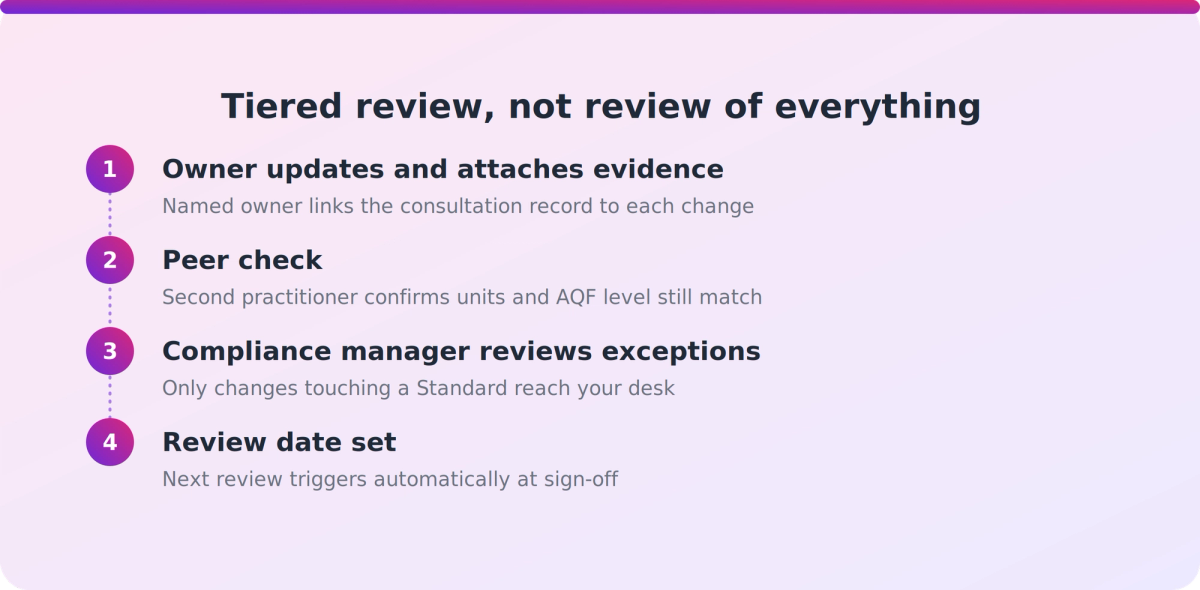
The redesigned pattern splits the job:
- Owner: the training manager owns the TAS and attaches the consultation record that prompted each change.
- Peer check: a second practitioner confirms the units of competency and AQF level still match the training package.
- Your review, by exception: you see only changes that touch a Standard, such as a changed assessment approach or a missing consultation link.
- Trigger: a review date is set at sign-off, so the next review surfaces without you remembering it.
You haven't given up control. You've moved it from reading every page to deciding what needs your eyes, and you've defined that rule in advance.
A note on AI-assisted checking
ASQA released Principles for the Responsible Use of Artificial Intelligence in VET (ASQA IQ, August 2026). Secondary sources expected revised Practice Guides on permitted and non-permitted uses, but I couldn't confirm their release. If anyone on your team uses AI to pre-check documents, it can flag gaps. The accountability for the sign-off stays with you, and your process should say so.
Our take
Most RTOs measure the compliance manager on how few things slip through, then wonder why that person approves everything. The incentive points one way. A person who is blamed for every miss will check every document.
Our view is that a compliance manager who personally reviews everything isn't a sign of rigour. It's a sign that assurance hasn't been designed. The better measure is whether the system would catch a problem if you were on leave for a fortnight.
That's uncomfortable, because it asks you to let go of some checks. But the 2025 Standards reward evidence you can trace, and a single reviewer is a poor way to build one.
FAQ
Why does every document review end up with the compliance manager?
Because you're accountable for registration and audit outcomes, and most RTOs haven't defined document owners, visible evidence trails or review triggers. Without those, the accountable person becomes the default reviewer.
What does ASQA expect as evidence of practice under the 2025 Standards?
Secondary commentary says audits test evidence of practice, including links such as TAS to consultation log. ASQA's own wording on that link wasn't retrieved, so check the Standards and ASQA guidance directly.
How can I reduce review load without raising risk?
Move to tiered review. Assign named owners, add a peer check, and reserve your review for changes that touch a Standard. Set review dates at sign-off so ageing documents surface on their own.
Should I use AI to check documents?
It can help flag gaps, but it supports your judgement and doesn't replace it. ASQA has released principles on responsible AI use in VET (ASQA IQ, August 2026), so read them before setting your own rules.
Your next step
Pick the five documents you reviewed most recently. For each, write down who owns it, where its supporting evidence lives, and what would have told you it was overdue. Wherever you can't answer, you've found where the bottleneck starts.