Moderation Report Analysis for PTEs in NZ: A Reading List
Reform is about to hand some PTEs other organisations' moderation files. Moderation report analysis can turn those files into searchable institutional knowledge. It only works if a standard-specific subject specialist verifies what the AI surfaces, and privacy and Māori data governance are settled before any learner work is processed.
Key takeaways
- Receiving PTEs will inherit moderation histories as reform moves work-based learning out of ISBs across 2026 and 2027. Capturing that knowledge early is a practical priority.
- NZQA's published direction is AI that assists moderation, with a subject specialist who knows the standard still verifying the outcome.
- Test any AI-assisted review of past moderation against a benchmark. NZQA has cited a 75% proxy human-to-human agreement rate for external moderation of internal assessment.
- Moderation files contain learner and assessor personal information. Plan privacy and Māori data governance first, not after procurement.
- No PTE-specific NZQA guidance on AI analysis of moderation records was found, so document your own rationale.
Why are PTEs about to inherit other organisations' moderation histories?
Because programmes are moving, and their records move with them. TEC says work-based learning divisions will move out of ISBs into polytechnics, wānanga or PTEs across 2026 and 2027.
The Ministry of Education says Te Pūkenga will be disestablished on or before 31 March 2027. All ISB programmes and enrolments must shift to polytechnics, PTEs or wānanga by 1 January 2028.
For a receiving PTE, that means years of moderation outcomes, assessor feedback and action plans, often held as scattered PDFs and spreadsheets. If nobody reads them, the lessons in them are lost at handover.
What does NZQA actually say about AI and moderation?
NZQA supports AI that assists, not AI that replaces the verifier. On its tertiary page, NZQA expects providers to have a coherent assessment and moderation system across everything they're accredited for. It also encourages providers to help staff understand how generative AI can be used in teaching, learning and assessment.
Two NZQA official information releases add detail:
- One release on AI marking and assessment says AI is not explicitly prohibited for internal assessment marking. Moderation and verification must still be done by a subject specialist with standard-specific knowledge.
- NZQA also described using AI to support moderation so it can better target moderation of internal assessment, piloting with historic material first.
That last point is useful. NZQA's own approach is to start with historic material, which is exactly what an inherited archive is.
One caution: these releases are not PTE-specific guidance. We found nothing from NZQA that addresses AI analysis of PTE moderation records directly, so treat the releases as direction of travel, not permission.
What can AI do with a pile of moderation reports?
It can read faster than any person, and that's the job. Used well, it helps you answer questions that are painful to answer by hand:
- Which unit standards or assessment tasks keep drawing the same moderation feedback?
- Which issues were raised, closed, then raised again?
- What did the previous provider's moderators say about a specific assessment decision?
- Where do assessor judgements diverge from moderator outcomes?
What it shouldn't do is decide whether an assessment judgement was right. That's the subject specialist's call.
A five-step approach, illustrated
Here's an illustrative example, not a case study. A PTE inherits a programme with several years of moderation files.
- Inventory. List what you received: reports, feedback, action plans, sample references.
- Remove or restrict personal information. Decide what the tool may see before it sees anything.
- Run the analysis. Extract themes, repeat issues and open actions, each linked to its source document.
- Verify. A specialist for each standard checks the findings against the original files.
- Record and reuse. Feed confirmed insights into assessor guidance and your next moderation plan.
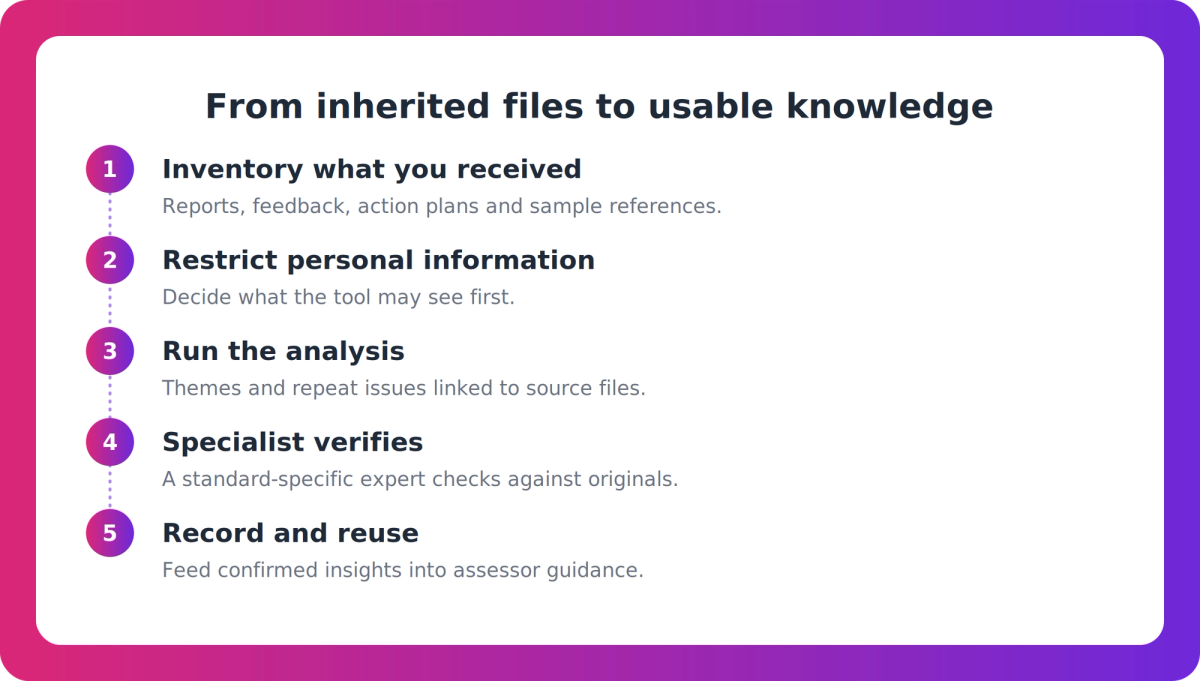
The source link in step 3 matters. A finding the specialist can't trace back to a file isn't a finding.
How do you know the analysis can be trusted?
Measure it against humans, not perfection. One NZQA official information release gives a proxy human-to-human agreement rate of 75% for external moderation of internal assessment.
Our suggestion, not an NZQA requirement: run the tool over a sample of past moderation where outcomes are known, and have specialists compare its results with the recorded ones. If agreement falls clearly below what humans achieve with each other, keep the tool in a purely supporting role. Write down the sample, the result and the decision.
What about privacy and Māori data governance?
Moderation files hold learner work and assessor details. Bell Gully reports that the Privacy Commissioner expects agencies to remain responsible for decisions made using AI tools. It also says privacy impact assessments are not mandatory but strongly encouraged.
One secondary source, Regulations.ai, describes them as mandatory. That conflicts with the law-firm reading, so we'd rely on the Commissioner's guidance and legal advice. Either way, doing one is cheap insurance.
The wider landscape is unsettled. Levy Street's overview notes NZ has no AI-specific statute as at 19 October 2026. B2B News reported that on 7 August 2026 the Human Rights Commission called for Māori data sovereignty and Te Tiriti o Waitangi to sit at the heart of AI governance. We haven't verified that against the Commission's own report, so check it.
Practically, that means asking where data is stored, who can access it, whether it trains anyone's model, and whether iwi, hapū or Māori learner groups should have a say in how their work is handled.
Is there a business case beyond compliance?
Possibly, but verify it. A vendor commentary on AI strategy for training providers (from Supahuman, which also publishes this blog) claims the PTE Rules 2026 took effect on 19 January 2026. It also claims TEC's consultation lets ISBs charge providers for activities like moderation.
We haven't confirmed either against primary TEC or NZQA documents. If they hold, owning your moderation knowledge matters more, because you'd stop paying repeatedly for lessons you already have.
The reading list
Start here before you buy or build anything:
- NZQA: Academic integrity and Artificial Intelligence, for the tertiary baseline.
- NZQA official information releases on AI marking and assessment and AI marking, for the human-verifier position and the 75% figure.
- TEC on work-based learning changes, for your handover timeline.
- Bell Gully on AI and privacy, for accountability and PIAs.
Our take
Most PTEs will treat inherited moderation files as a storage problem. We think that's a missed chance: those files record years of expert judgement about where assessment goes wrong. Reading them with AI is sensible, and NZQA's own piloting on historic material points the same way. But the value comes from the specialist who verifies the output, not the tool, so budget their time before you budget software.
FAQ
Does NZQA allow AI to analyse moderation records?
NZQA's releases say AI is not explicitly prohibited for internal assessment marking, but moderation and verification must be done by a subject specialist with standard-specific knowledge. We found no PTE-specific NZQA guidance on analysing moderation records, so document your reasoning and keep a human verifier.
Why does this matter now for PTEs?
TEC says work-based learning moves out of ISBs into polytechnics, wānanga or PTEs across 2026 and 2027. Te Pūkenga is to be disestablished on or before 31 March 2027, so receiving PTEs will inherit other organisations' moderation records.
Do we need a privacy impact assessment?
Bell Gully reports PIAs are not mandatory but are strongly encouraged, and that the Privacy Commissioner expects agencies to stay responsible for decisions made with AI tools. One secondary source calls them mandatory, so confirm with Privacy Commissioner guidance or legal advice.
How do we test whether AI-assisted review is reliable?
Compare its findings on past moderation against known outcomes, using specialists. NZQA has cited a 75% proxy human-to-human agreement rate for external moderation of internal assessment, which is a sensible reference point. Keep a record of the sample and result.
A practical next step: pick one inherited or ageing programme, list the moderation files you hold for it, and note who could verify a summary of them. That tells you whether you have a knowledge-capture project or just an archive.