Since NZQA replaced External Evaluation and Review with self-review and monitoring, "how we really do it" is a regulatory question, not just an operational one. A tacit knowledge audit finds the core processes that only work because one person remembers how, before a resignation, a restructure or a review finds them for you.
Why this lands on your desk
You own the machinery behind the Single Data Return, the board pack and the funding conversation. If the SDR only goes out cleanly because one person has a file-preparation routine nobody else has seen, that is a single point of failure for your TEC funding and monitoring data. It is also easy to miss, because it works every time until it doesn't.
The Private Training Establishment Rules 2026 commenced on 19 January 2026. They replace the PTE Registration Rules 2025 and the PTE Enrolment and Academic Records Rules 2022. Registration applications must now include a copy of the PTE's quality management system, which is required under the Quality Assurance of Tertiary Education Providers Rules 2026 (NZQA).
The re-issue reflects the removal of External Evaluation and Review in favour of self-review and monitoring. So the evidence of how your PTE actually runs has to come from your PTE. Someone will ask you for it, and "ask Sam, she's been here nine years" is not evidence.
Knowledge also walks out the door faster than anyone plans for. OIA documents reported by The Spinoff show Te Pūkenga lost over $80m in funding and about one in ten staff ahead of disestablishment. Your risk is smaller, but it is the same kind: one restructure, one competing offer or one burnout, and the process leaves with the person.
What has changed, and what to verify before you cite it
The primary-source facts are firm. The 2026 PTE Rules are in force, EER has been removed as a quality assurance mechanism, and a quality management system is required. TEC's SDR page, last updated 29 July 2026, cites *Data Specifications for SDR 2026 v3.1* and publishes an API portal for integrating systems directly with the Data Exchange Platform.
Some details come from secondary sources, so confirm them with NZQA or TEC first:
- A Technical Institute article says the integrated Quality Assurance Framework (iQAF) went live in January 2026, that NZQA stopped starting new EERs from 1 January 2026, and that non-university providers now complete an annual self-review and discuss it with NZQA.
- The same article says the annual financial return becomes two-yearly, though NZQA can still require a particular PTE to file annually.
- A vendor blog says providers without a compliant quality management system must have one by 1 January 2027. I could not verify that against the rules text, so don't plan around it until you have read the rules yourself.
The point of the audit doesn't depend on the exact dates. Whatever the deadline, you need to show how you run.
The audit in four moves
This is a resilience exercise. It is not a documentation project for its own sake, and it shouldn't produce a binder nobody opens.
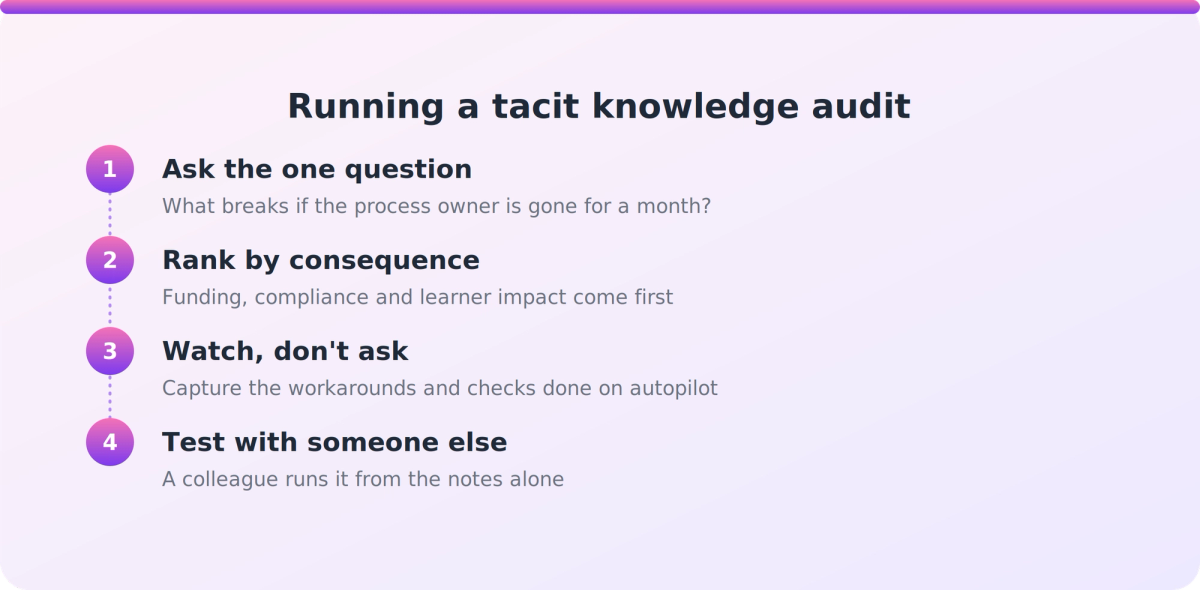
The one question
For each core process, ask: if the person who runs this was unreachable for a month, what would break, and who would notice first?
If the honest answer is "we'd work it out eventually", you have found tacit knowledge. Rank what you find by consequence (funding, compliance, learner impact), not by how annoying it is to write up.
Where to look first
- SDR preparation. Is it submitted through your student management system, or built by hand in a spreadsheet? TEC's API portal means system-to-system submission is possible. A hand-built workaround is the first thing to examine, because it depends most heavily on one person's memory.
- Self-review evidence. Where does the evidence come from, who assembles it, and could someone else rebuild it from your records alone?
- Standards tracking. One vendor blog says NZQA's 2026 Directory of Assessment and Skill Standards Rules replaced fixed review periods with "current", "expiring" and "discontinued" statuses (unverified; check the rules). If that is right, someone has to track status deliberately. If that someone is working from memory, it is a gap.
- Enrolment and academic records. These requirements now sit under the 2026 Rules. Can a new team member process an enrolment correctly using only what is written down?
- Relationships with standard-setting bodies. The Workforce Development Councils were disestablished on 31 December 2025 and eight Industry Skills Boards stood up in January 2026 (confirm the dates; TEC's September 2025 update gave a later one). If one person held those relationships, find out what they had agreed and what has since changed.
Capture how it's done, not how it's meant to be done
Sit beside the person and watch. Don't ask them to write it up. People skip the steps they do on autopilot, and those steps are usually the ones that matter. Record the workaround, the check they always do, and the thing they fix before it reaches anyone else.
Test it with someone else
A process is documented when a different person can run it from the page. Have a colleague do the next SDR preparation or evidence pull using only the notes. Every question they ask is a gap in the documentation.
Why growth makes this urgent
TEC expected transitions of work-based learning into providers during 2026 for many sectors. Management of Te Pūkenga's work-based training moves to Industry Skills Boards for up to two years, and ten regionally governed polytechnics are enabled from 1 January 2026 (NZ Government, Ministry of Education, TEC). For a PTE, that is potentially new learners and new provision.
Taking it on depends on repeatable processes, not individual heroics. If your only plan for 30 percent more enrolments is more hours from your three best people, you don't have a scaling plan. You have a burnout plan.
Our take
Most PTEs will treat the quality management system requirement as a document to produce for NZQA. That is the weaker reading. The stronger one is that NZQA has handed the evidence burden to the provider, and the provider's real defence is that its processes survive staff turnover.
We would rather see a thin QMS describing processes that were actually tested by a second person than a thick one describing how things are supposed to work. Auditors, boards and your own successor will tell the difference quickly.
Keep the audit small. Pick the three processes whose failure would cost you funding or compliance standing, and do those properly this quarter. Perfect coverage of everything can wait.
Key takeaways
- With EER removed and self-review and monitoring in its place, the evidence of how your PTE runs has to come from your PTE.
- The 2026 PTE Rules (in force 19 January 2026) require a copy of your quality management system with registration applications.
- The SDR can be submitted through TEC's API as well as by file, so a hand-built spreadsheet workaround is a prime audit target.
- The test for tacit knowledge: if the person who runs it vanished for a month, what breaks?
- Verify secondary-source details (iQAF timing, the 1 January 2027 QMS date, standards statuses) against NZQA and TEC before relying on them.
FAQ
What is a tacit knowledge audit in a PTE?
It is a structured check of which core processes only work because a specific person remembers how. For a PTE, that typically means SDR preparation, self-review evidence, standards tracking, and enrolment and academic records. The output is a ranked list of single-person dependencies, not a full documentation library.
Why does process documentation matter more for NZ training providers now?
NZQA's Private Training Establishment Rules 2026 require registration applications to include a copy of the PTE's quality management system. External Evaluation and Review has also been removed in favour of self-review and monitoring. Both mean you must show how you operate, using your own evidence.
Which process should I audit first?
Start with the one where failure costs the most. For most funded PTEs that is the Single Data Return, because it feeds TEC funding and monitoring. Check whether it is submitted via the Data Exchange Platform or built by hand, and whether anyone besides one person can do it.
Can I rely on the iQAF dates and the 1 January 2027 QMS deadline?
Not without checking. Those details come from a Technical Institute article and a vendor blog, not from NZQA or TEC. The rules text on the NZQA website is the authority. Read it, or ask NZQA directly, before you build a plan around any date.
A first step for this week: pick one process, ask the person who runs it to talk you through the last time it went wrong, and write down what they did. What did that conversation tell you that no document does?