The external review that used to force a tidy-up of your evidence is gone, and nothing replaces its deadline. Under NZQA's 2026 rules, your PTE keeps its own quality management system, runs a self-review and reports it to NZQA. Audit readiness is no longer an event. It's whether you can prove, on any day, that the system still holds.
Why this lands on your desk
You own the quality management system and the self-review story. Under the Quality Assurance of Tertiary Education Providers Rules 2026, which replace and revoke the Quality Assurance (including EER) Rules 2022, the PTE must keep that system current. It must also report on its self-review to NZQA and discuss it with NZQA.
A report is only as strong as the evidence behind it. If that evidence lives across shared drives, inboxes and personal spreadsheets, you can describe what happened but you can't easily show it.
The legal footing is plain. Under section 348(1) of the Education and Training Act 2020, a registered PTE must comply with the rules NZQA makes under section 452. The Private Training Establishment Rules 2026 were re-issued on 19 January 2026. They replace the PTE Registration Rules 2025 and the PTE Enrolment and Academic Records Rules 2022, and they reflect the removal of EER in favour of self-review and monitoring.
The scramble used to be a feature
Nobody misses audit panic. But a periodic external review did one useful thing: it set a date, and a date made everyone find the files.
That forcing function has gone. The regulator's review is no longer the prompt, so early warning of non-compliance now depends on your own processes. You are also the person judged on whether anything has slipped.
The cost of scattered evidence has changed shape. It used to be one bad fortnight. Now it is a year-round inability to say, with proof, that things still hold. That is harder to see, so it is easier to ignore.
Where scattered evidence actually hurts
Three obligations show up on your desk again and again.
Consent to assess and credit reporting
To maintain consent to assess, providers must meet the Consent and Moderation Requirements. These include accurately reporting credits within 3 months of assessment. Sub-contracting requirements have also moved into the Quality Assurance Rules.
If someone asks whether you met the 3-month window last year, you should be able to pull the answer up in minutes. Rebuilding it from assessor spreadsheets after the fact is a different, riskier exercise.
The Pastoral Care Code
Tertiary providers must follow the Education (Pastoral Care of Tertiary and International Learners) Code of Practice 2021. A provider must be a signatory to enrol international learners.
Providers such as SAE and Te Wānanga o Aotearoa publish their Code self-reviews. That tells you evidence of this work is expected to be visible, not buried in someone's inbox.
Documents that name structures which no longer exist
Industry Skills Boards were established formally from 1 January 2026, with a core role in standard setting. The work-based learning divisions of NZIST transferred to them on that date. NZQA's rule changes update terminology accordingly, including references to Workforce Development Councils.
Any policy, TAS or programme document that still names a WDC is a practical review item. You are the person who has to find them. Without a searchable record of which documents say what, that is a manual hunt.
Make traceability and ownership the readiness metric
Most PTEs measure readiness by what is complete. A better measure is what is provable, and by whom.
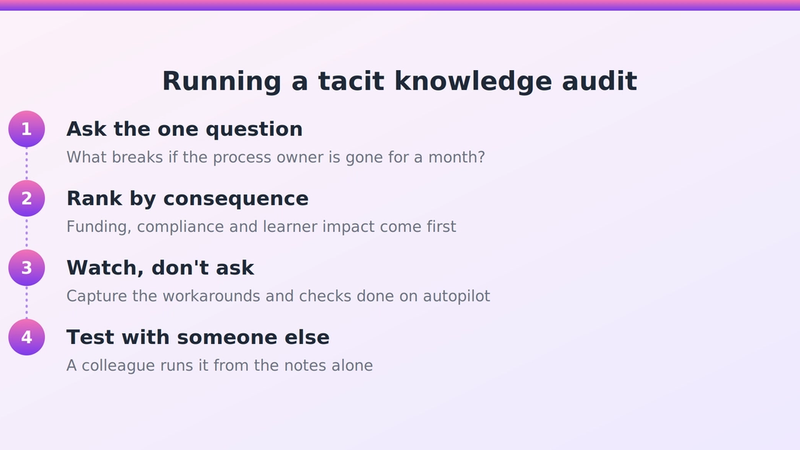
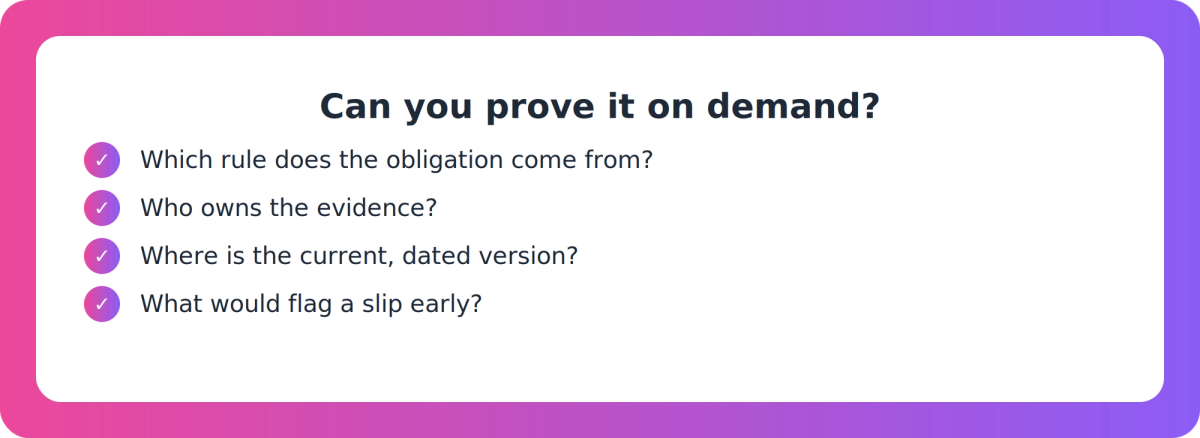
For any compliance obligation, you should be able to answer four things without opening six folders:
- What does the obligation require, and which rule does it come from?
- Who owns the evidence?
- Where is the current version, and when was it last reviewed?
- What would tell us early if it started to slip?
The fourth question is the one the old review cycle used to answer for you. Now you have to supply it.
Ownership matters as much as location. Evidence that belongs to "the team" belongs to nobody. If you are the bottleneck on every document review, the fix isn't working faster. It is moving ownership of evidence to the people who produce it, with you checking the system rather than every page.
A readiness test you can run this week
Pick three obligations: credit reporting, one Pastoral Care Code requirement, and your most recent self-review action. For each one, time how long it takes to produce the evidence and name the owner. If it takes more than a few minutes, or the answer is "it depends who you ask", you have found your real readiness gap.
What to hold loosely
Some operational details in circulation come from secondary sources and not from NZQA's own rules. Treat them as unverified until you have confirmed them with NZQA.
- One provider-sector source reports that NZQA stopped starting new EER reviews on 1 January 2026.
- The same source reports that annual self-review applies from July 2026, and that the summary report is completed in the MyNZQA portal rather than as Word or PDF files.
- Quality descriptors (proposed as Highly effective, Effective, Not effective) are expected from July 2027. The final outcome is to be confirmed on NZQA's consultation page.
- A vendor-reported 1 January 2027 deadline for building a compliant quality management system could not be verified. Check the Rules themselves.
The sound approach is to build evidence habits that work whichever dates and formats prevail. Good traceability serves you under any of them.
Key takeaways
- NZQA's 2026 rules put the early-warning job inside your PTE: a current quality management system, an annual self-review, and reporting to and discussion with NZQA.
- Scattered evidence is now a year-round risk, not a one-off audit-week cost.
- Credit reporting within 3 months, Pastoral Care Code evidence and ISB-era document updates are three places where you need proof on demand.
- Measure readiness by traceability and named ownership, not by how many documents exist.
- Confirm MyNZQA reporting, self-review timing and quality descriptor details with NZQA before you plan around them.
Our take
The loss of the external review is being talked about as relief. We think it is a transfer of responsibility, and it lands on one person's desk.
The PTEs that cope best won't be the ones with the biggest policy library. They will be the ones where any obligation can be traced to a rule, an owner and a dated piece of evidence, and where a missed one surfaces in the month it happens. A self-review you can defend line by line is worth more than a thick folder you can't navigate.
That is a cultural change before it is a tooling one. It starts with deciding who owns what.
FAQ
Has NZQA removed EER for PTEs?
NZQA's Quality Assurance of Tertiary Education Providers Rules 2026 replace and revoke the Quality Assurance (including EER) Rules 2022. The PTE Rules 2026 were re-issued on 19 January 2026 to reflect EER being replaced by self-review and monitoring. A secondary source gives 1 January 2026 as the date NZQA stopped starting new EER reviews. Confirm that date with NZQA.
What must a PTE report to NZQA under the new rules?
The Quality Assurance Rules 2026 include reporting on the self-review to NZQA and discussions about it with NZQA. A secondary source says the summary report is completed in the MyNZQA portal and that annual self-review applies from July 2026. Verify both with NZQA directly.
Which evidence should I be able to produce on demand?
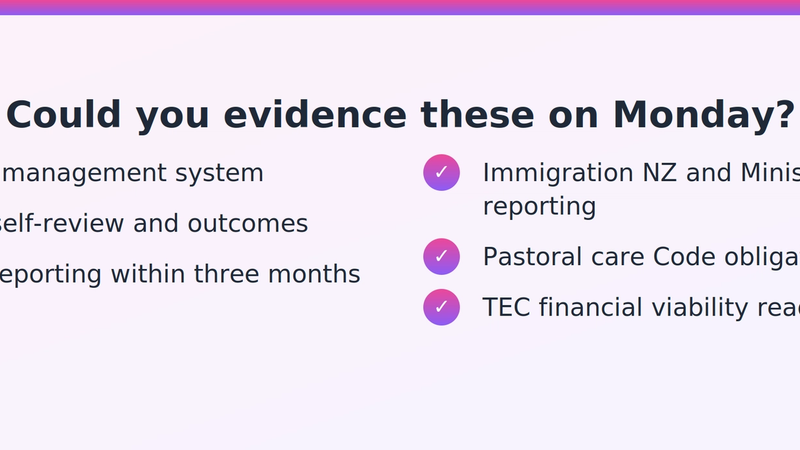
Start with what the rules make you answerable for: your current quality management system, self-review records, and evidence of accurate credit reporting within 3 months of assessment. If you enrol international learners, add your Pastoral Care Code self-review evidence. Each item should have a named owner and a current version.
Do I need to update documents that mention Workforce Development Councils?
It is a sensible review item. Industry Skills Boards were formally established from 1 January 2026, and NZQA's rule changes update terminology from WDCs to ISBs. Documents that still name WDCs may now be out of date, so check them for accuracy.
One place to start
Pick one obligation this week and ask: if NZQA asked for the proof tomorrow, who would hand it over, and how long would it take? Whatever the answer is, that is your first fix.