Your compliance system is only as resilient as the one person who truly understands it. Under the Private Training Establishment Rules 2026, a PTE must be able to show NZQA a documented quality management system, regular self-review and accurate credit reporting. If that knowledge lives in one head, the exposure is yours, not HR's.
Why key-person risk lands on your desk
You answer to the board or owners for regulatory standing, and for the P&L that standing protects. Key person risk at a training provider in NZ is usually filed as a staffing issue. Under the 2026 rules it is a governance one.
The PTE Rules 2026 came into force on 19 January 2026. They are made under section 452 of the Education and Training Act 2020. They replace the PTE Registration Rules 2025 and the PTE Enrolment and Academic Records Rules 2022, so enrolment and academic records requirements now sit inside one set of rules (NZQA).
We didn't find New Zealand sector data on how often compliance leads leave, or what it costs when they do. So we won't pretend to quantify it. The argument rests on what the rules require: obligations you must be able to evidence whoever holds the role.
The Friday resignation test
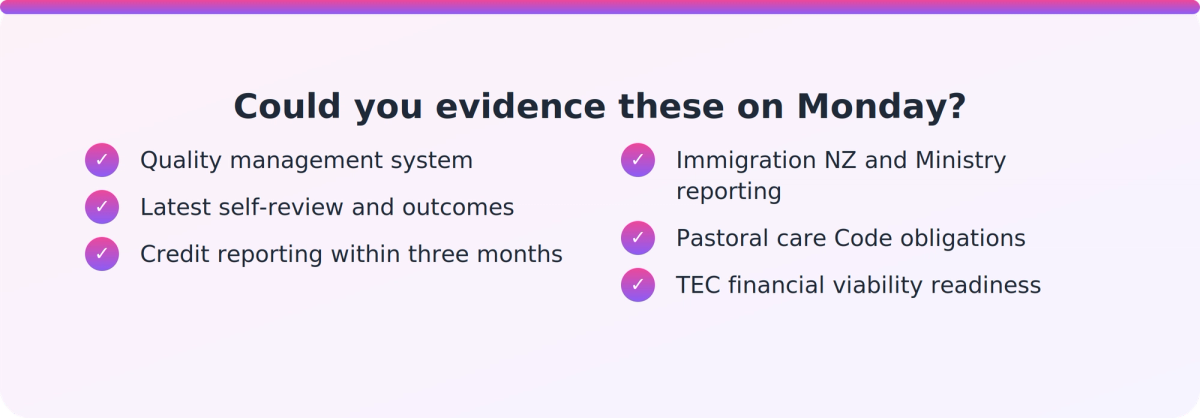
Picture your compliance lead or training manager resigning on Friday. On Monday, which of these could you evidence, and who would you ask to find out?
- Your quality management system. NZQA says a registration application must include a copy of the PTE's quality management system required under the Quality Assurance of Tertiary Education Providers Rules 2026.
- Self-review. All PTEs must undertake regular self-review. Can you show the last one, and what changed as a result?
- Credit reporting. PTEs must report credits accurately within three months of assessment, unless NZQA says otherwise.
- Ongoing registration conditions. You must keep complying with the PTE Rules, deliver at least one approved programme or micro-credential each year, meet Immigration New Zealand requirements and meet Ministry of Education reporting requirements.
- Pastoral care. If you enrol international students, you must be an approved signatory to the Education (Pastoral Care of Tertiary and International Learners) Code of Practice 2021.
- Financial viability. TEC's 2026 Funding Conditions Catalogue requires PTEs to take part in a financial viability assessment when TEC asks.
Each of those has an owner. The owner can leave. The honest answer for many providers is "we'd have to ask the person who just left", and that is the problem.
Why date-driven tasks fail first
Policies on a shared drive usually survive a resignation. Recurring, date-driven work is what stalls.
Credit reporting is the clearest example. The three-month window keeps running while you recruit. The annual financial return has also changed. It becomes biennial unless NZQA notifies a PTE that it must file annually (NZQA, Changes to NZQA Rules). That kind of detail is easy to hold in one person's memory and easy to lose with them.
The rules were also reworded to reflect the removal of external evaluation and review. We'd rather you read NZQA's own current description of how audits and reviews now work than rely on our summary. Ask whoever owns quality assurance today whether they can explain it to you without notes.
Funding turns a knowledge gap into a margin problem
TEC's 2026 Plan Guidance says demand for funding is expected to exceed supply and that additional funding is unlikely in 2026. It says appetite for risk will be lower, and that providers with strong delivery track records are better placed.
The 2027 investment round runs to a fixed timeline. Plans were due by 3 July 2026. TEC reviews them from July to October 2026 and notifies providers in writing from November 2026.
A compliance lapse after a key departure doesn't just cost a bad week. It can dent the track record that TEC is weighing. A PTE assessed as high risk in a financial viability assessment must also provide a financial viability action plan. You don't want to write one while your most knowledgeable person is on their notice period.
A restructuring sector leaves less slack
Eight Industry Skills Boards were established from 1 January 2026. Work-based learning is moving to providers, including PTEs, during 2026 and 2027. TEC's table of receiving PTEs includes BCITO Limited, MITO Limited and NZMA.
Large, newly stood-up competitors are taking on work that used to sit elsewhere. Arrangements are still shifting through 2027. If you depend on one or two people to hold your operation together, you have less room to respond when something changes. Check TEC's own documents for what the changes mean for your funding and obligations, rather than relying on secondary commentary.
What to do this quarter
You don't need a transformation programme. You need a few uncomfortable conversations and one decent test.
- Run the Monday test with your leadership team. For each obligation above, write down who owns it, who could cover it, and where the evidence lives.
- Ask for a walkthrough, not a document. Have a second person complete one credit report or one self-review cycle with the owner watching. Where they get stuck is where the knowledge is trapped.
- Name a deputy for every date-driven obligation. Make it a role expectation, not a favour.
- Check your board reporting. If the board only hears "compliance is fine", ask what that statement rests on and whose knowledge it depends on.
Key takeaways
- Under the PTE Rules 2026, your quality management system, self-review and credit reporting must be evidenced regardless of who holds the role.
- Credits must be reported within three months of assessment. That recurring deadline is the kind of task that stalls when its owner leaves.
- TEC's lower risk appetite and tight funding make a compliance lapse a P&L and track-record issue, not just an HR one.
- Restructuring across work-based learning and the Industry Skills Boards means less slack to absorb a key departure.
- The test is simple: if your compliance lead resigned on Friday, what could you evidence on Monday?
Our take
Most key-person risk is created by good people doing a great job. The person who quietly keeps everything on track becomes the system, and nobody notices until they leave. The fix isn't distrust or heavy bureaucracy. It's treating portable knowledge as part of the job you pay them for.
We think the CEO or GM should own this question personally, because nobody else can see across quality, funding and people at once. Your first step this week is to ask your compliance lead, kindly, "If you were away for a month, what would we get wrong first?" Then listen to the answer.
FAQ
What is key person risk for a training provider in NZ?
It is the exposure created when critical compliance or training-management knowledge sits with one individual. Under the PTE Rules 2026, a PTE must be able to show NZQA its quality management system, self-review and accurate credit reporting. If only one person can explain them, the provider is exposed.
Which PTE obligations are most vulnerable when someone leaves?
Recurring, date-driven ones are the most exposed. Credit reporting within three months of assessment is the clearest example. Self-review, Ministry of Education reporting, Immigration New Zealand requirements and Code of Practice obligations also each have an owner who could leave.
Does this affect TEC funding as well as NZQA registration?
Yes. TEC's 2026 Plan Guidance says funding is tight, risk appetite is lower and providers with strong delivery track records are better placed. TEC can also require a financial viability assessment. A lapse after a departure could weaken your position in the 2027 investment round.
Where should I check how NZQA audits and reviews now work?
Go to NZQA directly. The PTE Rules 2026 were reworded to reflect the removal of external evaluation and review. Secondary sources describe a new quality assurance framework, but NZQA's own guidance is the authoritative source for how it applies to your provider.