A validation session that ends in a signed form proves a meeting happened. It doesn't prove assessment is consistent. Under the Standards for RTOs 2025, the question your RTO validation and moderation process has to answer is what validation changed in your tools and practice, not whether it was held.
Why this lands on your desk
You own assessment quality across your trainers. Validation is the main way anyone, including you, finds out whether two assessors looking at the same evidence reach the same judgement.
It also tends to slip when you can least afford it. Trainer workload, casualisation and thin teams squeeze the hours for validation, and a tick-and-flick session is the easy way to meet the deadline. NCVER reports sector concern about ageing practitioners, high casualisation, industry currency and trainer capacity. The JSA VET Workforce Study (October 2024) says more comprehensive and consistent workforce data is still needed, so be careful with any shortage figure you can't trace to that report.
You also answer for what happens after a finding. ASQA's Assessment Practice Guide expects providers to show what action they took when validation found issues. An action left open is a quality gap and an audit exposure, and both sit with you.
What a signature can't tell you
The 2025 Standards for RTOs took effect on 1 July 2025. ASQA-regulated RTOs are now regulated against the Outcome Standards Instrument 2025 and the Compliance Standards and Fit and Proper Person Requirements Instrument 2025. The shift is toward outcomes. ASQA's 2025 Standards FAQ says providers must demonstrate that assessment practices and the assessment system have been validated, review assessment tools before use, and ensure validators collectively hold one of the credentials specified in the Credential Policy.
A signed form shows none of that. It records attendance and agreement, not whether the tools were sound, the judgements consistent, or anything improved afterwards.
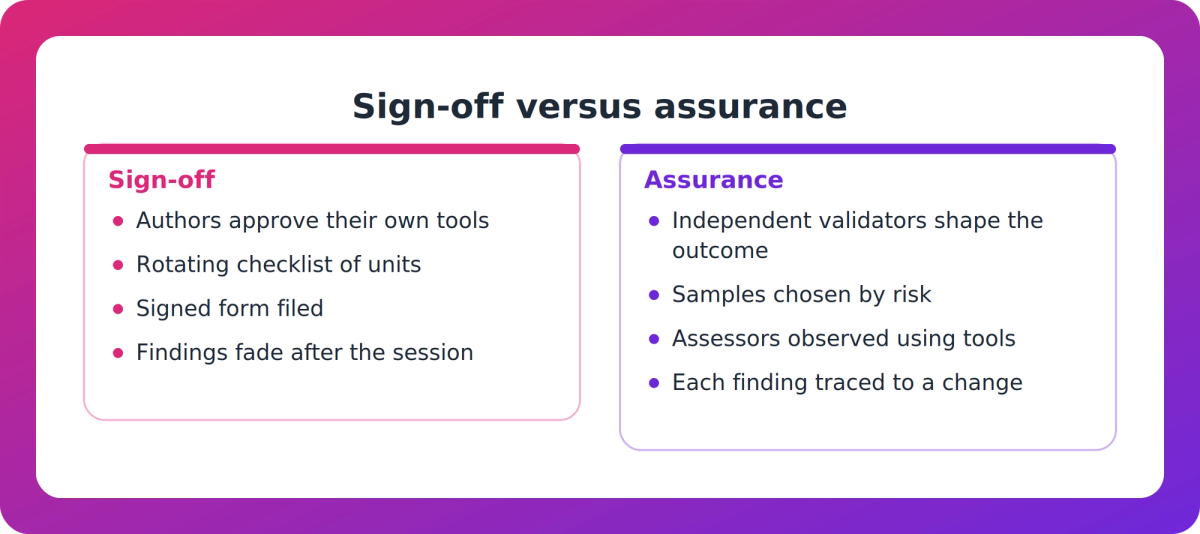
Sign-off versus assurance
The difference is easy to see side by side.
Three tests of real assurance
ASQA's Assessment Practice Guide (the legacy guide, still the clearest statement of the expectation) points to three things. Use them as a test of your own process.
1. Independence
The guide says the outcome of a validation must not be determined solely by a person who designed or delivered the training or assessment. If the authors of a tool are the only people approving it, that is sign-off, not independent assurance.
In a small RTO, true independence is hard. You may need an external validator, a trainer from a different program or a peer RTO. The FAQ's point about validators collectively holding the right credentials also applies. Check the exact independence and validation-cycle wording in the full FAQ and the Outcome Standards, because the research behind this post did not fully confirm it.
2. Samples chosen by risk
The guide expects a risk assessment process to decide which units of competency you sample. It also expects samples to reflect cohort diversity, delivery locations and the number of assessors, with the aim of a reasonable level of consistency of judgements across the RTO.
A rotating checklist of units does not meet that expectation on its face. Ask different questions:
- Which assessors have the least moderation history?
- Which campus or workplace delivery has never been sampled?
- Which cohort, such as a high-intake group or a new employer partner, carries the most risk?
The guide also lists observing assessors using the tools. Reading finished files tells you what was recorded, not how the judgement was made.
3. A visible trail from finding to change
This is the test most RTOs fail quietly. Knowledge Foundry frames it as showing how validation outcomes are used to change the assessment system. For every finding, you should be able to point to the revised tool, the new version, the briefed trainers and the date it took effect.
If you can't, the finding is still open, however tidy the minutes look.
Why integrity of competency raises the stakes
ASQA's 2025–26 risk priorities flagged RPL issued without appropriate assessment as an enduring and growing risk. They also noted that some RTOs strip training from courses and leave only assessment. Both put weight on how well an assessment decision can be defended.
Your assessment function is the first line of defence on those risks. Validation that changed something is the best evidence you have that competency outcomes are defensible. ASQA has since published 2026–27 priorities, so read those directly.
Making it work with a stretched team
You probably can't add validation hours. You can change what the hours produce. Four moves for this quarter:
- Audit your last cycle. Take the previous validation records and trace each finding to a change in a tool or practice. Count the ones you can't trace.
- Rebuild the sample on risk. List assessors, locations and cohorts, then mark where you have the least evidence of consistency. Sample there first.
- Run a single action register. Each finding gets an owner, a due date and a pointer to the changed document or version. Review it at every training meeting, not just at validation time.
- Brief casual trainers on the outcome. Tell them what changed and why, in 15 minutes, not in a long email. A fix that never reaches the assessor hasn't fixed anything.
If you're considering automating parts of validation preparation, such as collating samples or tracking actions, read the idea against ASQA's Principles for the Responsible Use of AI in VET. This post doesn't summarise them, so go to the source.
Key takeaways
- A signed validation form proves a session happened. It does not prove assessment is consistent.
- ASQA's Assessment Practice Guide points to independent validators, risk-based sampling across assessors, locations and cohorts, and demonstrable action on findings.
- The strongest test of assurance is closing the loop: each finding traced to a change in a tool, a version or practice.
- Integrity of competency is an ASQA risk focus, so what validation changed is your best evidence that outcomes are defensible.
- Check the full 2025 Standards FAQ and Outcome Standards for exact validation-cycle and independence wording.
Our take
Most validation problems are not compliance problems. They are follow-through problems. The sessions happen, the forms are signed, and the findings quietly dissolve into the next teaching term.
We think the sharper measure for a Head of Training is the ratio of findings raised to changes made, not the number of sessions held. If you can't show the changes, you have a record of conversations. The Standards for RTOs 2025 and ASQA's focus on integrity of competency both push the same way: show what you did about what you found.
FAQ
What should an RTO validation and moderation process prove under the Standards for RTOs 2025?
It should show that assessment practices and the assessment system have been validated, and that validation led to action. ASQA's FAQ expects providers to demonstrate this, review tools before use and ensure validators collectively hold the credentials specified in the Credential Policy.
Can the people who designed or delivered the training validate it?
They can take part, but ASQA's Assessment Practice Guide says the outcome must not be determined solely by someone who designed or delivered the training or assessment. Confirm the exact wording in the full 2025 Standards FAQ and the Outcome Standards.
How should I choose which units of competency to sample?
Use a risk assessment process. ASQA's guide expects samples to reflect cohort diversity, delivery locations and the number of assessors, aiming for reasonable consistency of judgements across the RTO. A fixed rotation of units doesn't show that reasoning.
What evidence shows validation findings were acted on?
A traceable record from each finding to the change made, such as a revised tool, a new version, trainer briefings and an effective date. ASQA's guide expects providers to be able to show what action they take when validation finds issues.
Here is a first step. Pick your most recent validation, choose three findings, and try to show someone the changed document for each. Wherever you stall is where your assurance process needs work.