TEC's educational performance indicators tell you how last year's learners finished, not how this year's are going. For a Head of Training, that gap is the job. Spotting drift in progress, assessment consistency and standards currency inside the delivery cycle is the difference between steering a programme and explaining one.
Why this lands on your desk
You own delivery and assessment quality. But the numbers you're ultimately judged on are published after the fact.
For provider-based programmes, TEC's educational performance indicators (EPIs) are first-year retention, qualification completion, successful course completion and progression. For work-based provision they are first-year apprentice retention, programme completion and credit achievement. These are outcome measures. They confirm what happened. They don't tell you what is happening.
The tolerance for slow discovery is also shrinking. TEC's 2026 plan guidance says it expects declines in work-based programme completion rates to reverse immediately. If you only learn about a decline when the year-end numbers land, "immediately" has already passed.
Then there is NZQA. Its new tertiary quality assurance framework went live on 1 January 2026. NZQA stopped starting new external evaluation and review (EER) processes, and it stopped starting assuring consistency reviews (those already underway will be completed). The Quality Assurance of Tertiary Education Providers Rules 2026 now require an up-to-date quality management system, annual self-reviews reported to NZQA, monitoring, sub-contracting requirements and retention of assessment records. Providers complete an annual self-review summary report and meet NZQA to discuss the improvement plan. Your evidence about delivery and assessment practice has to be credible and current, not assembled in a rush.
What the EPIs can't tell you
The timeframes alone show the problem. TEC's methodology, set out in its aide-mémoire on the 2022 EPIs, gives qualification completion two years for Levels 1–3 and four years for Levels 4–7 (non-degree). A cohort on a Level 5 diploma can drift for a long time before any published indicator reflects it.
Averages also hide the cohorts that matter. Education Counts (updated July 2026) shows that domestic completion for students who started Level 4 certificates three years earlier recovered to 62% in 2025, after a dip to 59% in 2024. Part-time students' rates remain lower than full-time students'. A healthy-looking headline can sit on top of a part-time cohort that is quietly slipping.
The lesson isn't to chase the national figure. It's to segment your own learners by level, study mode and, for work-based provision, employer or trainer, so that a pattern shows up in weeks rather than years.
One picture, not three chores
Most training teams report learner progress, assessment consistency and standards currency separately, often to different people on different cycles. That's three chores. Treat them as one early-warning picture, because each one weakens the other two.
Learner progress
The question is simple: are learners where they should be, at this point, against the programme's own milestones? Credit achievement for work-based learners, assessment submission and completion for provider-based ones. Look at it by cohort and mode, not just in total.
Assessment consistency
NZQA's Programme Approval, Recognition and Accreditation Rules 2026 require assessment that is fair, valid, consistent and appropriate, plus an effective system for moderating assessment materials and decisions. NZQA describes internal moderation as ensuring consistency within an organisation, over time and between assessors.
Here is the link people miss. If two trainers grade the same standard differently, that's a quality risk. It's also a warning that your progress data may not be trustworthy. A cohort that looks on track under a lenient assessor and stalled under a strict one isn't telling you about learners. It's telling you about marking.
Standards currency
Standards and Consent and Moderation Requirements (CMRs) are moving to the new Industry Skills Boards (ISBs), which began on 1 January 2026 and will update CMRs over the coming months. Training materials and assessment tools can fall quietly out of step. Assess against a superseded version and your completion data looks fine while your validity doesn't.
A first-pass early-warning view you can build this quarter
You don't need a new system to start. You need a consistent monthly look at the same few things.
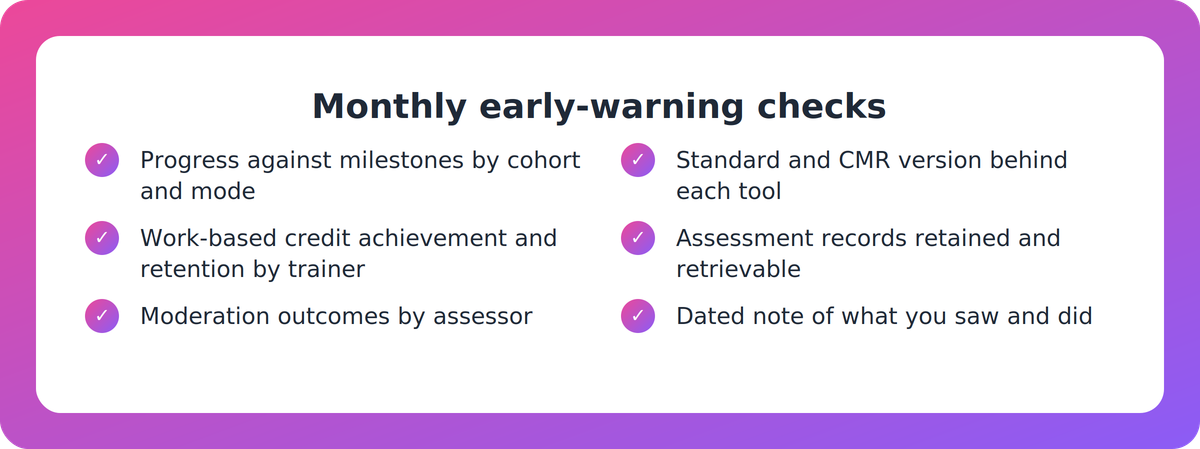
- Progress against milestones, by cohort, level and study mode
- Credit achievement and retention for work-based learners, by trainer
- Moderation outcomes by assessor, including where decisions were changed
- The standard and CMR version each assessment tool was built against
- A spot-check that assessment records are retained and retrievable
- A short written note of what you saw and what you did about it
That last item is the one that pays off at self-review time. A dated record of "we noticed this in month three and changed that" is far stronger evidence of a working quality management system than a retrospective summary.
What we don't know
Two honest caveats. First, NZQA consulted on replacing compliant/non-compliant outcomes with Highly Effective, Effective and Not Effective descriptors, assessed against four weighted criteria: programme design, delivery, assessment practice and quality management systems. The consultation closed on 7 September 2026. We couldn't find a final decision, so treat it as a proposal and check with NZQA directly.
Second, we found no authoritative sector-wide data on trainer burnout or time lost to assessment paperwork. Plenty of Heads of Training will tell you it's a problem, and they may well be right. But the argument here rests on the documented regulatory and performance-measure shifts, not on a workload claim we can't source.
The sector is also in flux. Te Pūkenga (now NZIST) is to be disestablished on or before 31 March 2027, with work-based learning moving to ISBs and then progressively to PTEs, polytechnics and wānanga. Whoever you deliver for next year, your own view of learner progress travels with you.
Key takeaways
- TEC's EPIs are outcome measures published after the fact. They can't steer delivery within a year.
- Qualification completion timeframes of two years (Levels 1–3) and four years (Levels 4–7, non-degree) mean drift can stay hidden for a long time.
- NZQA's 2026 rules put annual self-review, moderation and assessment records at the centre, so internal evidence now carries more weight.
- Inconsistent assessment is both a quality risk and a reason to doubt your own progress data.
- Track learner progress, assessment consistency and standards currency as one picture, segmented by cohort, mode and trainer.
Our take
Most providers already collect the data. What they lack is a single owner who looks at it together, while the cohort is still in the room.
That owner should be you. Not because the Head of Training has spare hours, but because you're the only role that sees trainers, timetables, assessment decisions and learner outcomes at once. If progress, moderation and standards currency sit with three different people, nobody sees the pattern until TEC publishes it.
The position, plainly: a monthly, honest, one-page view beats a polished annual report. It's cheaper, it's earlier, and it's the kind of evidence an annual self-review conversation with NZQA actually rewards.
FAQ
What are TEC's educational performance indicators?
For provider-based provision, the EPIs are first-year retention, qualification completion, successful course completion and progression. For work-based provision they are first-year apprentice retention, programme completion and credit achievement. TEC publishes them after the fact, so they're outcome measures rather than live indicators.
How is internal learner progress tracking different from EPIs?
EPIs are year-end verdicts. Internal tracking looks at the same learners during delivery, against your own milestones, segmented by level, study mode and trainer. It lets you act while the cohort is still enrolled.
What does NZQA's 2026 framework require of providers?
The Quality Assurance of Tertiary Education Providers Rules 2026 require an up-to-date quality management system, annual self-reviews reported to NZQA, monitoring, sub-contracting requirements and assessment records retention. Providers also meet NZQA to discuss the improvement plan.
Does moderation really connect to progress data?
Yes. NZQA describes internal moderation as ensuring consistency within an organisation, over time and between assessors. If assessors judge the same standard differently, your progress and completion figures reflect marking variation as well as learner performance.
A useful first step this week: pull one cohort's progress, split it by study mode, and ask whether you'd have spotted any gap before the year-end numbers did.