AI clinical documentation in NZ primary care can plausibly give clinicians back up to two hours a day, but that figure is an expectation, not a measured result. Most hard numbers come from vendor-reported emergency department pilots. For general practice, consent, data residency, clinician review and regulatory clarity decide whether the hours are actually reclaimed.
How much time can AI scribes really save in general practice?
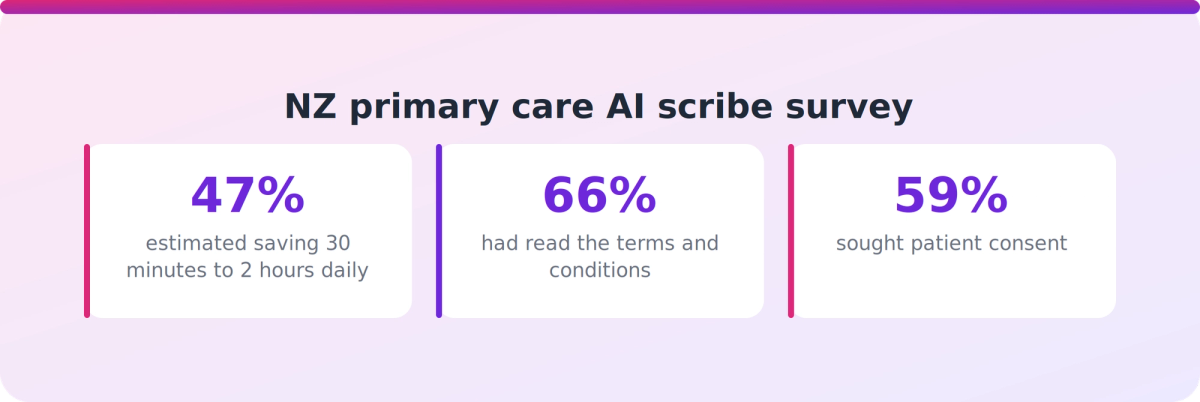
The best NZ primary care evidence is an exploratory survey in the *Journal of Primary Health Care* (Ballantyne et al., published 26 March 2026). It captured use in the first quarter of 2024. Of the respondents, 47% estimated an AI scribe could save 30 minutes to 2 hours a day.
That is useful, and it is also early. It is self-reported, it reflects clinicians' estimates, and it is not a measured before-and-after study. Treat it as a signal worth testing in your own clinic, not a number to put in a business case.
What the same survey says about governance
The survey also showed how loosely some clinics were operating:
- Only 66% of respondents had read the terms and conditions of the tool they were using.
- Only 59% sought patient consent.
The technology worked well enough for people to adopt it. The processes around it were the weak point.
Why don't the emergency department numbers transfer neatly?
The headline figures come from emergency departments. A Hawke's Bay pilot, reported in a Heidi release on 20 November 2025, put documentation time at about 17 minutes per patient falling to just over 4 minutes. It also reported after-shift admin falling by up to 81%.
Those are vendor-reported results from a different clinical setting. Public-system momentum is real, though. Healthcare IT News ANZ reported on 8 March 2026 that about 1,250 emergency clinicians use scribes across all public EDs. BusinessDesk has reported that Health NZ endorsed iMedX and Heidi for trial through the National AI and Algorithm Expert Advisory Group.
A ten-minute ED encounter and a fifteen-minute GP consult with a long-term condition review are not the same documentation problem. Use the ED numbers as indirect evidence that the gains are real. Don't treat them as a forecast for your clinic.
What is actually holding NZ clinics back?
The constraints are mostly not technical. The research points to five.
- Consent. A scribe records a clinical conversation. Patients need to know, and clinics need a consistent way to ask.
- Terms of service. If a third of users haven't read them, many clinics don't know where audio and transcripts go.
- Data residency. The Health NZ supplier panel, described by Health Informatics New Zealand (HINZ) around April 2026, required production data to be hosted in New Zealand or Australia. Creative HQ noted that NZ patient data was on Sydney servers as of late 2025.
- Security assurance. Newsroom reported on 20 March 2026 that researchers bypassed Heidi's guardrails in three prompts.
- Regulatory clarity. On 6 October 2026, NZ Doctor reported University of Auckland researcher Vanessa Selak arguing that scribes sit in an "AI no-man's land". They are treated as administrative tools, she said, but are better regulated as medical devices. NZ Doctor has also reported that a Health and Disability Commissioner (HDC) complaint over AI scribes is "only a matter of time".
The market is shifting too. Medtech AI has been built into Medtech Evolution since 23 February 2026, so clinics may soon be choosing between standalone scribes and tools inside their patient management system. Two things we couldn't confirm: the outcome of the national supplier panel, and any recent scribe-specific guidance from the RNZCGP or the Privacy Commissioner.
What does a governance-first rollout look like?
The Medical Council's position is clear. Doctors remain responsible and must check AI output before it enters the patient record. Practice networks such as Comprehensive Care (webinar, 28 July 2026) point clinics to the Privacy Act 2020, the Health Information Privacy Code 2020, the Privacy Commissioner's generative AI guidance, Health NZ requirements and the HDC Code of Rights.
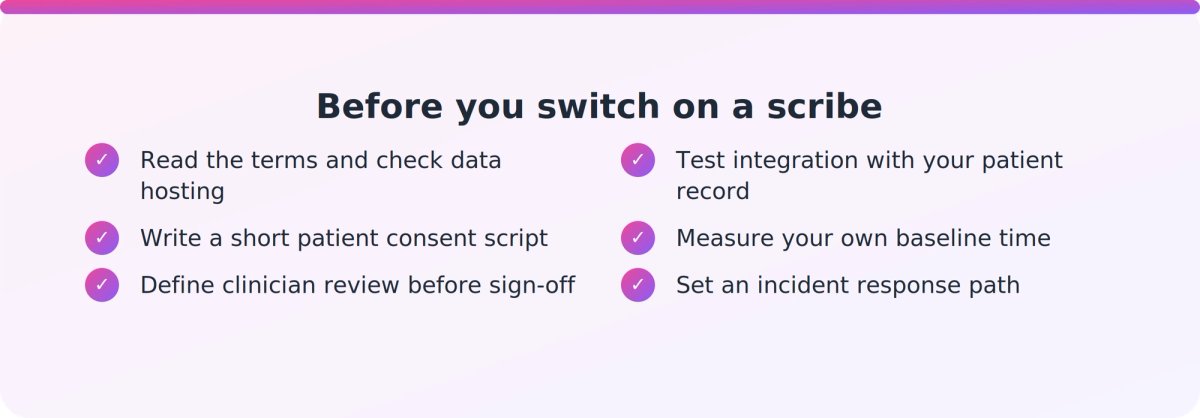
A practical sequence:
- Read the terms. Find out where data is hosted, what is retained and whether it trains models.
- Write a consent script. Make it short, make it routine, and record that consent was given.
- Define clinician review. Decide what "checked" means: every note, before sign-off, with a named responsible clinician.
- Test integration. A scribe that doesn't write cleanly into your existing patient record just moves the admin elsewhere.
- Measure your own baseline. Time a sample of notes before and after. Your clinic's number beats any vendor's.
- Set an incident path. Know what you will do when a note is wrong or a patient objects.
Key takeaways
- The "up to two hours a day" figure is a clinician estimate from an early NZ survey, not a measured outcome.
- The strongest time-saving data is vendor-reported and from emergency departments, so it is indirect evidence for general practice.
- Consent (59%) and terms-of-service awareness (66%) were the weak spots in the NZ survey.
- Data residency, security and regulatory status are unsettled, and they are buyer concerns today.
- Clinician review of every note is the non-negotiable control, and it is also what limits the time you save.
Our take
The debate is framed as "does it save time?" It probably does. The better question is whether a clinic can show, if a patient or the HDC asks, how consent was obtained, where the data went and who checked the note. Clinics that can answer that will keep their savings. Those that can't are borrowing time from a future complaint. We'd also push back on picking tools by demo polish. Fit with your existing workflow and records, and a clear way to measure the hours you reclaim, matter more than the feature list.
If you're weighing a scribe, which would you rather be able to prove first: the minutes saved, or the process behind them?
FAQ
How much time can an AI scribe save a GP in New Zealand?
In a peer-reviewed NZ primary care survey, 47% of respondents estimated savings of 30 minutes to 2 hours a day. These are estimates, not measured results. The strongest measured-style figures are vendor-reported emergency department pilots.
Do GPs need patient consent to use an AI scribe?
Consent is a core expectation under the privacy and patient rights frameworks that practice networks point to, including the Privacy Act 2020, the Health Information Privacy Code 2020 and the HDC Code of Rights. Yet only 59% of survey respondents said they sought it. Clinics should adopt a consistent consent process.
Who is responsible for errors in AI-generated notes?
The Medical Council's position is that doctors remain responsible. They must check AI output before it enters the patient record. A scribe does not shift accountability away from the clinician.
Where must scribe data be stored?
The Health NZ national supplier panel, as described by HINZ around April 2026, required production data to be hosted in New Zealand or Australia. Private clinics should check where any tool they use stores audio and transcripts, as the panel requirement was set for Health NZ procurement.
Are AI scribes regulated as medical devices in NZ?
That is unsettled. NZ Doctor reported in October 2026 that University of Auckland researcher Vanessa Selak argues scribes are treated as administrative tools but should be regulated as medical devices. We did not find scribe-specific guidance from the RNZCGP or the Privacy Commissioner.