RTO growth only forces a matching rise in administrators if your operating model can't carry the extra load. The 2025 Standards and the shift from AVETMISS to the VET Information Standard make the next two to three years a redesign window. RTOs that use it can grow without adding an administrator for every new cohort.
Why this lands on your desk
You own the systems that carry a learner's data from enrolment through delivery to reporting. The VET Information Standard replaces the AVETMISS VET Provider Collection Specifications, and NCVER describes the transition as involving new API-based data reporting technology. That lands on how your systems connect, which is your area.
You also answer for capacity and cost per enrolment. The Skills Insight VET Workforce Project (Stream One) links excessive compliance requirements to reduced efficiency, less viable RTO operations and difficulty attracting workforce. Secondary sources citing Jobs and Skills Australia report teacher shortages in every state and territory. We haven't retrieved the primary JSA document, so treat that as directional. Even so, adding people is neither cheap nor easy.
Then there is evidence. The 2025 Standards commenced on 1 July 2025 and replaced the 2015 Standards. Governance now has its own home in Quality Area 4, rather than sitting under the old Standard 7. The pressure to show that processes work in practice, not just that a policy exists, falls on operations.
The ceiling isn't demand. It's how data and knowledge move.
Most RTOs hit their growth limit in the same place. An enrolment gets re-keyed from a form into the student management system, then into a spreadsheet for funding, then into a board report. Someone knows which exceptions to chase and when. That person is a single point of failure, and every extra enrolment adds to their load.
Growth multiplies whatever you already have. If a reporting cycle eats a week at 800 enrolments, doubling the enrolments doesn't double the week. It breaks the week, and firefighting replaces improvement.
That is why headcount scales in step with enrolments. People are covering for gaps between systems and for knowledge that was never written down.
Clean data at the point of entry is an operations job
NCVER cautions that an AVETMISS-compliant system ensures correctly formatted files but may not check all data values. A certified system can still pass bad data cleanly. Software certification doesn't fix that, because someone has to own the question of who enters what, in which field, and who checks it.
That ownership is process design, and it's the work most worth doing before your transition date.
Know which date is yours
Timelines differ by RTO type, so confirm yours rather than assuming:
- NCVER's key dates list a second-half-2026 start for fee-for-service-only RTOs and SMS suppliers.
- State or territory funded RTO transitions fall in 2027–2028. If you have a state arrangement, follow the date your state training authority advises.
- Other RTOs choose a transition date up to 1 January 2029. The last AVETMISS submission is listed as February 2029.
- The Data Provision Requirements Amendment (Data Streamlining) Instrument 2026 takes effect on 1 October 2026, according to ASQA.
One vendor cites 31 December 2028 as the deadline. Verify that against NCVER before you plan around it. The same vendor claims reporting moves from annual batch to event-based, and that ANZSCO is replaced by OSCA. We couldn't confirm either from primary sources, so put both on your list of questions for NCVER.
Four moves to make before your transition date
These are things you can start this quarter, whatever systems you run.
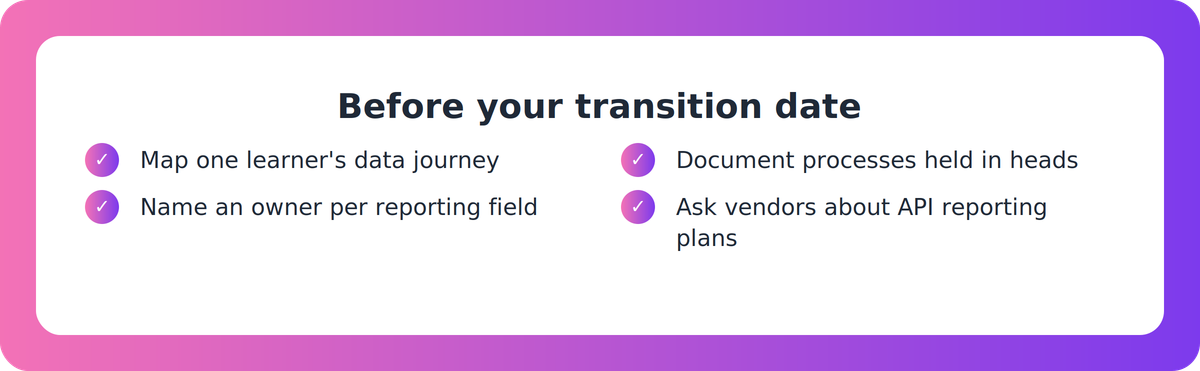
- Map the data journey. Trace one learner from enquiry to completion and note every point where data is typed again. Each re-key is a cost and an error risk.
- Name an owner for every field that feeds reporting. The owner is accountable for accuracy at entry, not for fixing it at submission.
- Write down what lives in heads. Pick the three processes that would stall if one person left, and document them as steps someone else could follow.
- Test your connections before the deadline does. Ask your system vendors in writing what their API-based reporting approach will be and when.
Why hiring your way out is a weak plan
Linear hiring assumes you can find and keep the people. With staff shortages and funding unpredictability cited in the Skills Insight work, that is a fragile bet. It also bakes in the problem, because new administrators learn the workarounds and perpetuate them.
The regulatory picture adds another reason. ASQA's 2026 Environmental Scan lists four interconnected risks:
- provider governance, market conduct and non-genuine operations
- quality, sufficiency and fitness-for-purpose of delivery
- integrity of qualifications and competency outcomes
- transparency and accountability in complex and international delivery models
Secondary attendee notes from the March 2026 ASQA update flagged third-party arrangements, and more so where they go unmonitored. Each of these depends on records you control. A tangle of spreadsheets makes it hard to show you are in control, however many people you hire to maintain it.
Key takeaways
- Growth needs more administrators only when data re-keying and undocumented knowledge are doing the work of process.
- The 2025 Standards (in force from 1 July 2025) and the VET Information Standard make the next two to three years a natural redesign window.
- Your VET Information Standard transition date depends on your RTO type and state arrangements. Confirm it with NCVER or your state training authority; all RTOs must report under it by January 2029.
- NCVER warns that a compliant system can still pass unchecked data values, so accuracy at entry needs a named human owner.
- Treat unverified claims, such as event-based reporting, as questions for NCVER rather than planning assumptions.
Our take
Most RTO leaders treat the VET Information Standard as a compliance deadline to survive. We think that undersells it. The transition forces you to look hard at how data moves through the organisation, and that is the same job as raising capacity per person.
We'd also argue against the instinct to wait for a perfect system and then fix the process. Do it the other way round. Clear ownership, documented steps and one entry point per data item make any system work better, and they make a poor system's flaws visible early.
We don't know how your transition will unfold. The rules are still being clarified, and some timelines are secondary-sourced. But none of that changes the first step. Trace one learner's data from enquiry to report this week, count the re-keys, and ask who owns each one.
FAQ
Does RTO growth really need to mean proportional headcount growth?
No, but it will unless the operating model changes. When staff spend their time re-keying data and chasing exceptions only they understand, each new enrolment adds work in proportion. Fixing data flow and process ownership breaks that link.
When do RTOs have to report under the VET Information Standard?
NCVER states that all RTOs must report under the new standard by January 2029. Fee-for-service-only RTOs and SMS suppliers start from the second half of 2026, and state or territory funded RTOs transition in 2027–2028 on the date their state training authority advises. Confirm your date with NCVER or ASQA.
Is an AVETMISS-compliant system enough to guarantee accurate reporting?
No. NCVER cautions that a compliant system ensures correctly formatted files but may not check all data values. Accuracy depends on how data is captured at entry and who owns each field.
What should a COO prioritise first?
Start with a single learner journey. Map where data is re-entered, name an owner for each reporting field, and document the processes that would stall if one person left. These steps cost little and apply whichever system you use.