AI document processing software uses AI to read, classify and extract data from documents such as invoices and forms. Unlike basic OCR, it interprets context and structure. In NZ, first decide whether you are buying extraction into Xero or MYOB, or generation and validation of regulated documents. They are different purchases.
What is AI document processing software, and how is it different from basic OCR?
Basic OCR turns an image of text into characters. Intelligent document processing (IDP) goes further. One NZ AWS consultancy, apiconnects.co.nz, describes it as using AI and machine learning to extract, interpret and use data while understanding a document's context and structure. Note that is a vendor's description.
Gartner's 2025 Magic Quadrant, its first for IDP solutions, lists the typical components:
- Data preprocessing, including document classification
- Extraction from images, text and multilingual content
- Review of extracted data, with automated and human-in-the-loop checking
Gartner describes a market of more than 100 vendors, some from adjacent markets. The full reports are paywalled and we haven't verified the scoring detail. Gartner also doesn't test NZ-specific needs such as data residency or Xero and MYOB integration, so treat it as a map of the category, not a shortlist.
Which job are you actually buying for?
This is the question that saves the most time. "Document processing" covers two quite different jobs.
Extraction. Documents come in (supplier invoices, forms, PDFs) and structured data goes out into Xero, MYOB, Cin7 or an ERP. The goal is less manual keying. NZ providers in this space include Automate AI in Wellington, Flex Consulting (built on UiPath, with Microsoft AI Builder listed), Kiwi Systems (advertising ABBYY Vantage with Xero and MYOB integration) and DocSmart (built on M-Files).
Generation and validation. The software helps produce complex documents in regulated work, then checks them against requirements. Think assessment resources mapped to standards, compliance reports, or technical reports. The output needs a qualified person's judgement, an audit trail and approvals.
A packaged extraction tool won't do the second job well. A custom build is usually overkill for the first.
How do you compare NZ options when accuracy and pricing claims are vendor-reported?
All the NZ accuracy and pricing figures we found are self-reported. Automate AI, for example, claims 95%+ accuracy and pricing from $299/mo + GST. That may well hold for its customers. But we found no independent NZ benchmark or NZ-specific accuracy certification, so treat any headline figure as unverified until you've tested it on your own documents.
A proof-of-concept checklist
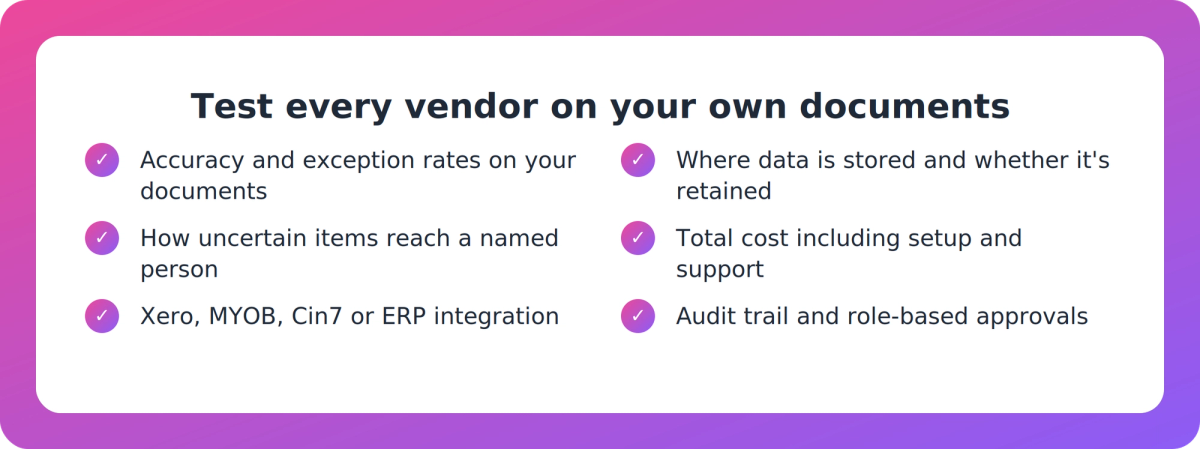
Run every shortlisted option against the same sample set: real GST invoices, local forms, awkward scans. Then weigh:
- Accuracy and exception rates on your documents, not the demo set.
- Human-in-the-loop quality. How are uncertain items flagged and routed? Does a named, accountable person approve outputs? Common NZ vendor themes are that only uncertain items go to a person, and one regional council case study from Changeable describes people retaining judgement and accountability.
- Integration with Xero, MYOB, Cin7, your ERP or your document management system.
- Data handling. Where is data processed and stored? Does the vendor retain it or train on it? How does breach notification work?
- Pricing and total cost. Per month, per page or per project, plus setup, integration and support.
- Audit trail, version history and role-based approvals, if outputs feed compliance or assessment work.
What do the Privacy Act 2020, OPC guidance and IPP 3A mean for you?
The Privacy Act 2020 is administered by the Office of the Privacy Commissioner (OPC). Invoices, applications and HR documents routinely contain personal information, so software that ingests them is squarely in scope.
The OPC published "Artificial intelligence and the Information Privacy Principles" on 21 September 2023, building on its May 2023 generative AI guidance. Law-firm summaries say it expects senior leadership approval, privacy impact assessments, transparency, human review for decisions affecting people, and no retention or disclosure of personal information by AI providers without a lawful basis. We couldn't retrieve the OPC site directly, so confirm the wording at privacy.org.nz. A secondary source says the principles apply even when the tool comes from an overseas provider.
There is also something newer. IPP 3A, on indirect collection, came into force on 1 May 2026 under the Privacy Amendment Act 2025 (Ministry of Justice). Ingested documents often contain personal information about people other than the sender, such as an employee named in a supplier's paperwork. Whether your workflow triggers IPP 3A depends on the facts, so take legal advice. HGM Legal notes that an agency acting solely as a service provider for another agency doesn't carry the principal's IPP 3A obligation, because the principal remains responsible under section 11. Ask any vendor which role they play.
For supplier due diligence, MBIE's voluntary Responsible AI Guidance for Businesses (released 8 July 2025 alongside NZ's first AI Strategy) is a sensible reference. A secondary summary says it covers governance, data, procurement, security, stakeholder engagement and generative AI. NZ has no AI-specific statute, and the guidance is non-binding. It's a checklist, not a requirement.
If a product does face matching on ID documents, the Biometric Processing Privacy Code 2025 may also matter. Check the OPC original.
When does a custom-built AI application make more sense than an off-the-shelf tool?
Off-the-shelf extraction wins when the documents are standard, the destination is Xero or MYOB, and speed to value matters. Choose custom when the job is generating, validating or auditing documents against specific requirements, and no packaged product matches your workflow.
Supahuman's AI Studio is one such option. Its sites describe custom AI applications for complex, regulated work such as document generation, compliance validation and insights analysis, built with the client and then run as a managed service. To be clear about the fit: the sites don't describe it as an invoice, OCR or form-field extraction product, and they state no confidence scoring, ERP integrations, accuracy rates or per-page pricing. If you want packaged invoice extraction, look elsewhere.
VETos is the productised result of one custom build, the Mast Intelligence course engine. It drafts NZQA-aligned assessment tools, assessor guides, learner guides and mapping, with role-based review and approval, version history and an audit trail. The AI assists. Qualified people stay accountable for validating every output. For NZ training providers, the AI Studio page also lists bespoke workflows VETos doesn't cover yet, such as enrolment-to-completion automation, compliance reporting and RPL.
Two caveats. The sites say builds run under ISO 27001-aligned and NZISM-aligned controls, hosted on AWS Australia. Weigh that against your own data residency requirements. And customer outcomes, such as Mast's 80% cut in authoring effort and Soil & Rock's geotechnical report drafting dropping from around ten hours to twenty minutes, are vendor-reported and not independently verified.
Key takeaways
- Decide first whether you need extraction (invoices and forms into Xero or MYOB) or generation and validation of regulated documents. They're different purchases.
- NZ accuracy and pricing figures are vendor-reported. Run a proof of concept on your own documents before trusting any number.
- Keep a named person accountable for uncertain items and for any output that feeds compliance work.
- Check Privacy Act 2020 obligations, the OPC's AI guidance and IPP 3A (in force since 1 May 2026), and take legal advice on your specific workflow.
- Use MBIE's voluntary Responsible AI Guidance for supplier due diligence, and ask where your data is processed and stored.
Our take
Most buyers start with a vendor comparison and should start with a job description. If you can't say in one sentence whether you're extracting data or producing validated documents, any demo will look impressive and tell you little. We'd also push harder on privacy than most buyers do. Decide who is accountable under the Privacy Act before you sign, not after the first awkward invoice.
FAQ
What is AI document processing software, and how is it different from OCR?
It uses AI and machine learning to classify documents, extract data and interpret context and structure. OCR only converts images of text into characters. Most IDP tools also include review of extracted data, with automated and human-in-the-loop checking.
How should I compare NZ document processing vendors?
Test each on the same sample of your own documents, such as GST invoices and local forms. Measure accuracy and exception rates, how uncertain items are routed to a person, integration with Xero, MYOB or Cin7, data handling and total cost. Vendor accuracy and pricing claims are self-reported.
Does IPP 3A apply to software that ingests invoices and HR documents?
Possibly. IPP 3A on indirect collection came into force on 1 May 2026, and ingested documents often contain personal information about people other than the sender. It depends on the facts, and a service provider acting solely for another agency may not carry the principal's obligation, so take legal advice.
When is a custom AI build better than an off-the-shelf tool?
When the job is generating, validating or auditing regulated documents against specific requirements and no packaged product fits. For standard invoice or form extraction into Xero or MYOB, an off-the-shelf IDP tool is usually the more practical choice.