AI Strategy for Training Providers NZ: A CEO's P&L Filter
Most AI proposals that reach a PTE chief executive are judged on how impressive they look. Judge them on the P&L instead. In 2026, cost, risk and scrutiny are moving onto providers, so an AI idea earns budget only if it cuts a named cost line, lowers audit or key-person risk, or protects funded-provision outcomes.
Why this lands on your desk
You own the margin, and 2026 adds pressure to it. The Private Training Establishment Rules 2026 came into force on 19 January 2026. They replace the PTE Registration Rules 2025 and the PTE Enrolment and Academic Records Rules 2022, and they remove the annual fee (NZQA). That is welcome, but it is one small relief in a year of shifting costs.
You also answer for regulatory standing and funding. TEC's Plan Guidance for 2026 says it is difficult to justify funding teaching that does not lead to a pipeline of graduates entering in-demand or priority work. Its supplementary guidance says TEC will consider the poorest-performing provision in funding decisions.
And you decide where a scarce technology budget goes while the system is still settling. That is exactly when a vendor demo is most persuasive and least useful.
Where 2026 moves cost and risk onto providers
Three changes matter most to a chief executive. None is an AI story, but each defines what AI should be pointed at.
A possible new line for moderation
The Workforce Development Councils were disestablished on 31 December 2025. Eight Industry Skills Boards (ISBs) now lead standard-setting, qualification development and, temporarily, work-based training management. TEC's consultation document says ISBs can charge providers such as PTEs for activities like moderation, and TEC says ISBs will have lower government funding.
That is a possible new cost line, not a confirmed one. Model it now, and ask how many staff hours sit behind each moderation cycle in your organisation.
Work-based learning landing with providers
TEC expected work-based learning to move from ISBs into providers during 2026 for many industry sectors. Its work-based learning page names funded PTEs such as NZMA/Builders Academy, Skills Group, NZSE and St John.
More learner tracking and employer coordination probably means more administration. The research does not quantify it, so don't let anyone hand you a figure. Work out your own.
Scrutiny of outcomes and viability
TEC's 2026 Funding Conditions Catalogue requires PTEs to take part in financial viability assessments when asked, and to provide an acceptable action plan if rated high risk. TEC will monitor compliance with conditions, Investment Plan commitments and delivery against minimum requirements.
Cost per student and a single view of performance are now regulatory concerns as well as management ones. If you can't produce them quickly, that is the exposure.
One caution on reporting. Non-funded PTEs now provide annual financial returns every two years unless NZQA directs otherwise, and TEC-funded PTEs aren't required to submit these statements to NZQA (PTE Rules 2026). The rules cut one reporting burden. They don't cut your need for good management information.
A three-question filter for any AI proposal
Put every proposal through the same three questions before it gets a budget line.
- Which named cost line falls, and by roughly how many hours or dollars? "Productivity" is not a cost line. Moderation preparation, enrolment processing or evidence collation are.
- Does it lower key-person or audit exposure? If one compliance manager is the only person who knows where the evidence lives, anything that makes that knowledge visible and repeatable is worth a look.
- Does it help us see, evidence and improve learner outcomes? In a funding round that weighs the poorest-performing provision, that is the question TEC is effectively asking you.
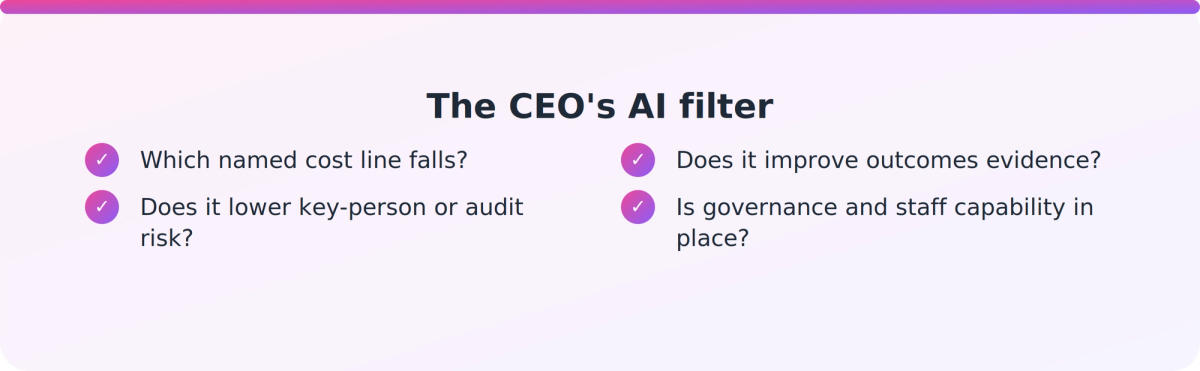
If a proposal answers none of the three, it is staff-facing novelty. It might be pleasant, and it can wait.
Governance and staff capability come first
The first AI decision is not a purchase. NZQA's academic integrity guidelines recommend four policy elements: uphold, prevent, detect and respond. They cover generative AI use and call for clear policy on which detection tools staff may use, plus support in using them. NZQA also encourages providers to help staff understand how generative AI can be used in teaching, learning and assessment.
So before you fund anything, check that your academic integrity policy addresses generative AI, that staff know which tools are sanctioned, and that someone owns the response when a case is detected. This costs little, and it is what an auditor will ask about.
Build your own baseline first
Here is the honest gap. The research found no authoritative sector-wide PTE margin or cost-per-student benchmark, and no data on AI adoption among New Zealand PTEs. Anyone quoting you a confident industry figure is borrowing it from somewhere else.
So make your own. For a fortnight, have the people who run moderation, enrolment, learner tracking and reporting record where their hours go. Pair that with your cost per student by programme. Now every AI proposal has something to be measured against, and you will know within a quarter whether it moved anything.
Key takeaways
- Use the P&L as your AI filter: a named cost line, key-person or audit risk, or funded-provision outcomes.
- ISBs can charge providers for activities like moderation, and ISB government funding is lower, so model it as a possible new cost.
- Work-based learning is expected to move to providers during 2026, probably adding administration you should measure rather than guess.
- TEC will weigh outcomes, pipeline and financial viability, so cost per student and a single performance view are regulatory concerns.
- NZQA puts AI governance and staff capability first. Policy before purchasing.
- No reliable PTE margin or AI adoption benchmarks exist, so build your own baseline.
Our take
The biggest AI risk for a PTE in 2026 is not missing out. It is spending scarce discretionary money on something that looks modern and changes no number the board or TEC cares about.
We think the sensible posture is deliberately unglamorous. Fix governance, measure your own hours, then back the narrow uses of AI that take time out of compliance and outcomes evidence. Everything else can wait without costing you a thing. Waiting for the system to settle is a strategy, as long as you spend the time building your baseline.
FAQ
What is the best filter for evaluating AI proposals in a PTE?
Ask whether the proposal reduces a specific cost line, lowers key-person or audit risk, or strengthens evidence of learner outcomes. If it does none of these, it is a low priority however impressive the demo.
Will Industry Skills Boards really charge PTEs for moderation?
TEC's consultation document says ISBs can charge providers such as PTEs for activities like moderation, and that ISBs will have lower government funding. Treat it as a possible new cost line and model it, rather than assuming a figure.
What does NZQA expect from PTEs on generative AI?
NZQA's academic integrity guidelines recommend four policy elements (uphold, prevent, detect, respond), cover generative AI use, and call for clear policy on which detection tools staff can use, with support for using them. NZQA also encourages helping staff understand how generative AI can be used in teaching, learning and assessment.
Is there a benchmark for PTE margin or cost per student I can compare against?
The research found no authoritative sector-wide benchmark for either, and no data on AI adoption among New Zealand PTEs. Build a baseline from your own time and cost data instead.
Here is a first step for this week. Pick one back-office process that you suspect is eating hours, ask the team to log the time for two weeks, and put a dollar figure beside it. That figure is the bar any AI idea has to clear.