Assessment Consistency in RTOs: A Head of Training's Guide
Assessment consistency rarely fails because one trainer is careless. It fails because two capable trainers, working the same cohort, the same unit of competency and the same assessment tool, make slightly different judgements, and the RTO can't show how it noticed. Under the Standards for RTOs 2025, that gap is yours to close.
Key takeaways
- Inconsistency between trainers is a design problem across tools, allocation, moderation and validation. It isn't a matter of individual diligence.
- Consistency has to be built in before the first learner is assessed. Validation can confirm it but can't create it.
- No public ASQA figure isolates inconsistency between trainers, so treat it as a recognisable risk and not a measured audit rate.
- Trainer allocation under Standard 3.2 is a compliance decision as well as a rostering one.
- A five-yearly validation event is the floor. Everyday calibration is what holds up when an auditor asks how you'd know.
Why this lands on your desk
You own the trainers, the training and assessment strategies and the quality of assessment judgements. When two trainers assess one cohort differently, the exposure sits with your delivery team, whatever the paperwork says.
ASQA's Corporate Plan 2026-27 names embedding the 2025 Standards as its most significant regulatory priority. Its risk priorities include the quality and fitness-for-purpose of training delivery and the integrity of qualifications and competency outcomes. Inconsistent judgements are most visible in exactly those areas.
What the Standards for RTOs 2025 ask of your assessment system
The 2025 Standards replaced the 2015 Standards on 1 July 2025, according to Vivacity's comparison. The Outcome Standards cover 23 standards across four quality areas, including training and assessment and the VET workforce, per this summary from Training Services. Three requirements matter most here.
- Tools reviewed before use. eSkilled's comparison places this under Standard 1.3. The implication is that consistency starts when a tool is approved, not when it's audited.
- Validation by suitably skilled people. Standard 1.5 is quoted as requiring an assessment system quality assured by appropriately skilled and credentialled persons, through regular validation of assessment practices and judgements (Training Services). Secondary sources say each training product must be validated at least once every five years, and more often where risk, change or feedback indicate a need.
- Credentialled assessors only. Standard 3.2 limits training and assessment to people holding the credentials in the Credential Policy. Where someone delivers under direction, the RTO needs systems to ensure they don't make assessment judgements.
These are secondary readings. Check the wording against the legislative instruments (F2025L00354 and F2025L00355) before you build procedures on them.
What the audit evidence does and doesn't show
No ASQA statistic we could find isolates inconsistency between trainers teaching the same cohort. Anyone quoting an audit rate for it is guessing.
What exists is adjacent. Secondary reporting of ASQA data says 221 of 284 performance assessments (78%) in 2024-25 found non-compliance. The most common areas were training and assessment strategies and practices (1.1-1.2), conducting effective assessment (1.8), and trainer and assessor employment (1.13 and 1.16), all 2015 clause numbers. From July 2025 to March 2026, 45 of 116 (39%) found non-compliance.
Don't read that drop as a trend. The two periods fall under different standards. Verify the figures against ASQA's own reporting before you put them in a board paper.
The defensible conclusion is modest. Assessment practice stays a frequent area of non-compliance, and clause 1.8 (2015) is the closest public category to the risk you manage. Consultant commentary from VET Resources adds that RPL draws heavy scrutiny because it demands consistent, evidence-based decisions across assessors.
Where consistency slips in a stretched team
Consistency erodes when teams are thin. A JSA 2024 study, reported secondarily by Learn TAE, estimates about 223,000 people in the VET workforce, including roughly 32,000 VET teachers, with teachers in shortage nationwide for two years. Check JSA directly before quoting it. Industry Skills Australia reports a significant shortage of Teach, Train and Assess professionals in regional, rural and remote areas.
The practical result is cover trainers, sessional assessors and mid-term handovers. Each one is a new calibration point. Nobody did anything wrong, but the cohort now has three people's judgement in it.
An illustrative example
This one is hypothetical. Two trainers assess the same cohort on a knowledge question requiring a described workplace procedure. Trainer A accepts a correct answer in the learner's own words. Trainer B expects the unit's terminology and asks for a resubmission.
Both judgements are defensible. Neither trainer broke a rule. But the learners received different outcomes from one tool, and at audit you'd need to show where the RTO decided what an acceptable answer looks like. If the answer is "in each trainer's head", the tool wasn't ready.
Five things to build into delivery this quarter
- Pre-use tool review with marking guidance. Require benchmark answers and examples of unacceptable responses before a tool goes live, not after the first complaint.
- Calibrate before the cohort starts. Have every assessor mark the same two or three samples, and record where they diverged and what you decided.
- Treat allocation as a compliance decision. Where a cohort is split across trainers, note who makes judgements and who delivers under direction, in line with Standard 3.2.
- Sample mid-delivery, not only at the end. Pull a few marked submissions per assessor while a cohort is running, when a correction can still reach learners.
- Feed findings back into validation. Where moderation turns up a recurring ambiguity, treat that as the feedback that brings a validation forward, rather than waiting for the five-year point.
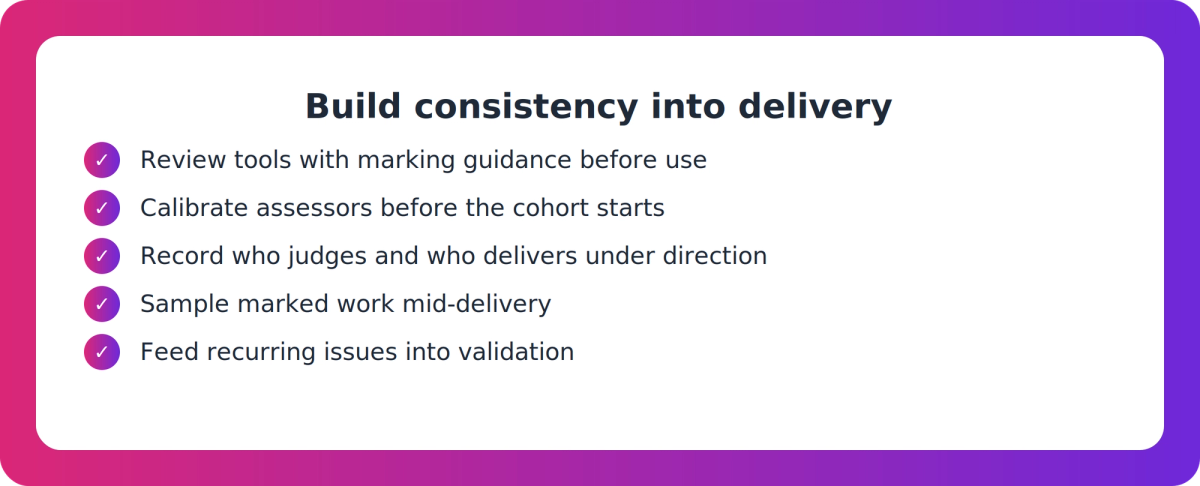
The common thread is evidence of a decision. An auditor can't see consistency, but they can see a record of divergence found and resolved.
Our take
Most Heads of Training already know validation matters. The harder point is that validation, run as a periodic event, answers the wrong question. It asks whether the system was sound over a period. It doesn't tell you whether Tuesday's marking matched Thursday's.
We think the better stance is to assume divergence exists and to make finding it routine and unremarkable. A team that logs small disagreements openly is safer than one that reports none. If your records show no calibration gaps at all, that's a reason for more scrutiny, not comfort.
FAQ
Does ASQA publish how often inconsistency between trainers causes non-compliance?
No public ASQA statistic found isolates it. Clause 1.8 of the 2015 Standards (conducting effective assessment) is the closest public category. Frame consistency as a recognisable risk and don't quote an audit rate.
How often must assessment be validated under the Standards for RTOs 2025?
Secondary sources say every training product must be validated at least once every five years, and more often where risk, change or feedback indicate a need. Confirm the exact wording in the Standards themselves.
What does Standard 3.2 mean for rostering one cohort across several trainers?
Only people holding the credentials in the Credential Policy can make assessment judgements. Where someone delivers under direction, the RTO needs systems to ensure they don't make those judgements, so allocation records matter.
Is validation enough to demonstrate consistency?
Not on its own. The Standards also call for tools to be reviewed before use, so a validation event after the fact can't be your only evidence. Pre-use review, calibration records and mid-delivery sampling show consistency being managed continuously.
A first step this week
Pick one unit with more than one assessor. Pull two marked submissions from each and compare them against the tool's marking guidance. If you can't explain every difference from the paperwork alone, you've found where to start.