RTO Compliance Software: What Helps Meet the 2025 Standards
No regulator defines or endorses RTO compliance software, so the right tool depends on the job you need done: governance and evidence tracking, a student management system with compliance modules, or assessment mapping and resource development. Whichever you choose, it should reflect the enforceable Standards for RTOs 2025 and produce evidence of practice, with qualified staff still signing off.
Key takeaways
- Decide which job you need done before comparing vendors. Governance tracking, student management and assessment mapping solve different problems.
- ASQA does not endorse, accredit or require any software. We found no public independent benchmark either, so treat feature lists as vendor claims until you test them.
- The 2025 Standards reward demonstrable outcomes. A tool that only stores policies does not show practice; look for evidence trails and audit logs.
- Ask how fast each vendor updates after changes such as the 10 December 2025 Credential Policy update, and whether Standard references stay unambiguous.
- Where AI is involved, it should assist qualified assessors and compliance staff, who still review, validate and sign off.
What kinds of RTO compliance software are there?
Vendor descriptions fall into at least three types. All of them are vendor statements, not regulator definitions.
- Governance, risk and validation platforms. Standalone tools such as RTO Radar and RTOSafe. Advertised features include evidence mapping to the Standards hierarchy, risk registers mapped to clauses, risk-based validation scheduling, trainer credential and PD expiry tracking, and board or CEO compliance reports.
- Student or learning management systems with compliance modules. eSkilled is one example. The compliance sits inside the system that already holds enrolments and learner records.
- Assessment-mapping and resource-generation tools. These help you build or update assessment tools and learning resources and trace them back to units of competency and standards.
Most RTOs have a gap in one of these areas, not all three. Naming the gap first stops you buying a broad platform to fix a narrow problem.
Does ASQA endorse any compliance software?
No. We found no ASQA endorsement of software, and no public certification, standardised evaluation framework or independent benchmark for this category. Feature claims mostly come from the vendors themselves.
That shifts the work to you. Run any shortlisted tool against your own scope, your own data and your own audit questions in a demo.
What do the 2025 Standards mean for the tool you buy?
The 2025 Standards for RTOs took effect on 1 July 2025 and are enabled by the National Vocational Education and Training Regulator Act 2011. They have three components: the Outcome Standards, the Compliance Requirements and the Credential Policy. ASQA's Melinda Cox has said all three are enforceable, while DEWR notes the policy documents present the Standards in an accessible format and do not themselves impose legal obligations, with the legislative instruments on the Federal Register. Check any tool against the instruments, not just a vendor summary.
ASQA says the Standards focus on the quality of outcomes for students and employers and give providers more flexibility in how they demonstrate compliance. A policy library alone won't show practice. You want software that captures what you did, when, who signed off and what changed as a result.
Two more things to test:
- Updates. Skills Education reports the Credential Policy was updated on 10 December 2025, and a Standard reference can now point to either an Outcome Standard or a Compliance Standard. Ask how the vendor keeps references unambiguous.
- Transition. ASQA's legacy site says regulatory activity that began under the 2015 Standards and continues past 1 July 2025 may require additional evidence against the 2025 Standards. A tool should cope with that overlap.
What should you check before buying?
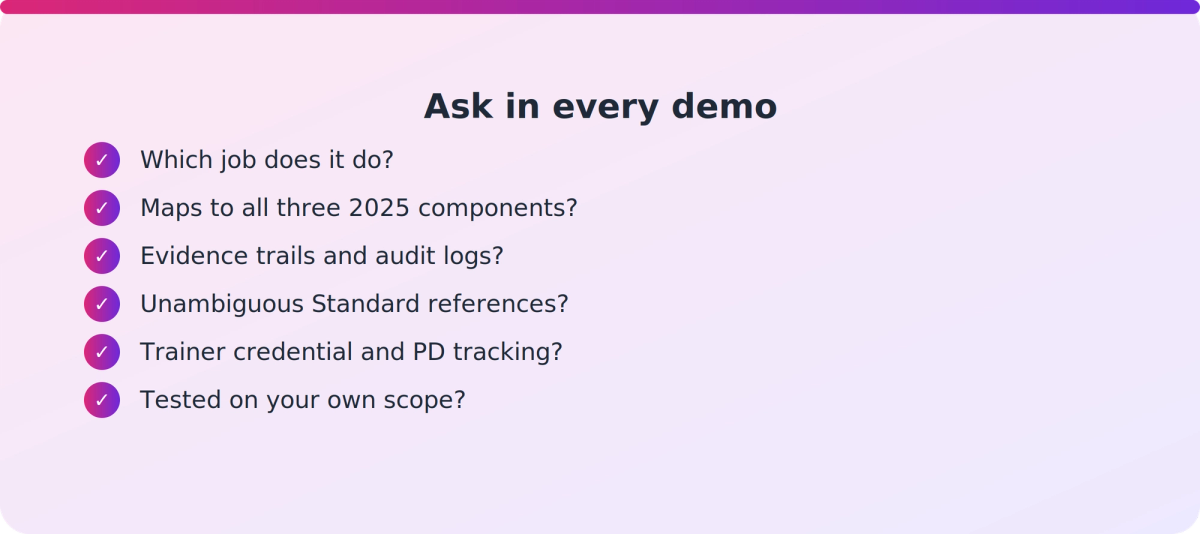
Use these questions in every demo. Ask the vendor to show answers, not describe them.
- Which job does it do? Governance and risk, student management, or assessment mapping? Be wary of a vendor claiming all three equally well.
- Does it map to all three 2025 components, and how quickly does it update after regulatory changes?
- Does it produce evidence trails and audit logs that show practice and outcomes, not just stored documents?
- Are Standard references unambiguous? Ask to see how an Outcome Standard and a Compliance Standard with the same number are told apart.
- Does it support trainer credential and PD tracking and risk-based validation scheduling?
- For mapping tools: does it trace requirements through to assessment tasks, use current training.gov.au data and flag superseded units?
- Data and integration. Where is data hosted, what security controls apply, and does it integrate with your existing student or learning management system?
- Pricing and testability. Is pricing transparent, and can you test claims on your own scope?
A worked example (illustrative)
Say an RTO's trainer credentials sit in a spreadsheet, and its validation schedule lives in one coordinator's head. Its gap is governance tracking, so a risk and validation platform is the logical category to demo. A new student management system wouldn't touch that gap. The test is simple: ask the vendor to load your validation plan and show the evidence trail for one completed validation.
How do you keep AI assistive, not decisive?
AI can speed up drafting, mapping and checking. It cannot be accountable. Qualified assessors and compliance staff should review, validate and sign off every output, and the tool should make that review visible.
Ask whether reviewer actions are logged, whether outputs are editable before use, and whether the tool's use can be recorded in your risk register. One secondary source, CAQA, suggests recording AI tools in the risk register. We did not verify any ASQA statement on AI, so don't assume one exists.
Where does Supahuman's VETos fit?
VETos is mainly an assessment-mapping and resource-generation tool. It is not a governance or risk register platform. Supahuman says it generates assessment tools, learner guides, study guides, SCORM packages and training and assessment strategies, each mapped back to the relevant unit and standard. It also says it flags superseded units and supports re-mapping existing tools with the version trail intact. These are self-reported claims, so test them on your own scope.
Supahuman's VETos FAQ says it does not remove professional judgement from the loop. For work VETos doesn't yet cover, such as AVETMISS and compliance reporting or RPL at scale, Supahuman offers a custom-build AI Studio service. We found no Australian RTO case study or independent verification for it, so ask for references. Also note that customaistudio.io is a separate general AI consultancy, so confirm which "Custom AI Studio" you're evaluating.
Our take
Buy against a named gap, not a Standards acronym. The 2025 Standards ask RTOs to show outcomes, so the most valuable software is whatever makes your evidence easier to produce and your people easier to hold accountable. We'd also trust a vendor more if it welcomes a demo on your own messy data. Without independent benchmarks, that is the best test you have.
FAQ
What kind of software actually helps an RTO meet the Standards for RTOs 2025?
Three categories: governance, risk and validation platforms; student or learning management systems with compliance modules; and assessment-mapping or resource-generation tools. The best fit depends on where your compliance gap sits. Whichever you choose, it should reflect the enforceable 2025 instruments and produce evidence of practice.
Does ASQA endorse, accredit or require any particular compliance software?
No. We found no ASQA endorsement of software, and no public certification or independent benchmark for this category. Feature claims largely come from vendors, so test them against your own scope.
What should I check before buying a tool that claims to map to the 2025 Standards?
Check that it covers the Outcome Standards, Compliance Requirements and Credential Policy. Ask how it handled the 10 December 2025 Credential Policy update, whether Standard references are unambiguous, and whether it produces evidence trails and audit logs, not just stored documents.
If a tool uses AI, how do I keep decisions with qualified staff?
Make sure qualified assessors and compliance staff review, validate and sign off every output, and that the tool logs those actions. Record the tool's use in your risk register. AI assists accountable people and does not replace them.
Next step
Before you book a demo, write down your single biggest compliance gap and the three pieces of evidence you'd want to produce for it. Bring those to every vendor. If assessment mapping is your gap, you can see how VETos approaches Standards for RTOs 2025 compliance and compare it with other options.