Data Sovereignty AI Australia: Two Costly Assumptions
Two assumptions trip up most Australian AI deployments. One is that an Australian cloud region makes data sovereign. The other is that a human sign-off keeps a tool outside the Privacy Act's new automated decision-making rules. Law-firm summaries of the OAIC's guidance say neither holds from 10 December 2026, and accountability stays with you.
Key takeaways
- From 10 December 2026, privacy policies must disclose automated decision-making (ADM) that uses personal information and could affect people's rights or interests. Human sign-off doesn't exempt a tool.
- "Australian region" is a hosting fact, not a sovereignty guarantee. Foreign-parent legal exposure, logs, backups and telemetry can all sit outside it.
- APP 8 and s16C keep the Australian entity accountable for overseas recipients. A vendor's terms of service don't transfer that accountability.
- Tranche 2 (a controller/processor split) is still an exposure draft, not law. Review vendor contracts now anyway.
- Start with an audit of every tool involved in decisions, including embedded and third-party AI.
What actually changes on 10 December 2026?
A new transparency duty under APP 1.7 to 1.9 takes effect. APP entities that use personal information in ADM with the potential to affect rights or interests must say so in their privacy policies. They also need to describe the kinds of personal information used and the kinds of decisions made, according to Maddocks' summary of the OAIC guidance.
Maddocks also reports that the OAIC can now issue infringement notices for certain APP 1 privacy policy deficiencies. Its advice for entities in doubt is to take a cautious approach and include the APP 1.8 information.
A caveat on evidence: the OAIC's final guidance page couldn't be opened during our research. What follows relies on law-firm summaries, so read the primary document yourself. None of this is legal advice.
Mistake one: "We use the Sydney region, so we're sovereign"
Is hosting in Australia the same as sovereignty? No. Location answers where data sits. Sovereignty asks whose law can reach it and where it travels.
Three gaps come up repeatedly in the sources:
- Foreign-parent exposure. AusGPT (vendor commentary) argues that data held in Australia by a US-headquartered provider isn't, by itself, beyond US legal process. That's the CLOUD Act point.
- Everywhere data can land. Automata AI (also vendor commentary) says real sovereignty covers prompts, outputs, logs, caches, backups and telemetry, not just the primary database.
- No blanket onshore rule. Sprintlaw notes there's no general requirement to store data onshore. But any cross-border disclosure triggers APP 8.
So the right question isn't "is it onshore?" It's "what leaves, who can compel it, and did we take reasonable steps first?"
Mistake two: "A human signs off, so it isn't automated"
Does human review take a tool out of scope? Not according to the guidance summaries. Allens says the requirements extend well beyond truly "automated" or AI-driven decisions.
The definition of "computer program" is also wide. Per the summaries, it's read broadly enough to take in spreadsheets and rules engines, and generative AI tools, including chatbots, are in scope.
Off-the-shelf tools aren't safe either. Holding Redlich says an entity needn't control or customise a program's decision parameters to attract the obligation.
*Illustrative example:* a training organisation that is an APP entity uses a chatbot to triage enrolment enquiries, and a staff member approves the outcome. That staff sign-off doesn't obviously take the chatbot out of the picture. The tool still influenced a decision about a person, so it belongs in the audit.
Why can't the vendor contract carry the risk?
Under APP 8, an entity must take reasonable steps before disclosing personal information to an overseas recipient. Under s16C it can remain accountable for what that recipient does, as AusGPT explains.
Amaze adds the practical sting: a privacy clause in a vendor's terms of service doesn't transfer legal accountability. The contract can allocate cost and indemnity. It can't move your obligation to your customers or students.
What's coming next: Tranche 2
The Privacy Amendment (Personal Data Protection) Bill 2026 exposure draft, released 31 August 2026, is not law. Its proposed controller/processor framework would reallocate privacy responsibilities between businesses and AI service providers, with implications for outsourcing, cloud, SaaS and AI contracts.
Gadens reports that the Government intends to legislate before the end of 2026. It also reports that the draft omits mandatory privacy impact assessments and has no standalone AI-specific obligations beyond ADM transparency.
Sovereign-compute policy is a separate track. The March 2026 national expectations for data centres and AI infrastructure developers cover data sovereignty, but don't apply to small-scale edge or on-site enterprise data centres. The PM&C consultation paper points toward standards for large data centres. Neither is aimed at ordinary enterprise deployments.
How do you audit before December?
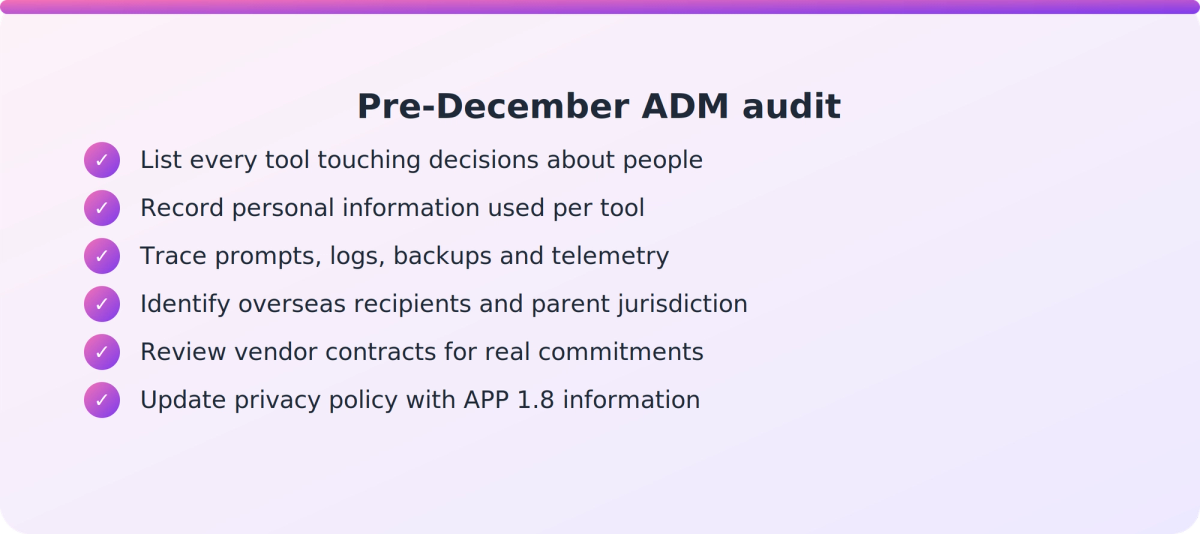
Allens recommends an ADM audit that maps all computer programs and internal processes used in decision-making, including third-party tools and embedded AI products. A workable sequence:
- List every tool that touches a decision about a person. Include spreadsheets, rules engines, chatbots, CRM scoring and AI features embedded in software you already pay for.
- Record the personal information each tool uses and the kind of decision it informs.
- Trace the data flows. Note prompts, outputs, logs, backups and telemetry, and where each is stored or sent.
- Identify overseas recipients and the parent company's jurisdiction. Document the reasonable steps you took under APP 8.
- Read vendor contracts for what they actually promise on subprocessors, retention and data location. Flag gaps for a Tranche 2 world.
- Update the privacy policy, including the APP 1.8 information, and set a review date.
Our take
Most businesses will treat 10 December as a privacy-policy rewrite. The harder job is knowing what your tools do with personal data, and many organisations can't yet say. We think the sensible move is to map the tools first and write the policy second. Treat "sovereign" as a claim to test rather than a feature on a vendor's spec sheet. Custom-built or tightly scoped systems are easier to explain and audit than a stack of opaque embedded features, though they still need the same scrutiny.
FAQ
Does the ADM transparency duty apply if a human makes the final decision?
Possibly, yes. Allens says the requirements extend well beyond truly automated or AI-driven decisions, so human sign-off doesn't take a tool out of scope. Check the guidance and get legal advice for your situation.
Is hosting AI in an Australian cloud region enough for data sovereignty?
No. Location doesn't settle foreign-parent legal exposure, or where logs, backups and telemetry end up. Sprintlaw notes there's no blanket onshore storage rule, but cross-border disclosure triggers APP 8.
Can a vendor contract shift Privacy Act accountability to the vendor?
Not fully. Under APP 8 and s16C, the Australian entity can remain accountable for overseas recipients. Amaze notes that a privacy clause in a vendor's terms doesn't transfer legal accountability.
Is the Tranche 2 controller/processor split law yet?
No. It's in an exposure draft released 31 August 2026. Gadens reports the Government intends to legislate before the end of 2026, so contract reviews are worth starting now.
Next step
This week, pick one workflow that influences decisions about people, such as enrolments, hiring or credit, and trace every tool and data flow behind it. If you can't draw that map in an hour, you've found where to start.