New Zealand manufacturers are buying robots and talking about AI, yet rostering, timesheets and labour costing often still live in spreadsheets. The headline numbers hide this: 91% of larger organisations use AI, but only 4% say it has transformed core operations. The gap is data foundations and decision clarity, not enthusiasm.
Key takeaways
- "We use AI" and "AI changed how we run the business" are very different claims. The survey data shows a wide gap between them.
- Manufacturers are investing in machines and sensors while the people-and-cost data around them stays in spreadsheets. That is a sequencing problem.
- The main barriers for non-adopters are unclear ROI and not knowing which tools fit, not upfront cost.
- Small, scoped workflow builds tied to one measurable outcome are a more realistic path than broad AI ambitions.
- Every figure here comes from commercial surveys with different samples. Treat them as directional, not definitive.
Does 91% AI adoption mean NZ manufacturers are AI-ready?
No. The 91% figure measures use, not transformation. Datacom's 2026 State of AI Index covers organisations with 100+ staff and reports 91% using some form of AI, up from 87% in 2025 and 66% in 2024.
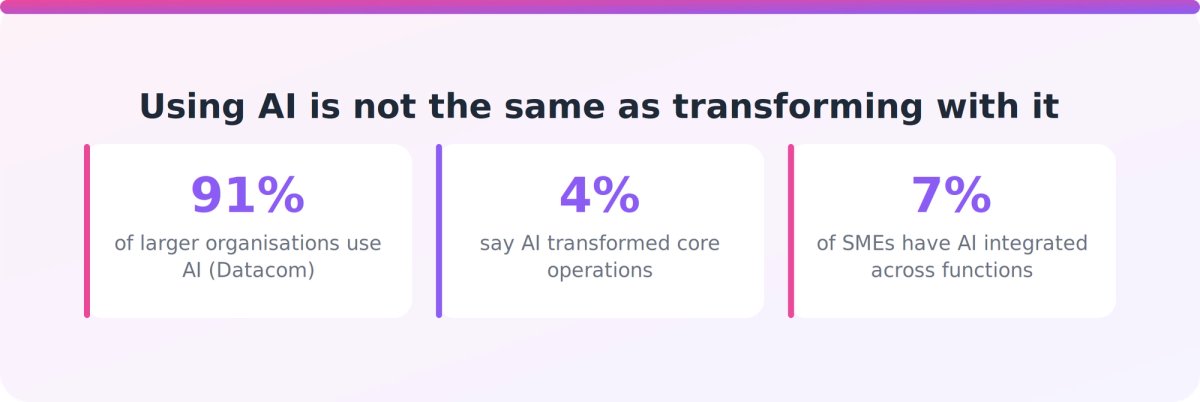
Look one level down. IT Brief NZ's coverage of the same research says 81% are still at the exploratory or implementation stage, 15% are scaling AI across the organisation and just 4% say it has transformed core operations. Datacom's Peter Nelson said many organisations find AI adoption easier than AI transformation.
Smaller firms tell a similar story. Prospa's SME tracker, as reported by Ecommerce News NZ, shows 59% of NZ SMEs using AI but only 7% with it integrated across multiple functions.
Who you ask also changes the answer. Levy Street's roundup cites MYOB at 36% of SMEs proactively using AI and Deloitte/2degrees at 82%. Stats NZ's Business Operations Survey was paused for 2024 and 2025, so there's no official benchmark to settle it.
What is the "automation sequencing problem"?
It's buying the shiny automation before the boring data work. ECI Solutions describes this in its ANZ manufacturing trends report: firms invest in robots, sensors and connected machines while rostering, timesheets and labour cost tracking stay on paper or spreadsheets.
ECI reports that 40% of NZ manufacturers were actively implementing Industry 4.0 technologies in 2025, up 11 points since 2023. It also puts NZ manufacturing labour productivity at roughly 54% of US levels.
Two caveats. ECI sells ERP software, so it has a stake in the argument. And no NZ study we found directly measures how many manufacturers run these processes on spreadsheets. The pattern is plausible and widely described, but it isn't proven at scale.
Why is data readiness the real bottleneck?
Because AI can only work with data it can reach, trust and interpret. A global Rockwell Automation finding, reported by Infrastructure News NZ, says almost 90% of food and beverage manufacturers use or plan to use AI, yet effectively use only about 45% of the data they collect. It isn't NZ-specific, but NZ food and beverage is the leading Industry 4.0 sector, so it's a fair signal.
Progress in that report came from two things:
- Linking operational and business systems.
- Tying AI to specific targets.
The NZ integration picture is patchy. An Omdia/Boomi survey, reported by Infrastructure News NZ, finds:
- Only 39% of NZ organisations have a platform-led approach to integration.
- 34% can't effectively measure whether AI initiatives are succeeding.
- 43% have no dedicated AI budget.
- 89% say data integration, access and governance is a priority, but only 38% have AI-specific data governance policies.
The source is vendor-linked, so read it as a pointer rather than a verdict.
Is cost really what holds firms back?
Not mainly. In Prospa's tracker, the top barriers for non-adopters are uncertainty about ROI (34%) and not knowing which tools suit their needs (32%). Upfront expense ranks sixth, at 12%. The data covers all SMEs, not just manufacturers.
That's a clarity problem. A planner who can't say what a spreadsheet-based process costs in hours and errors can't evaluate any tool, AI or otherwise. Generic products that don't match the way a plant actually runs shifts make it worse.
What does a small, scoped workflow build look like?
It replaces one spreadsheet-driven process with a workflow that has an owner, a baseline and a target. Here's an illustrative example, not a customer story: a mid-sized food manufacturer builds its weekly roster in a spreadsheet, then re-keys timesheet hours into a separate costing file.
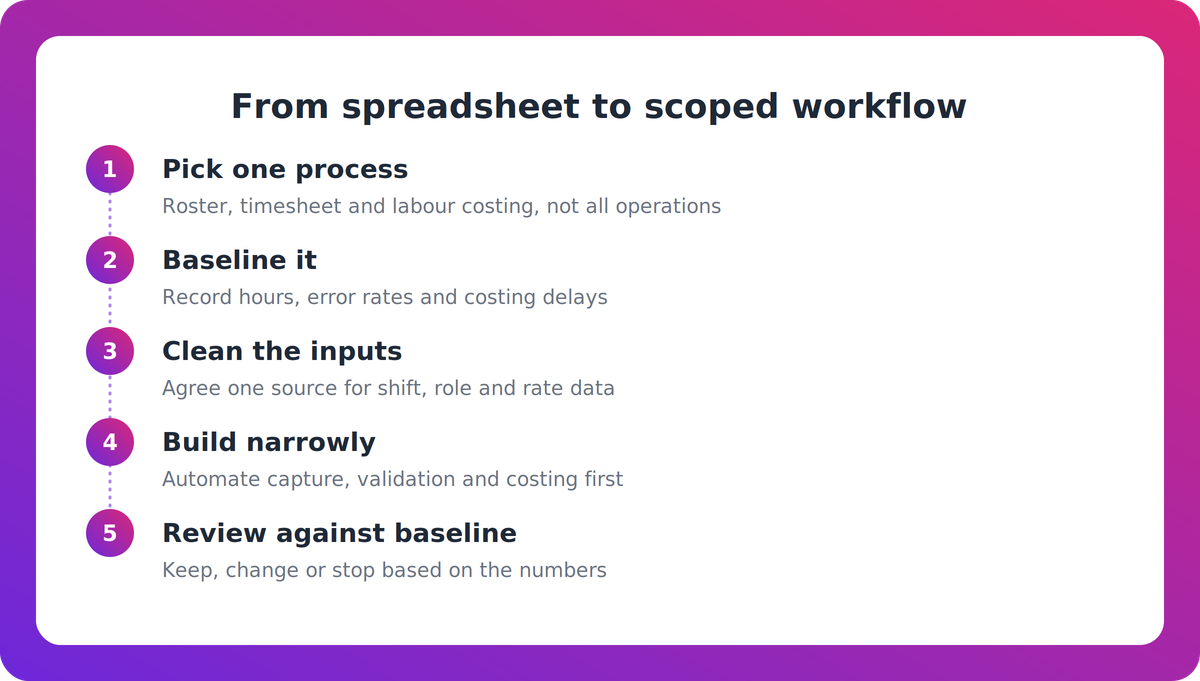
A scoped build would work through these steps:
- Pick one process. Roster-to-timesheet-to-labour-cost, not "our operations".
- Baseline it. Record planner hours per week, error rates and how late costing arrives.
- Clean the inputs. Agree one source for shift, role and rate data.
- Build the narrow workflow. Automate capture, validation and costing. Add AI only where judgement or unstructured data is involved.
- Review against the baseline. Keep it, change it or stop it, based on the numbers.
This fits what the Rockwell finding points to: link the systems, tie the work to a target. It also answers the ROI doubt that holds many firms back, because the result is measurable within one cycle. For a related look at where operational data pays off on the plant floor, see our piece on predictive maintenance AI in NZ manufacturing.
Our take
The sector's AI conversation is running ahead of its plumbing. A factory that can't get clean labour-cost data out of a spreadsheet by Friday isn't ready for a plant-wide AI programme, and no survey headline changes that. We think the better bet is unglamorous: pick one painful workflow, measure it honestly, and build something small that fits how the floor actually runs. Firms that do this a few times end up with the data foundations the big ambitions need.
FAQ
How many NZ organisations use AI?
Datacom's 2026 State of AI Index, covering organisations with 100+ staff, reports 91% using some form of AI. Other surveys of SMEs range from 36% (MYOB) to 82% (Deloitte/2degrees), because samples and definitions differ. All are commercial surveys, so treat them as directional.
Has AI transformed operations for most NZ firms?
No. Datacom's data, as reported by IT Brief NZ, shows only 4% say AI has transformed core operations. Another 15% are scaling it across the organisation, and 81% are still exploring or implementing.
Why do manufacturers still use spreadsheets for rostering and costing?
No NZ study measures this directly. ECI Solutions describes a pattern where firms invest in robots and sensors before fixing rostering, timesheets and labour costing. It's a vendor view, but it matches the wider data-readiness gap in the surveys.
What stops smaller NZ businesses adopting AI?
In Prospa's tracker, the top barriers are uncertainty about ROI (34%) and not knowing which tools suit their needs (32%). Upfront expense ranks sixth at 12%.
Where should a manufacturer start?
Start with one spreadsheet-driven process, baseline its time and error costs, and build a narrow workflow against a clear target. Review the result before expanding.
A next step
This week, list the five spreadsheets your operations team would struggle to run without. Next to each, note who owns it, how many hours a week it takes and what decision it feeds. The one with the biggest gap between effort and value is your first candidate for a scoped build.