The reporting fortnight isn't really a data problem. It's an operating-model problem. If your team spends around two weeks each funding cycle pulling evidence out of enrolment, delivery, completion and finance systems that don't talk to each other, you're paying in capacity and error risk. The two weeks is my estimate, not a sector statistic. Measure your own.
Key takeaways
- NZ funded PTEs report through the Single Data Return (SDR), so the problem to solve is how the SDR is assembled, not which spreadsheet template to use.
- The PTE Rules 2026 expect current financial records, adequate internal financial controls and demonstrable financial sustainability. That is evidence your own systems must hold all year.
- Annual self-review replaces EER for non-university providers, so the evidence trail has to be built into daily operations rather than reconstructed under deadline pressure.
- No authoritative figure exists for time spent on PTE reporting. Treat "two weeks" as a hypothesis and test it with a simple self-audit.
- Direct system feeds, such as TEC's API route to the Data Exchange Platform, show where the sector is heading: systems feed the return, people don't re-key it.
Why the reporting fortnight lands on your desk
You own the systems that feed the return: enrolment, delivery, completions and finance. When those systems disagree, the reconciliation work doesn't go to the board or to compliance. It goes to your team, at the worst possible time.
Terminology matters here. TEC-funded providers report through the Single Data Return, the data set the Ministry of Education and TEC use for funding, performance monitoring, published performance information and statistical reporting. If you've borrowed process advice from an Australian source built around AVETMISS, it won't map cleanly. The principle carries over. The specifics don't.
A good week is one where your team improves a process. A bad week is one where three capable people are matching student IDs against a finance export. The fortnight is what the bad week looks like when it's scheduled.
What the rules now expect you to hold
The Private Training Establishment Rules 2026 took effect on 19 January 2026. They replace the PTE Registration Rules 2025 and the PTE Enrolment and Academic Records Rules 2022, and they remove the annual fee. They also require you to:
- keep financial records up to date
- maintain adequate internal financial controls
- remain financially sustainable
- keep the organisation chart current
None of that is a once-a-year document exercise. It describes how the operation runs on an ordinary Tuesday.
Quality assurance has moved the same way. One provider guide says NZQA stopped starting new EER processes on 1 January 2026, and that non-university providers now complete an annual self-review discussed with NZQA. Treat that as a pointer, not gospel, and confirm the detail on NZQA's iQAF pages. The operational inference is still sound: when review is annual and self-led, the evidence lives in your systems, and someone has to be able to produce it on demand.
Pastoral care has its own rhythm. NZQA's enquiries page says self-review and attestations under the Code of Practice are due 1 November for PTEs and Wānanga. That date has just passed. It's a good moment to ask what the process cost your team.
Where the two weeks actually go
In most operations I'd expect the time to go on four things, none of which is analysis:
- Re-keying. Data is exported from one system and typed into another.
- Reconciling. Enrolment, delivery and finance records disagree, and someone chases the difference.
- Remembering. The one person who knows why a field is filled a certain way is on leave.
- Firefighting. Errors found late force rework close to the deadline.
Here is an illustrative sum, not a measured outcome. Four people each lose three days to a reporting cycle. That is 12 person-days, more than two working weeks of one person's capacity, gone before anyone has improved a process. Multiply by the cycles you run in a year and the number gets uncomfortable quickly.
The sector context makes this costlier. Eight Industry Skills Boards began operating on 1 January 2026, replacing the six Workforce Development Councils. Te Pūkenga functions are transferring to regional polytechnics. TEC also says a small number of PTEs deliver work-based learning and will continue to in 2026. Standards and delivery arrangements are shifting while compliance demands rise, and capacity spent on manual reporting is capacity not spent adapting.
A self-audit you can run this quarter
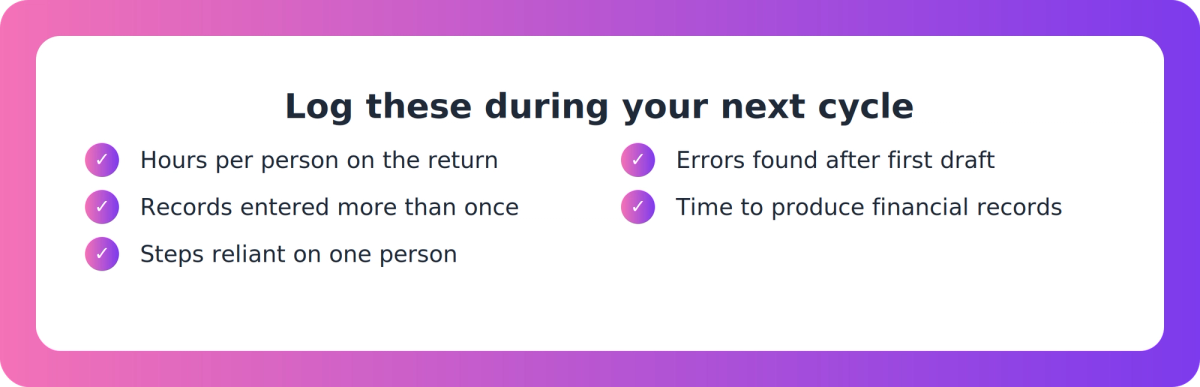
You don't need a project to start. Over your next cycle, have the team log the following:
- hours spent per person on assembling, checking and correcting the return
- the number of times the same record was entered or exported in more than one place
- which steps depend on one person's knowledge
- the errors found after the first draft, and where they originated
- how long it would take to produce your current financial records and organisation chart if NZQA asked tomorrow
Then compare the log with your estimate. If it's two weeks, you have a business case. If it's three days, you have a different and better problem. Either way you'll be working from your own numbers.
One direction is worth knowing about. TEC's SDR page describes an API route for submitting data to the Data Exchange Platform, and lists the Data Specifications for SDR 2026 v3.1. That is a practical sign that the intended model is systems feeding the return, not people re-keying it. Whether you pursue that is your call. Knowing the option exists changes what "normal" should cost.
For related thinking, see this piece on board reporting cadence for NZ PTEs and this one on escaping the firefighting trap.
Our take
Most reporting pain is a design choice made years ago and never revisited. Systems were added one at a time, each solving a local problem. The return became the place where they all meet, and your team became the integration layer.
With the PTE Rules 2026 and annual self-review, being able to show your evidence at any time is the standard, not a deadline sprint. The operations leaders who cope best won't be those with the hardest-working teams. They'll be the ones who stopped treating the fortnight as inevitable. We don't know what the sector average is. Nobody does, and that's the point of measuring your own.
FAQ
Do NZ PTEs report through AVETMISS?
No. TEC-funded NZ providers report through the Single Data Return (SDR). AVETMISS is an Australian standard and doesn't apply here.
Is the "two weeks" a real sector figure?
No. No authoritative data exists on time spent on PTE reporting cycles. It's an illustrative estimate, and the self-audit above is how you replace it with your own number.
What do the PTE Rules 2026 mean for operations?
They took effect on 19 January 2026 and require up-to-date financial records, adequate internal financial controls, financial sustainability and a current organisation chart. Those are things operations keeps in order day to day.
Has EER gone?
One provider guide says NZQA stopped starting new EER processes on 1 January 2026 and that non-university providers now complete an annual self-review. Confirm the detail with NZQA's iQAF pages before you plan around it.
Your next step
Before your next reporting cycle, ask your team to log hours and re-entries for one week. Then compare the result with your own estimate of the fortnight. The gap tells you where to start.