Manual document handling costs Australian professional services firms more than most partners realise, mainly because almost nobody measures it. Document automation in Australian professional services is now also a governance question: from 10 December 2026, new Privacy Act transparency duties apply to automated decisions that affect people.
Key takeaways
- The best-known local benchmark puts a paper or PDF invoice at roughly AU$27–31 against AU$9.18 for a structured e-invoice. It is secondary-cited and covers accounts payable only, so treat it as a rough anchor.
- Adoption is wide but shallow. CPA Australia reports 88% of Australian businesses use AI, but only 10% have embedded it extensively.
- Globally, only 18% of professionals say their firm tracks AI return on investment. If you haven't baselined manual document time, you can't prove any saving.
- From 10 December 2026, regulated entities must disclose in their privacy policies how personal information is used in substantially automated decisions. Build that transparency in before you automate.
What does manual document processing actually cost?
The honest answer is that nobody has a clean number for professional services. The figures people quote come from accounts payable, not contracts, workpapers or client files.
The usual anchor traces back to ATO and Deloitte Access Economics benchmarks, as repeated in vendor explainers such as Pulsify's write-up on manual AP in Australia:
- PDF invoice: about AU$27.67
- Paper invoice: about AU$30.87
- Structured Peppol e-invoice: about AU$9.18
We couldn't retrieve the primary ATO/Deloitte document, so check it before you put these in a board paper. Some AP vendors also claim errors, duplicate payments and fraud add another 10–20% on top. That is one vendor's estimate, not an ATO figure.
The point isn't the exact dollar amount. It's the gap between structured and unstructured handling, and the fact that your firm's version of this gap is probably sitting unmeasured in timesheets and write-offs.
Why is document automation in Australian professional services still shallow?
Because using AI and embedding AI are different things. CPA Australia's 2026 findings, as reported by The Accountant, show 88% of Australian businesses use AI but only 10% have embedded it extensively. That is the lowest level of broad integration among the markets covered.
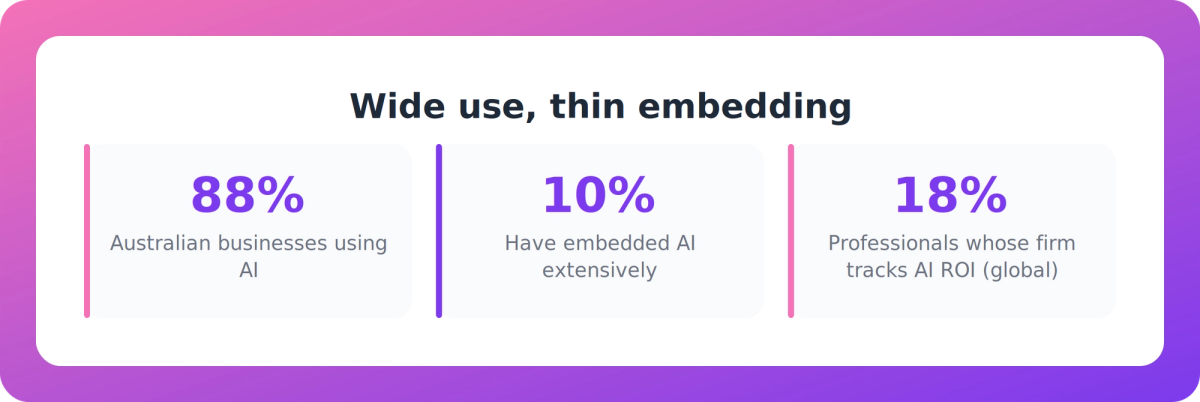
Two other numbers from the same research tell the story:
- Only 28% use agentic AI.
- Only 36% use custom-built AI. For comparison only, the figure on the Chinese Mainland is 61%.
A reasonable reading is that many firms have given staff a chat tool and stopped there. Pasting a contract into a general assistant is not a document workflow. It doesn't touch your practice management system, your matter files or your review process.
Where does the document work actually pile up?
In review, extraction and reconciliation. Those are the repetitive tasks that sit between a client sending something and a professional signing it off.
Some signals from the sector:
- Legal: citing LEAP's 2026 Profitability in Law report, Ask.Legal says document review and analysis is the top AI use case at 54%. It also says only 16% of Australian legal professionals use legal-specific AI daily, against 49% globally.
- Accounting: Bentleys says AI in Australian accounting now includes document extraction, with BAS review cycles cut by 30–50%. That is a practitioner claim and unaudited.
Demand is clearly there. What's missing is evidence that firms know their starting point.
Why don't firms measure it?
Because the cost is spread thin. Fifteen minutes here, a re-key there, a rework loop nobody logs. No single line item screams.
Secondary summaries of the Thomson Reuters Institute 2026 AI in Professional Services Report say only 18% of professionals report their firm tracks AI return on investment. The same summaries say organisational generative AI use rose from 22% to 40% in a year. These are global figures, not Australian, and we saw them only second-hand.
Spend is climbing while measurement lags. That is how a firm ends up with five AI subscriptions and no idea whether any of them paid back.
A simple way to put a number on it
Start with a model you can adapt. Sandlabs, an Australian vendor, models 500 documents a month at 15 minutes each and $40 an hour. That's about $5,000 a month manually, against about $500 a month after an intelligent document processing build.
Treat it as a template, not evidence. The assumptions are the vendor's, unaudited, and the page is older than 90 days. Sandlabs also claims custom builds costing A$15K–A$60K beat licensing above roughly 1,000 documents a month. That's a claim to test against your own volumes.
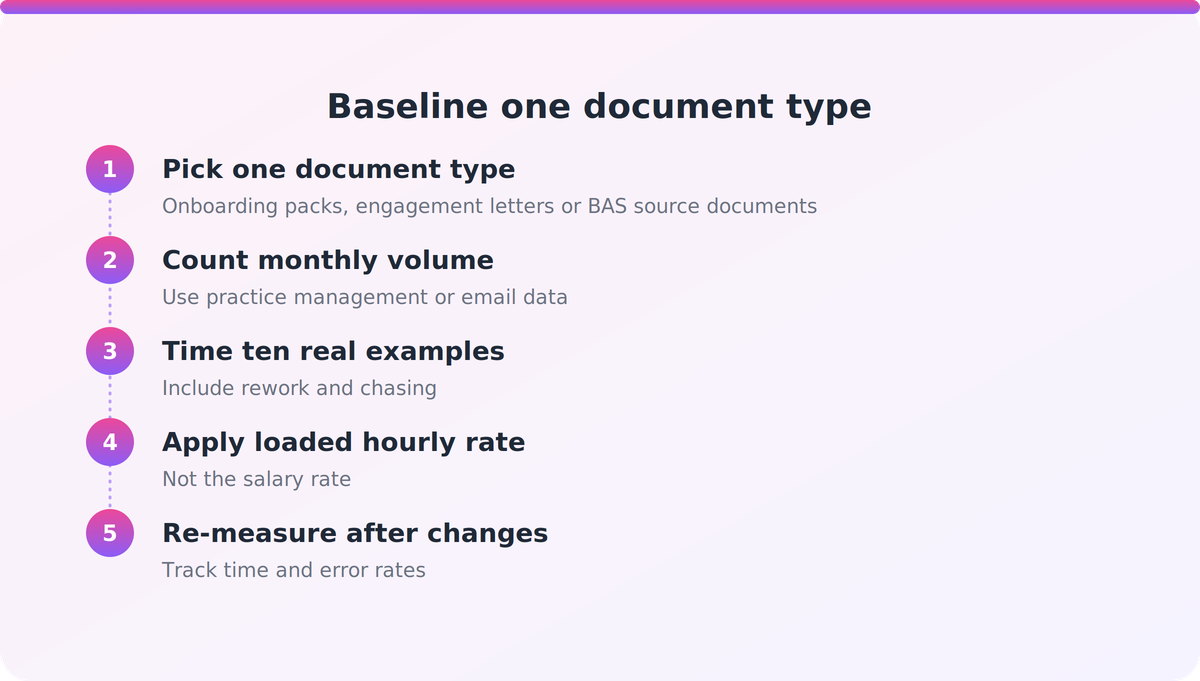
Here is a five-step version for your own firm:
- Pick one document type, such as client onboarding packs, engagement letters or BAS source documents.
- Count monthly volume from your practice management or email system.
- Time ten real examples end to end, including rework and chasing.
- Multiply by a fully loaded hourly rate, not the salary rate.
- Record error and rework rates. Re-measure after any change.
Illustratively, a firm doing 300 documents a month at 20 minutes each is spending 100 hours. At $40 an hour, that's $4,000 a month before anyone counts mistakes. Your numbers will differ. That's the point of measuring.
What changes on 10 December 2026?
Automated decisions about people become something you have to explain. Per the Department of Industry's response to the Senate AI inquiry, from 10 December 2026 regulated entities must disclose in their privacy policies how personal information is used in substantially automated decisions affecting individuals.
For document workflows, that has practical consequences:
- Know which documents contain personal information and where they go.
- Identify any step where software, not a person, effectively decides something about an individual. Examples include triage, eligibility or risk flags.
- Keep a human reviewer in the loop where outcomes matter.
- Update your privacy policy to describe what you actually do.
Some vendors also point to APRA CPS 230 and APES 320 as sources of AI policy requirements, and one source mentions a September 2026 Administrative Review Tribunal practice direction. We couldn't verify any of these against primary sources. Confirm them with APRA, the professional bodies or the Tribunal before relying on them.
Governance first, or governance never
It is far cheaper to design transparency into a document workflow than to retrofit it. Logging, review steps and clear data handling are design decisions. Added later, they are a remediation project.
This is also where generic tools tend to fall short. A workflow built around your matter types, your systems and your review points is easier to explain, audit and defend than a loose set of prompts.
Our take
The expensive part of manual document work isn't the keystrokes. It's that nobody can say what it costs, so nobody can say what a fix is worth. We think firms should baseline one document type this quarter, before the December deadline, and treat privacy transparency as a design requirement rather than a late compliance task. The firms that measure first will be the ones able to explain their automation to regulators and clients.
FAQ
How much does manual document processing cost in Australia?
The most-cited benchmarks are for invoices: about AU$27.67 for a PDF, AU$30.87 for paper and AU$9.18 for a structured e-invoice. They are secondary-cited and cover accounts payable only. There is no verified Australian figure for professional services documents such as contracts or workpapers.
How widely is AI used in Australian businesses?
CPA Australia's 2026 findings say 88% of Australian businesses use AI, but only 10% have embedded it extensively. Only 28% use agentic AI and 36% use custom-built AI.
What is the Privacy Act change on 10 December 2026?
Per the Department of Industry's response to the Senate AI inquiry, from 10 December 2026 regulated entities must disclose in their privacy policies how personal information is used in substantially automated decisions that affect individuals. Check the primary legislation and OAIC guidance for how it applies to your firm.
Do most firms track AI return on investment?
No. Secondary summaries of the Thomson Reuters Institute 2026 report say only 18% of professionals report their firm tracks it. That is a global figure, not an Australian one.
Is custom-built automation better than licensing a tool?
It depends on volume and fit. One Australian vendor claims custom builds of A$15K–A$60K beat licensing above roughly 1,000 documents a month, but those assumptions are unaudited. Run your own numbers first.
Your next step
This week, pick one document type and time ten real examples from start to finish. Write the total next to the volume. That single figure will tell you more than any vendor benchmark.