The NZ businesses most likely to get value from AI won't be the biggest spenders. They'll be the ones who pick one workflow, set a baseline, build a working AI prototype and measure it before committing more. Adoption is climbing, but trust, privacy and governance gaps make staged builds the safer bet.
Why are NZ SMEs starting with prototypes rather than big programmes?
Because most smaller firms are still testing. MYOB's 2026 Business Monitor found 36% of NZ SMEs proactively using AI, up from 32% a year earlier. The split by size is stark: 30% among firms with 1–5 employees, against 64% among firms with 20 or more.
That gap tells you something. A five-person business can't absorb a failed six-figure rollout. A small, working prototype lets it learn what AI does in its own workflow before it makes a bigger bet.
One caution: we couldn't find an independent NZ study measuring prototype outcomes. The case for staged builds is an inference from adoption, barrier and policy evidence. It is a strong inference, but it is still an inference.
What is actually slowing SMEs down?
Mostly practical things, not technical ones. Xero and The Purpose Business surveyed 1,081 Xero customers between 31 March and 7 April 2026. They found 45% of SMEs see AI as the biggest opportunity since the internet. Data privacy, time and trust still slow adoption.
The upside is real for those who get going. Among users in that research, 64% say AI saves time, averaging about one working day.
Common brakes include:
- Trust: not knowing whether outputs can be relied on.
- Privacy: uncertainty over what customer or learner data can safely go into a tool.
- Time: no spare capacity to experiment properly.
- Not knowing where to start: too many tools, no clear first use case.
A prototype answers each of these on a small scale. It uses limited data, a short timeframe and one clearly defined job.
Is governance keeping pace with use?
No. An EMA survey of more than 300 member businesses (July 2026) found 83% already use AI. Only 13% have an AI policy, and in 18% of companies AI is used without a clear owner.
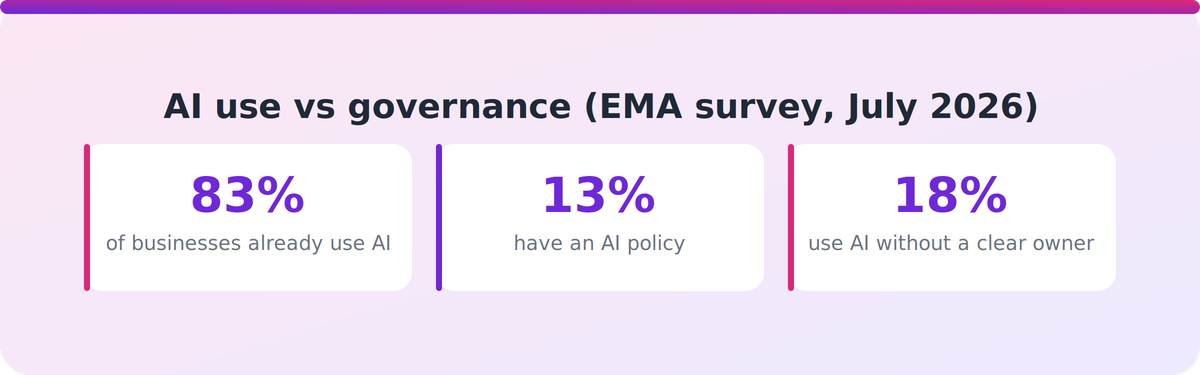
Treat that as directional. It is a member survey, so it may lean towards larger or more engaged firms. Even so, it points to a sensible rule: build ownership, a short policy and guardrails into the prototype from day one, not after it succeeds.
How is government shaping the staged approach?
Through co-funding that rewards planning first. The AI Advisory Pilot, delivered via the Regional Business Partner Network, co-funds a tailored AI roadmap and its implementation, up to $15,000. It originally co-funded up to 50%.
Beehive reports that a further 120 small businesses will get help and that the pilot has been extended to 30 June 2027. About 150 businesses joined from January. Check current eligibility on the Beehive and MBIE sites before relying on any of this.
The compliance baseline is existing law. MBIE's Responsible AI Guidance for Businesses (July 2025) is voluntary and non-statutory. Businesses remain subject to the Privacy Act 2020, fair trading law and workplace safety law. A prototype should be designed with those in mind from the start.
What does a staged AI prototype look like?
The sequence is simple. Each step produces something you can look at and judge.
- Pick one workflow. Choose something repetitive, document-heavy or bottlenecked, such as enquiry triage, report drafting or evidence checking.
- Set a baseline. Record how long it takes now, who does it and how often errors occur. Without this, you can't prove anything later.
- Name an owner and set guardrails. One accountable person, a one-page policy, and a clear rule on what data is off limits.
- Build a working prototype. Aim for something people can use on real tasks, not a slide deck.
- Measure against the baseline. Time saved, error rates, user confidence. Decide in advance what result earns the next stage.
- Decide where freed capacity goes. Time saved only matters if it moves to higher-value work.
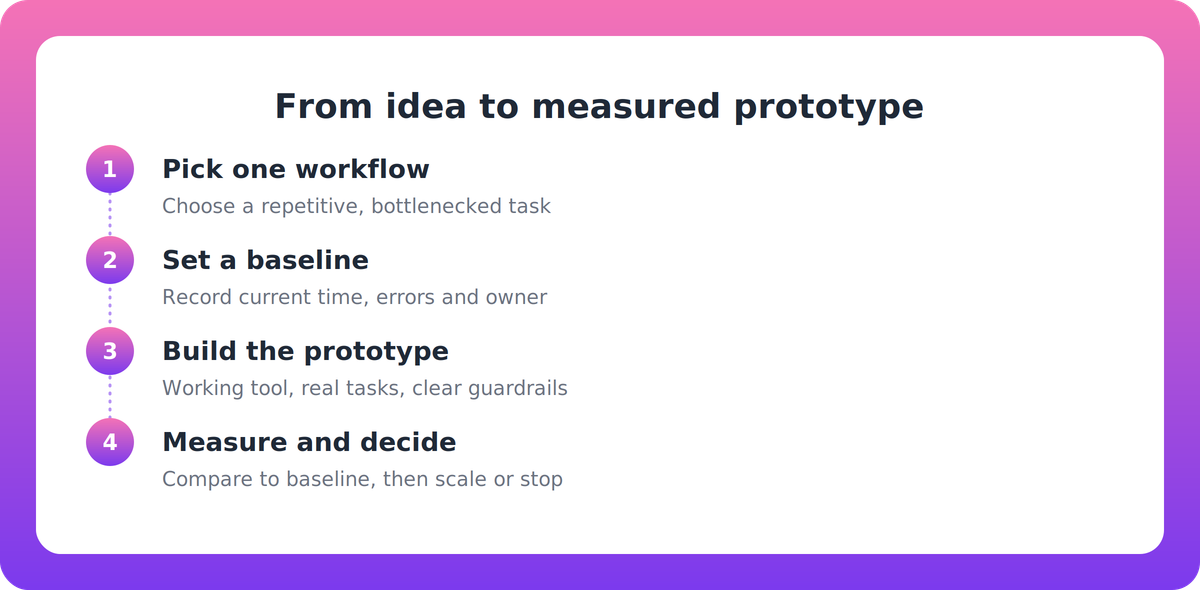
Commercial guides, including Enterprise DNA, say firms that follow this pattern are far likelier to see a return. We'd trace the underlying Datacom and MIT sources before quoting any specific figure.
What does a measurable return look like?
It looks like a defined workflow with a number attached. A Xero survey of NZ accounting practices (October 2026) found 78% have tried AI and 49% use it in daily workflows. The average saving was seven hours a week per practice.
That is one sector, and it is a specific one. Don't assume the same figure applies to your business. The lesson is the method: accounting practices have clear, repeatable workflows that are easy to measure.
What is "pilot purgatory"?
It's when an experiment never graduates. A Concentrix CX index, reported by Reseller News, describes 66% of NZ businesses as stuck in early pilot phases. By comparison only, Australian organisations were reported to be more than twice as likely to be accelerating AI in customer operations. The sample and methodology are unclear, so treat the numbers cautiously.
The risk is still plausible. Pilots without a baseline, an owner or a success threshold have nothing to graduate towards. Define the exit criteria before you build.
If you're weighing a first build, which single workflow would you be happiest to measure honestly for 60 days?
Key takeaways
- MYOB's 2026 data shows NZ SME adoption at 36%, with smaller firms well behind larger ones. Low-commitment prototypes suit them.
- Governance trails use: EMA found 83% use AI, 13% have a policy and 18% have no clear owner.
- The AI Advisory Pilot, extended to 30 June 2027, co-funds a roadmap and implementation, up to $15,000. Verify eligibility first.
- Start with one workflow, a baseline, an owner and a pass/fail measure, so a pilot has a way to graduate.
- The Privacy Act 2020 and other existing law apply to AI prototypes, even though MBIE's guidance is voluntary.
Our take
The smartest AI money a small NZ business can spend right now is the money it spends on a baseline. Plenty of firms will buy tools. Far fewer will know afterwards whether anything improved. We think the prototype is the right unit of investment, provided it is built on real workflow data, has a named owner and comes with a decision rule for what happens next. That applies to training providers and PTEs as much as any other SME. If you want to see what a purpose-built prototype looks like, Supahuman is one place to start.
FAQ
What is an AI prototype for a New Zealand business?
It's a small, working version of an AI solution built around one real workflow. Its job is to test whether the idea saves time or improves quality, using your data and processes, before you commit to a larger build.
Does the AI Advisory Pilot fund prototypes?
The pilot co-funds a tailored AI roadmap and its implementation, up to $15,000, through the Regional Business Partner Network. Beehive reports it has been extended to 30 June 2027. Check current eligibility and what counts as funded implementation on the Beehive and MBIE sites.
Do NZ businesses have to follow AI rules?
MBIE's Responsible AI Guidance for Businesses (July 2025) is voluntary and non-statutory. But businesses remain subject to the Privacy Act 2020, fair trading law and workplace safety law, and a prototype should be designed with these in mind.
How do I measure whether an AI prototype worked?
Record a baseline first: time taken, error rate and who does the task. Then compare the same measures after the prototype has been used on real work. Set the pass/fail threshold in advance, and decide where any freed-up time will go.
Why do so many AI pilots stall?
Often because no one owns them and there is no baseline or exit criteria. A Concentrix index reported by Reseller News put 66% of NZ businesses in early pilot phases, though its methodology is unclear. The pattern is plausible even if the figure needs verifying.