Student management software for a NZ PTE should hold the enrolment and academic records the PTE Rules 2026 require, produce accurate Single Data Return (SDR) and NZQA reporting data, support international-student records under the Pastoral Care Code, and meet Privacy Act duties, including IPP 3A from 1 May 2026. No official certified-vendor list exists, so test every claim yourself.
What does student management software do for a NZ PTE?
A student management system (SMS or SIS) helps a PTE manage enrolment, attendance, compliance reporting, certification and academic records. That description comes from a vendor blog (CloudAssess), not an authoritative definition. The useful way to read it: this is a records-and-reporting decision first, and a convenience decision second.
The rules refer to an SMS directly. The Private Training Establishment Rules 2026, re-issued on 19 January 2026, replaced the PTE Registration Rules 2025 and the PTE Enrolment and Academic Records Rules 2022. They also reflect the removal of External Evaluation and Review (EER) in favour of self-review and monitoring. Some PTEs must electronically send the Ministry of Education the student information it requires from their SMS. Which rule applies depends on whether you are a Code signatory and whether you receive TEC funding.
What records must the system hold?
Start with the mandatory fields. The system needs to store:
- name, address and contact details
- national student number, where held
- nationality and domestic or international status
- the education or training the student is enrolled in
- start and finish dates
Then check retention. Enrolment records must be kept at least two years after completion. Student assessment materials must be kept at least 12 months from completion. Ask whether the software enforces those periods or simply leaves you to remember them.
What must it report?
Awarded qualifications and micro-credentials must be reported so they appear on the learner's Record of Achievement. You can do that through the NZQA provider portal or the Single Data Return, within three months or by the next SDR round.
The Ministry of Education's SDR manual has PTE-specific rules. The 2024 edition is the one we reviewed, so check which edition is current and ask any vendor to demonstrate against that one, not an older manual. Unfunded PTEs enrolling international students must also submit enrolment and provider data used for Export Education Levy calculations.
If TEC reporting is your pressure point, our piece on why the TEC reporting process is a funding risk covers it in more depth.
What changes if you enrol international students?
The Education (Pastoral Care of Tertiary and International Learners) Code of Practice 2021 has applied since 1 January 2022. For international enrolments, signatories must keep records such as insurance details. Registered PTEs must also comply with the Student Fee Protection Rules and the Quality Assurance of Tertiary Education Providers Rules.
So ask practical questions. Can the system hold insurance details, agent details and fee protection records against each student? Can you pull them quickly when asked?
How does IPP 3A affect an SMS or AI feature?
The Privacy Amendment Act 2025 added Information Privacy Principle 3A from 1 May 2026. It is a notification duty that applies when personal information is collected from someone other than the individual. It applies only to information collected on or after that date.
That matters if your system, or anything built around it, pulls in data from agents, referees or other third parties. Ask the vendor how it supports notification, and where your data is hosted. This is a point to settle with your own privacy officer or legal adviser, not to take on a vendor's word.
How do you compare systems when there is no approved-vendor list?
There is no official NZQA or TEC certified-vendor list. There is also no independent market-share data, no analyst comparison and no published pricing benchmark. One vendor says over 100 of the 180 government-funded PTEs use its product (SELMA SIS). That is a vendor claim, and we couldn't verify it.
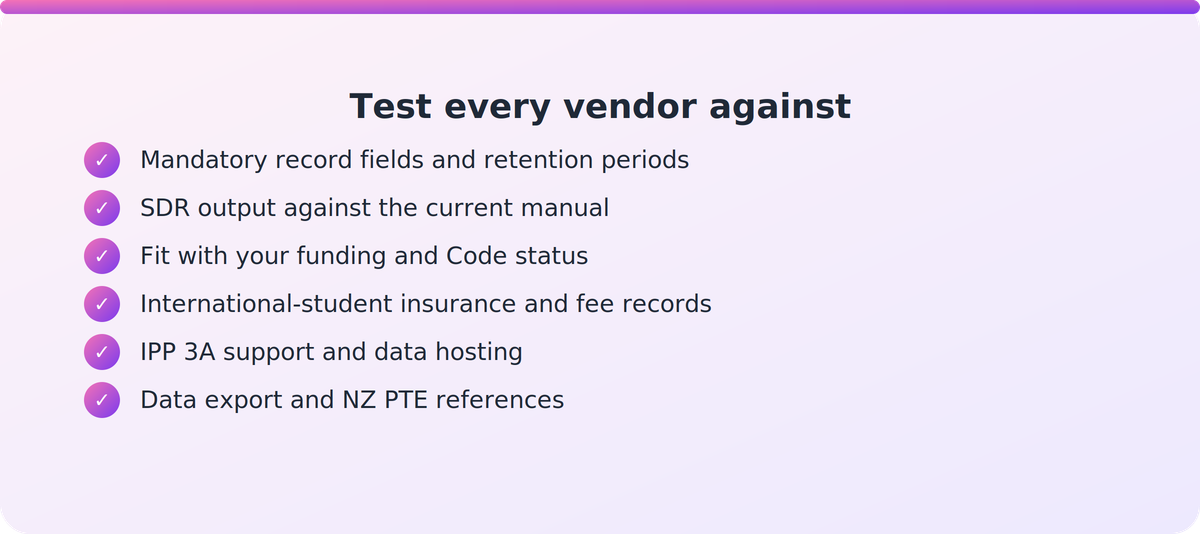
So build your own test. Weigh each option on:
- Record coverage. Every mandatory field, including the national student number, plus retention enforcement.
- Reporting output. SDR-ready data and support for reporting awarded qualifications and micro-credentials, shown live against the current manual.
- Funding-status fit. TEC-funded or unfunded, Code signatory or not, international enrolments or not.
- International-student support. Insurance, agent details and fee protection records.
- Privacy readiness. IPP 3A support and data hosting location.
- Integration and portability. How it connects to your existing systems, and whether you can export all your data.
- Evidence quality. Ask for NZ PTE references and separate them from marketing claims.
- Total cost. With no public benchmarks, get itemised quotes, including implementation, support and exit.
Where a product includes AI features such as data extraction or drafting, check that qualified staff review the outputs. The PTE stays accountable for compliance, whatever the software does.
Off-the-shelf SMS or custom AI work around it?
For most PTEs the system of record should be a proven SMS. It holds the records, produces the returns and is built for the rules above. Custom work is a different category. It makes sense when a specific workflow, such as enrolment-to-completion handling, RPL at scale or reporting preparation, doesn't fit what your SMS does.
To be plain about our own position: SupaHuman's AI Studio is custom-build engineering, not a packaged student management system. It doesn't offer a standard student record system, attendance tracking, fee management or a pre-built SDR module. It could sit alongside your SMS. It doesn't replace one. The Studio's stated approach is to design the system, prove it on your own data, then run it. It also says builds keep human decisions on anything that matters. That fits the principle that AI assists accountable staff and doesn't stand in for them.
A sensible next step
Write down your funding status, Code status and the three records or returns that cost your team the most time. Take that list to every vendor demo. If something sits outside what a standard SMS does, a conversation about a custom build is fair. Pricing for the AI Studio isn't published, and work starts with a chat via the book-a-demo page. Our guide to AI document data extraction for NZ PTEs may help too.
Key takeaways
- Judge an SMS on records and reporting first: the PTE Rules 2026, SDR and NZQA data, the Pastoral Care Code and the Privacy Act.
- Make vendors demonstrate against the current SDR manual and your own funding and Code status.
- No official vendor list or pricing benchmark exists, so separate vendor claims from verifiable evidence and ask for NZ PTE references.
- IPP 3A applies from 1 May 2026 to information collected indirectly on or after that date.
- Custom AI work can sit around a core system, but it isn't a packaged SMS, and qualified staff stay accountable for compliance.
Our take
Buy the system of record for what it holds and reports, not for its feature list. Compliance gaps usually show up in the returns and retention rules, not the dashboard. We'd treat AI and custom automation as a second decision, made only after the core system is settled and only where a specific workflow justifies it. And whoever builds it, a qualified person at the PTE should still review the output and own the sign-off.
FAQ
What must student management software hold for a NZ PTE?
It must support the enrolment and academic records the PTE Rules 2026 require. These include name and contact details, national student number where held, nationality and domestic or international status, the enrolled programme, and start and finish dates. Enrolment records must be kept at least two years after completion, and assessment materials at least 12 months.
Is there an approved list of student management systems in NZ?
No. There is no official NZQA or TEC certified-vendor list, and we found no independent market-share data or published pricing benchmarks. Test vendors against the current rules and SDR manual, and ask for NZ PTE references.
Should a PTE buy an off-the-shelf SMS or commission custom AI work?
Most PTEs need a proven SMS as the system of record. Custom AI or automation can be built around it for workflows a standard product doesn't cover. It isn't a replacement for an SMS, and qualified staff must still review outputs and remain accountable for compliance.
How does IPP 3A affect student data collected from agents or referees?
From 1 May 2026, IPP 3A adds a duty to notify individuals when their personal information is collected from someone other than them. It applies only to information collected on or after that date. Ask vendors how their system supports notification, and confirm your obligations with a privacy adviser.