AI Document Data Extraction for NZ PTEs: A Buyer's Guide
4 August 2026 · 9 min read

For a New Zealand Private Training Establishment, a genuinely useful AI document extraction tool is one that reliably captures every field the Private Training Establishment Rules 2026 require — entry-requirement evidence, itemised fees, and for international students, visa, insurance and agent details — while keeping a clear line back to the source document and to a staff member who checks the result before it counts as a compliant record.
That's a narrower test than most "document AI" marketing implies. Plenty of tools can read a passport photo page. Fewer can be trusted to feed a record NZQA might audit, or a return TEC actually collects. This guide separates the two.
What the Private Training Establishment Rules 2026 actually ask an enrolment record to hold
Under the Private Training Establishment Rules 2026, a PTE's enrolment records need to include, at minimum:
- Entry-requirement evidence, including English-language scores where these apply to the programme.
- Itemised fee and payment records for each student.
- For international students specifically: visa and immigration details, agent contact details, copies of health and travel insurance, fee-protection trustee records, and passport numbers.
Those records must be kept for at least two years after a student finishes their study, and stored so they're easily recoverable and printable from the PTE's electronic data storage system. PTEs enrolling international students also carry a separate obligation as an approved signatory to the Education (Pastoral Care of Tertiary and International Learners) Code of Practice 2021 — the Code sits alongside the PTE Rules, not instead of them.
That's the actual checklist an extraction tool has to serve. A tool that pulls name, date of birth and a couple of headline fields from a passport is doing something different from a tool that can consistently locate fee-protection trustee references or agent details buried in a scanned enrolment pack.
From basic OCR to document AI: what "extraction" means in 2025–26
Intelligent Document Processing (IDP) is now a recognised software category in its own right — Gartner published its first Magic Quadrant for IDP in September 2025, assessing 18 vendors. The shift underneath that recognition matters for buyers: legacy optical character recognition (OCR) tends to sit around 60–80% accuracy on real-world documents, while newer systems built on large language models or vision-language models are reporting 99%+ accuracy on extraction tasks.
That gap is the difference between a tool you can lean on and one you have to double-check every time. But accuracy numbers quoted by a vendor are marketing until they're tested on your documents — scanned passports, handwritten fee schedules, agent-submitted packs with inconsistent formatting.
Evaluation criteria: how to judge a tool against your enrolment records, not a demo
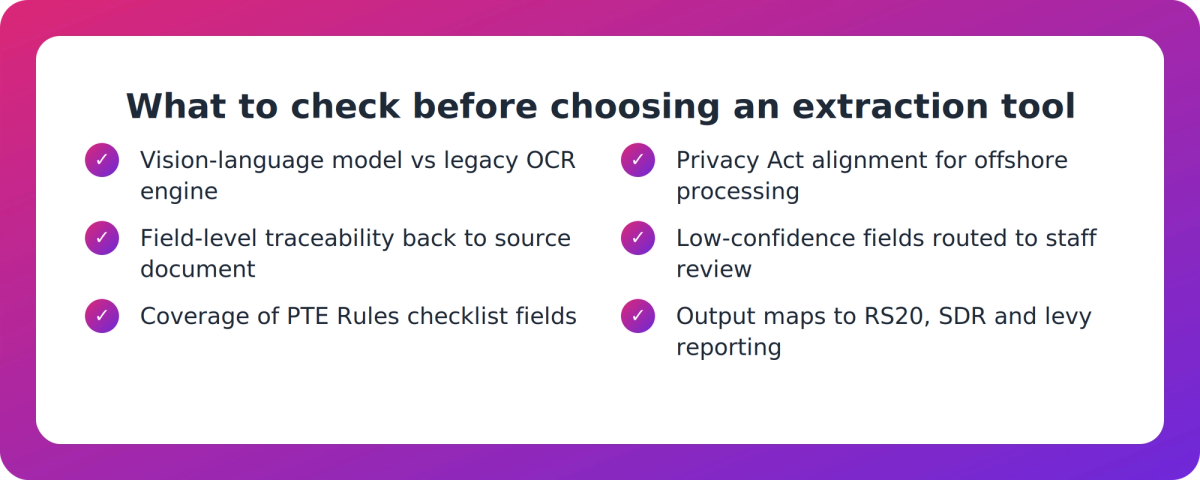
When you're comparing options, weigh them against your actual documents and your actual compliance obligations, not a generic feature list:
- Underlying engine — is extraction built on a vision-language model with contextual understanding, or legacy OCR with an AI label bolted on? This affects real accuracy on scanned forms and passports far more than the sales deck suggests.
- Traceability — does every extracted field point back to its exact location on the source document, so you could defend it field-by-field at an NZQA audit or moderation visit?
- Fit against the PTE Rules checklist — can it reliably capture entry-requirement evidence, itemised fees, visa and insurance details, not just generic name-and-date fields?
- Privacy Act alignment — where is the data processed and hosted, and is there a documented basis for any overseas disclosure?
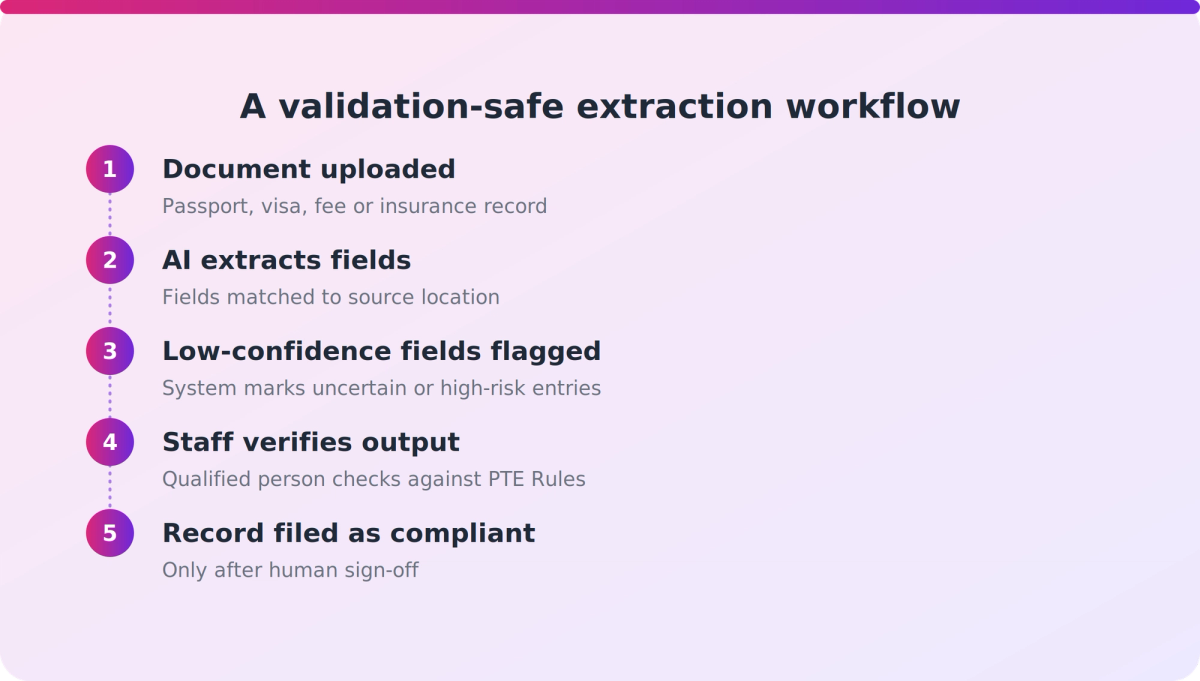
- Human-in-the-loop routing — does it flag low-confidence or high-risk fields for staff review, rather than presenting output as already-verified?
- Reporting fit — does the extracted data need re-keying for government collections, or does the tool cut that duplication?
Because the IDP market now runs to well over a hundred self-described vendors, treat any extraction-accuracy claim as a starting hypothesis to test on your own enrolment-type documents, not a settled fact.
Is it safe under the Privacy Act 2020 to run passports and visas through an AI tool?
Enrolment documents are full of personal information — passport numbers, visa details, health insurance records. New Zealand's Privacy Act 2020 and its Information Privacy Principles apply to any organisation handling that information, with no small-business exemption. Two principles matter directly here:
- IPP8 requires reasonable steps to keep information accurate — relevant if an extraction tool is the thing populating your student record.
- IPP12 requires reasonable assurance that an overseas processor will protect the information to a comparable standard, which matters because many AI tools send data offshore for processing.
From 1 May 2026, a new rule — IPP3A — will require organisations to notify a person when their personal information is collected from someone else, such as an agent submitting enrolment documents on a student's behalf. That's directly relevant to any tool extracting data from third-party-submitted packs.
The Office of the Privacy Commissioner's 2023 AI guidance sets out reasonable checkpoints for any vendor handling personal information: leadership sign-off before deployment, a privacy impact assessment, transparency about what the tool does, human review of outputs, and data minimisation. Ask a vendor to walk you through each of these, not just their extraction accuracy score.
Will extracted data actually reduce work on RS20, SDR and levy reporting?
PTE-generated data has to flow into several government collections: the annual RS20 census, the Single Data Return/Indicative Enrolment Collection required by TEC and the Ministry of Education, and international enrolment data used to calculate the Export Education Levy. If an extraction tool's output has to be manually re-keyed into these formats, you haven't removed the admin — you've just moved it. Ask any vendor directly how (or whether) their output maps to these specific collections before assuming it saves reporting time.
Does using AI to extract enrolment data remove the need for staff to check it?
No — and any tool that implies otherwise should raise a flag, not confidence. Even a system reporting high extraction accuracy is producing a draft record, not a verified one. A qualified staff member still needs to check that fields have been read correctly, that nothing critical has been missed, and that the record meets the PTE Rules before it's treated as compliant. AI can genuinely cut the time spent typing data in; it can't take on the accountability for what ends up in the file.
Key takeaways
- The Private Training Establishment Rules 2026 set a specific enrolment-record checklist — entry-requirement evidence, itemised fees, and (for international students) visa, insurance and agent details, retained for at least two years and easily recoverable.
- Document AI has genuinely moved on from legacy OCR's 60–80% accuracy toward LLM/vision-model systems reporting 99%+, but treat vendor accuracy claims as unproven until tested on your own documents.
- Privacy Act 2020 obligations — IPP8 accuracy, IPP12 overseas processing, and the incoming IPP3A notification rule from 1 May 2026 — apply directly to any tool handling passports, visas and insurance records.
- Extracted data still needs to map to RS20, SDR/IND and Export Education Levy formats to actually save reporting effort.
- Whatever the extraction accuracy, a qualified staff member still validates the output before it counts as a compliant enrolment record.
Our take
The interesting shift here isn't that AI can now read a passport — it's that "document AI" has become specific enough to be evaluated against a real regulatory checklist rather than a generic accuracy percentage. A PTE buyer should treat that checklist, not the vendor's demo, as the test. We'd be wary of any tool pitched as removing the need for staff sign-off on enrolment records; the Rules, and plain accountability, mean someone in your organisation is still the one who has to stand behind what's in the file.
FAQ
What fields must a PTE's enrolment record actually capture?
Under the Private Training Establishment Rules 2026, records must include entry-requirement evidence (including English-language scores where relevant), itemised fee and payment records, and for international students: visa and immigration details, agent contact details, health and travel insurance copies, fee-protection trustee records and passport numbers, retained for at least two years and easily recoverable.
Is it safe to run student passports and visas through an AI extraction tool?
It can be, provided you check the Privacy Act 2020 basics: IPP8 (accuracy), IPP12 (overseas processing assurance if the tool processes data offshore), and from 1 May 2026, IPP3A's requirement to notify a person when their information is collected from a third party such as an agent.
How accurate does an extraction tool need to be before it can feed NZQA or TEC reporting without manual re-checking?
No accuracy figure removes the need for a manual check on a compliance-critical record. Even tools reporting 99%+ extraction accuracy should route low-confidence or high-risk fields to staff for review, and their output should still be verified before it feeds RS20, SDR/IND or Export Education Levy reporting.
Does AI extraction remove the need for a staff member to validate enrolment records?
No. AI can speed up capturing fields from enrolment documents, but a qualified person still needs to check the extracted data against the PTE Rules requirements before it's treated as a compliant record — the accountability doesn't transfer to the software.
Where does Supahuman/VETos fit into this?
Supahuman's demonstrated NZ PTE work centres on NZQA-aligned content and compliance-documentation workflows, including audit-trail and moderation-evidence support, with human review built into the process. Based on the material available, it isn't shown as a dedicated enrolment-document, passport-and-visa extraction product — so treat it as an adjacent capability worth asking about, not a direct substitute for a specialised extraction tool, and always check any vendor's Privacy Act position against the specific data you'd be processing.
If you're evaluating extraction tools for enrolment records, start with the PTE Rules checklist above and test any vendor's accuracy on your own scanned documents before deciding — not on a demo dataset.