ESOL assessment design in NZ trades comes down to one question: is this task measuring trade competence or English reading ability? Industry Skills Boards have run work-based learning since 1 January 2026, and a new residence pathway for tradespeople opens on 24 August 2026. Providers have good reason to answer that question on purpose.
What changed for NZ trades providers in 2026?
Three shifts landed close together, and each touches how assessments get designed and approved.
- Work-based learning moved. TEC's new work-based learning model has applied since 1 January 2026, with a transition through 2026 and 2027. Industry Skills Boards (ISBs) now carry responsibilities that sat elsewhere before.
- Standards-setting moved. The Waihanga Ara Rau Workforce Development Council was disestablished on 31 December 2025. Its industries now sit under three boards: Construction & Specialist Trades, Energy & Infrastructure, and Electrotechnology & Information Technology.
- NZQA's updated Rules took effect on 19 January 2026. They align with the integrated Quality Assurance Framework. The Programme Approval Rules reduce requirements for qualifications made up entirely of skill standards, and Type 2 changes no longer need ISB endorsement.
For practical purposes, standards and moderation questions for trades now go to the ISBs.
Why does language-fair assessment matter now?
Because the learner mix is likely to shift, and the stakes for each learner are rising.
From 24 August 2026, the Skilled Migrant Category Trades and Technician pathway requires an eligible trades occupation paid at least the median wage, a Level 4 or higher qualification, and relevant post-qualification experience. Immigration New Zealand also says English test results are valid for five years for applicants with a recognised occupational registration.
A Level 4 qualification is now a concrete step towards residence. If a written task fails a capable electrician or carpenter because of sentence structure, that is a quality problem, not just an equity one. The assessment hasn't measured what the unit standard says it should.
Entry English thresholds are also tightening. One secondary source (workingin.nz) reports that from 1 June 2026, Accredited Employer Work Visa applicants for Skill Level 3 roles must meet minimum English requirements. Confirm that with Immigration NZ before relying on it. Either way, meeting an entry threshold doesn't remove the language load of a site-safety quiz or a written case study.
What does NZQA actually say about ESOL in trades?
Not much, and it's worth being direct about that.
Rule 21 of the updated NZQA Rules covers English proficiency for international students at entry. It doesn't address how an assessment is designed. NZQA's English language assessment resources help people assess against current English language unit standards, which is a useful lens for separating language outcomes from trade outcomes. But they aren't trades-specific guidance.
Our research found no 2026 report from an ISB, TEC, Ako Aotearoa or NZCER on ESOL assessment in trades. The Ministry of Education's ESOL bulletins cover schools. NZCER's work on assessing English language learners focuses on primary schools. The principles carry over. The trades-specific guidance doesn't exist yet.
How do you design trade assessments that test the trade, not the English?
Start from the standard, not the template. The steps below are our practical read of the principle, not NZQA requirements.
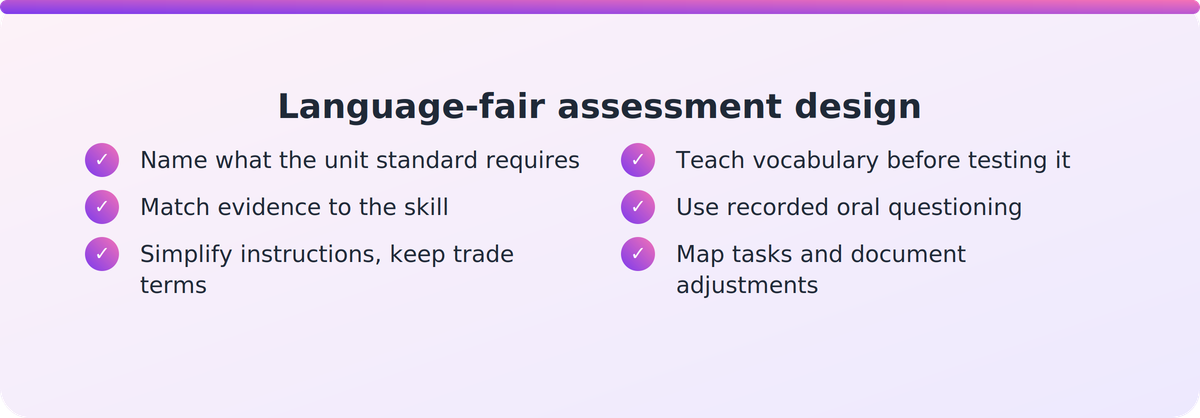
- Name the construct. Write down what the unit standard says the learner must do. Then list the language the task demands that the standard doesn't.
- Match the evidence to the skill. Where the standard allows it, favour observation, demonstration and product evidence over long written responses.
- Simplify the instructions, not the trade. Use short sentences, one instruction at a time and active verbs. Keep the technical terms the trade genuinely requires.
- Teach vocabulary before you test it. Use labelled diagrams and glossaries for terms taught in the course. Don't make learners decode them cold.
- Use oral questioning. Assessor questions can confirm understanding when a written answer would only show writing skill. Record the questions and responses.
- Map and document. Show how each task maps to the standard, and note any adjustments you made and why. That is what a moderator will want to see.
Context matters too. A scenario about a ceiling-fixing job lands differently for a learner on a building site than one about an office. Workplace, classroom and distance delivery each change what language load is reasonable.
A quick language-fairness check
Before sign-off, ask three questions of every task:
- Could a competent tradesperson with limited written English still show they meet the standard?
- Is any marking criterion about grammar or spelling when the standard doesn't mention it?
- Would a native speaker with no trade experience pass this by reading alone?
If the last answer is yes, the task is testing English.
Where does moderation fit in the transition?
Moderation is where language-fair design gets tested. With responsibilities moving to ISBs and a transition running through 2027, providers will meet new reviewers and new expectations at the same time.
The reduced Programme Approval requirements for qualifications made up entirely of skill standards give providers some room. They also place more weight on the provider's own quality management. A short design rationale per assessment is cheap insurance. It records what you tested, what you adjusted and how it maps back to the standard.
This is also where manual workflows strain. Producing contextualised, mapped, assessor-guided versions of the same assessment for different learner profiles by hand takes weeks per unit. That's the practical case for building the process properly, whatever tools you use.
What is still uncertain?
- No ISB has published ESOL-specific assessment guidance for trades that we could find.
- The AEWV English requirement for Skill Level 3 roles comes from a secondary source.
- It's too early to say how ISBs will approach moderation of adjusted assessments during the transition.
Providers shouldn't wait for guidance. The unit standard already defines what must be demonstrated, and that is enough to design from.
Key takeaways
- Since 1 January 2026, work-based learning and trades standards functions sit with Industry Skills Boards. Direct moderation and standards queries there.
- NZQA's Rule 21 covers English at entry for international students. It says nothing on assessment design.
- The Trades and Technician pathway, open from 24 August 2026, makes Level 4+ qualifications more valuable. Fair assessment matters more as a result.
- Separate trade competence from language load, and document your reasoning for moderation.
- Trades-specific ESOL guidance is thin. Be honest about that and design from the standard.
Our take
Most ESOL support in trades training happens at entry, through English tests and bridging courses. The real risk sits later, in the assessment that quietly rewards reading speed. We think providers who write down their language-fairness reasoning now will find the 2026–27 transition easier, because moderators will see the thinking behind every adjustment. The gap in public guidance is an opening for providers to set the practice, not a reason to wait.
FAQ
Does NZQA have specific rules on assessing ESOL learners in trades?
Not that we found. Rule 21 of the updated NZQA Rules covers English proficiency for international students at entry, not assessment design. NZQA's English language assessment resources relate to English language unit standards and aren't trades-specific.
Who handles trades standards and moderation questions now?
Since 1 January 2026, Industry Skills Boards. Waihanga Ara Rau's functions passed to three boards: Construction & Specialist Trades, Energy & Infrastructure, and Electrotechnology & Information Technology.
Does adjusting an assessment for ESOL learners weaken the standard?
No, if the adjustment removes language demands the unit standard doesn't require. The learner must still demonstrate the same competence. Map each task back to the standard and record why you changed it.
Why does the Trades and Technician pathway matter for assessment design?
From 24 August 2026 it requires a Level 4 or higher qualification, among other criteria. Migrant learners therefore have a clearer reason to complete NZ-recognised qualifications, and assessment fairness carries higher stakes.
Can providers rely on the AEWV English requirement for Skill Level 3 roles?
Treat it with caution. The 1 June 2026 date comes from a secondary source, workingin.nz. Check Immigration New Zealand directly before using it in planning.