Your content cost probably isn't driven by enrolments. It's driven by how many times your subject experts rebuild the same thing: for a new standard, a new delivery mode, a new review cycle. NZQA's move to fewer, larger skill standards makes that rebuild work lumpier. The fix is a repeatable process, not more people.
Why this lands on your desk
You own the process and capacity question. If every standards change, new cohort or delivery-mode variant triggers a manual rebuild by the same few experts, content headcount follows enrolments. The process knowledge also stays in those experts' heads.
Three pressures are stacking up at once:
- Funding. TEC has warned it won't have enough funding to cover all domestic enrolments in 2027, the third consecutive year of shortfall. Growth aligned to TEC priorities has to come from reprioritising within existing allocations. You are being asked to reshape provision without adding proportional cost.
- Delivery models. Work-based learning is moving to providers during 2026 and 2027, and PTEs such as BCITO, MITO, HISO (HITO) and NZMA already hold work-based provision. Your teams may be absorbing new delivery models and content needs on top of the old ones.
- Evidence. NZQA's Private Training Establishment Rules 2026 came into force on 19 January 2026. External evaluation and review (EER) is replaced by self-review under iQAF. You answer for whether your own assessment and content processes are controlled, consistent and evidenced.
What is changing in the standards
NZQA says skill standards will progressively replace unit standards. They will generally replace several unit standards, carry larger credit values, include transferable competencies and be less prescriptive. Standard-setting bodies are expected to set two-year transition periods for superseded unit standards.
The timing is not yours to set. Only standard-setting bodies can apply to NZQA to list standards, and currently that means the Industry Skills Boards (ISBs) plus NZQA's Māori Qualifications Services and National Qualifications Services. Each ISB reviews on its own timetable, so your rework arrives in waves.
The reviews are already moving:
- The Services ISB cookery review covers 32 Level 3–4 unit standards. Fifteen have had no usage since at least 2021, and the ISB proposes to expire them without replacement. The review also includes developing skill standards.
- Services ISB submitted snowsports skill standards to NZQA Quality Assurance in August 2026, to be listed on the DASS once approved.
Two 2026 rule changes matter here. The DASS Rules 2026 remove the five-year maximum period for reviews, so standards are not on a fixed rhythm. That makes rebuild effort harder to forecast. Separately, the 2026 programme approval rules reduce approval requirements for qualifications made up entirely of skill standards. They also remove the need for ISB endorsement for Type 2 changes.
Regulatory friction is easing. What's left is your own capacity to re-map and rebuild content.
The cost curve nobody has measured
We found no authoritative source that quantifies what this rework costs providers. So don't borrow a number. Measure your own.
Most PTEs can say what a unit costs to teach. Far fewer can say what it costs to produce and maintain the assessment and learning material behind it. Until you can, you can't tell whether content cost is flat, linear or stepped as you grow.
What to measure this quarter
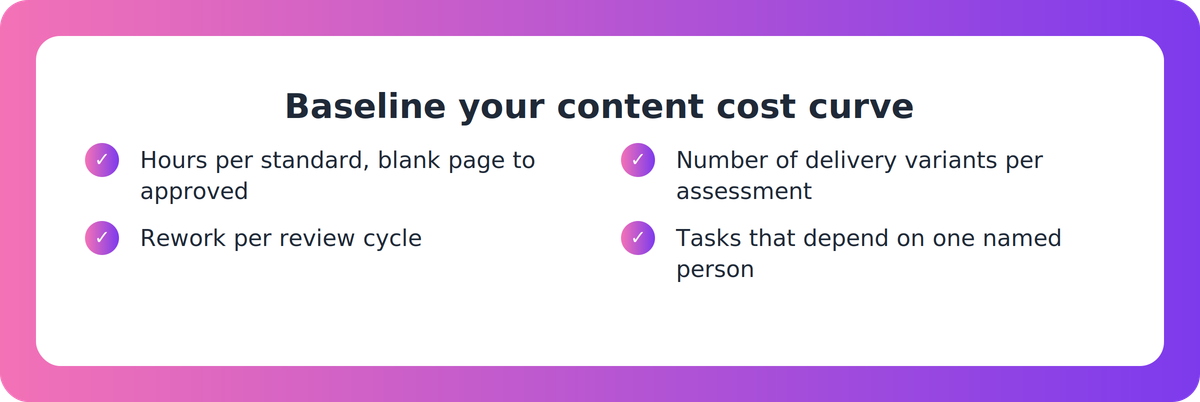
Pick one qualification and one recent standards change, then pull four numbers.
- Hours per standard. From blank page to approved, including the subject expert's time, the reviewer's time and every round of changes.
- Rework per review cycle. When the last standard changed, what share of existing content had to be touched, and how long did it take?
- Variant multiplier. How many versions of the same assessment exist for classroom, workplace and distance delivery, and for different learner needs? Count the versions, then count how many are edited separately.
- Key-person dependency. Which of these tasks could not happen next week if one named person were away?
The fourth number is the one that tends to shock. It tells you whether you have a process or a craft.
From craft to process
A craft depends on the person. A process survives them leaving. For content production, the difference shows up in a few places:
- Mapping is recorded, not remembered. Every assessment task traces to a specific standard and its outcomes. When a standard changes, you can see in minutes what is affected rather than discovering it in moderation.
- One source, several outputs. If a classroom version, a workplace version and a distance version are each built by hand, you pay for each rebuild separately. Build once and adapt, and the rebuild cost stops multiplying.
- Context is a parameter. Industry setting and learner profile (including ESOL and LLN needs) should change inputs, not trigger a fresh project.
- Review is staged early. Quality checks before moderation catch problems when they're cheap to fix, not when they hold up a cohort start.
- Evidence is a by-product. Under self-review, version history, mapping and approval records are part of your own evidence base. Producing them as you go costs far less than reconstructing them later.
None of this requires a particular tool. It requires deciding that content production is an operational process with owners, steps and records.
Our take
Most PTEs treat content as an academic matter and enrolments as the thing operations scales. We think that's backwards. Enrolment growth is mostly a delivery and admin problem you already know how to solve. Content production is the step that quietly keeps its own headcount curve.
Skill standards raise the stakes. Fewer, larger, less prescriptive standards mean each rebuild is bigger, and each interpretation choice matters more. A provider that rebuilds by hand each time will feel every review as a project. A provider with a mapped, repeatable process will feel it as a maintenance task.
We can't tell you your cost curve. Nobody can, and no source we found tries to. But we'd bet the first measurement surprises you, and that the surprise is a person, not a standard.
Key takeaways
- Content production is often the hidden step-cost in a PTE's model: headcount follows rework, and rework follows standards changes, delivery variants and cohorts.
- Skill standards will progressively replace unit standards, with two-year transition periods expected, and each ISB reviews on its own timetable.
- The DASS Rules 2026 remove the five-year maximum review period, so rebuild effort is harder to forecast.
- TEC has warned of a 2027 funding shortfall for domestic enrolments, so growth has to come from reprioritising existing allocations.
- No authoritative source quantifies provider rework cost. Measure hours per standard, rework per review cycle, variant count and key-person dependency yourself.
FAQ
Will skill standards reduce our content workload?
Not automatically. NZQA says skill standards will generally replace several unit standards and carry larger credit values. That consolidates the standards list, but each rebuild is bigger. How your workload changes depends on how your content is mapped and maintained.
How much notice will we get when a standard is replaced?
NZQA's guidelines say standard-setting bodies are expected to set two-year transition periods for superseded unit standards. The timing of each review follows the relevant ISB's timetable, and the DASS Rules 2026 remove the five-year maximum review period. Track the ISBs in your sectors directly.
Why does self-review make content process more important?
Under NZQA's 2026 rules, EER is replaced by self-review under iQAF. That puts more weight on your own evidence. Consistent, traceable assessment and content processes become part of what you can show about your own quality.
What should I measure first?
Take one qualification and one recent standards change. Record hours per standard, rework per review cycle, the number of delivery variants and which tasks depend on a single person. That gives you a baseline without relying on an external figure.
A first step
Before your next planning meeting, ask your content lead one question: if the standards behind your biggest programme changed next month, how long would it take to know exactly what needs rebuilding? The answer is your cost curve.