Assessment generation software uses AI to draft assessment instruments, marking guides and sometimes learning material mapped to a unit or skill standard. NZQA does not approve, certify or list any such tool. Under the 2026 Rules, your PTE stays accountable for assessment and moderation, so buy software that supports your quality management system, not one that tries to replace it.
What is assessment generation software, and does NZQA endorse any of it?
The category is defined by vendors, not by the regulator. Typically, you give the tool a unit standard or skill standard. It drafts tasks, marking guides and assessor guidance against that standard. Some tools also produce learner-facing training material.
There is no NZQA definition, certification scheme or approved-vendor list for this. If a vendor implies NZQA endorsement, ask for the source. Treat "NZQA-aligned" as a claim to test, not a credential.
What do the 2026 Rules mean for the buying decision?
NZQA's updated Rules apply from 19 January 2026. They include the Private Training Establishment Rules 2026 and the Quality Assurance of Tertiary Education Providers Rules 2026. The latter require a quality management system that covers assessment and moderation. A provider without one on 1 January 2026 must create one before 1 January 2027.
Programme approval and accreditation under the 2026 Rules also expect you to show the capability to make assessment materials and decisions fair, valid, consistent and appropriate for the level. You also need an effective moderation system. Software can help you produce and organise materials. The obligations stay with you.
How do you check AI-drafted assessments will survive moderation?
Start with the standard, not the interface. Consent to assess and moderation requirements are standard-specific. Each standard on the DASS has a CMR document setting out the requirements for consent to assess and moderation. National external moderation checks your assessment against the national standard. Non-compliance can lead to compliance notices, conditions, or withdrawal of consent to assess or programme approval.
So test any tool against a standard you know well. Ask it to produce a task for that standard and then check:
- Does it work from the current version of the standard and its CMR?
- Does it show, line by line, how the content maps to the standard's outcomes and evidence requirements?
- Can your most experienced assessor tell where it's weak?
What about the move from unit standards to skill standards?
Unit standards are progressively being replaced by skill standards. A skill standard replaces several unit standards, carries a larger credit value and is less prescriptive. It is mandatory where specified in qualifications and micro-credentials. NZQA's April 2025 guidelines say standard-setting bodies are expected to set two-year transition periods for superseded unit standards.
Your materials will straddle both for a while. A tool should draft against skill standards, help you convert existing unit-standard materials, and flag when a standard changes. If it only handles one, you'll be redoing work within a couple of years.
What should you ask a vendor about approval gates, audit trails and security?
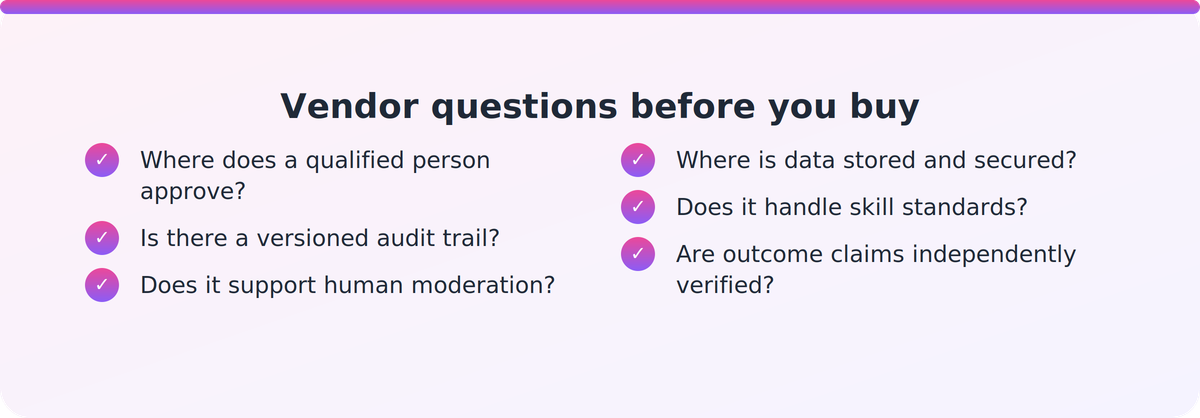
Here's the evaluation list we'd use.
Questions to put to every vendor
- Human approval gates. Where exactly does a qualified, accountable person review, validate and sign off between AI drafting and anything being finalised? Can you see who approved what?
- Audit trail and version control. Are outputs mapped, versioned and logged so you can show your working to NZQA?
- Moderation support. Is it positioned as support for your human moderators, or as a substitute? Only the first fits the Rules.
- Fit with your QMS. Does it follow your assessment and moderation process, or force you into its own?
- Context and learner fit. Can it adapt to your industry, delivery mode and learner groups, such as ESOL or literacy and numeracy learners?
- Output formats. Do you get assessor guides and learning content in print, LMS or SCORM formats you can actually use?
- Data and security. Where is data stored, which security certifications apply, who owns the content, and what are the pricing terms?
- Local credibility. Is NZ-specific regulatory knowledge obvious, or is it an Australian product with a New Zealand page?
NZQA's own use of AI is a useful model. For the 2025 writing literacy assessment, it used Automated Text Scoring with human markers double-checking, and the human mark was used where scores differed. Human-in-the-loop isn't a feature to tick. It's the design.
One caution on AI guidance. NZQA's published guidance on not permitting generative AI in external assessment is aimed at kura and schools (NCEA). It isn't PTE rules. NZQA's tertiary page, Academic integrity and Artificial Intelligence, lists provider expectations, including supporting staff to understand how generative AI can be used in teaching, learning and assessment. Read it in full.
How far can you trust claims like "six weeks to six minutes"?
Treat them as unverified until you've tested them against your own standards and moderation process. Vendor case studies are written to sell. They also describe one customer's setup, not yours.
A good example sits in this very market. SupaHuman publishes a Mast Academy case study, a New Zealand PTE, reporting an 80% reduction in assessment and learning material creation time and course creation cut from six weeks to six minutes. It's one customer, vendor-published, with no independent verification we could find, and the page is well over a year old. That doesn't make it wrong. It means you should run your own pilot and measure how long it takes to get to a moderation-ready, human-approved result, not just a first draft.
Also separate live features from "coming soon" ones, and check funding or market-size figures against primary sources. A "400+ PTEs" figure describes market size, not a customer list.
Where does VETos fit?
VETos is one option, and a fair one to put on your shortlist. It's positioned for New Zealand PTEs, polytechnics and wānanga. It describes generating assessment tools and assessor guides mapped to unit and skill standards and the CMRs under them. It says it can draft against skill standards, upgrade existing unit-standard materials as they convert, and detect NZQA standard updates from uploaded standards so dependent assessments can be regenerated. Outputs are described as mapped, versioned and logged, with a QA Engine checking against the NZQA Principles of Assessment.
Its own buyer's guide frames moderation support as support for human moderation, which is the right framing. Caveats: NZ pricing, hosting and security certification details weren't in the material we reviewed, so confirm those directly. Off-framework courses and AQA (Assessor Quality Assurance) are marked "Coming Soon", so don't assume they're live.
Whichever vendors you shortlist, a sensible next step is a pilot: pick one standard, run it through the tool, and put the output in front of your own moderator. You can see what VETos says about itself at supahuman.com.
Key takeaways
- NZQA has no approved-tool list for assessment generation software. The category is vendor-defined, so test claims yourself.
- Under the 2026 Rules, your PTE stays accountable for a quality management system covering assessment and moderation.
- Check mapping to current unit and skill standards and their CMRs, and how the tool handles the unit-to-skill transition.
- Insist on explicit human approval gates, plus an audit trail and version history you can show NZQA.
- Treat outcome claims, including single-customer case studies, as unverified until a pilot proves them on your standards. Confirm data, security and pricing in writing.
Our take
The best question isn't "how fast can it draft?" It's "how quickly can a qualified person verify and approve what it drafted?" Speed that skips validation just moves the cost to moderation, where it's more expensive and more public. We'd back any tool that makes your assessors' judgement easier to apply and easier to evidence, and we'd walk away from any that makes it optional.
FAQ
Does NZQA approve or certify assessment generation software?
No. There is no NZQA definition, certification scheme or approved-vendor list for this category. The description comes from vendors. Your PTE remains accountable for assessment and moderation under the 2026 Rules, whichever tool you use.
How do I check AI-drafted assessments will stand up to NZQA moderation?
Test the tool against a standard you know well, using the current standard and its CMR. Check that it maps content to the standard, that a qualified assessor reviews and approves the output, and that your own moderation process still applies before anything is finalised.
What should I ask a vendor before buying?
Ask where data is stored, what security certifications apply, who owns the content, what the pricing terms are, and what approval gates sit between AI drafting and finalisation. Also ask about audit trails, version control and how the tool handles skill standard updates. Get answers in writing.
Can I trust vendor claims like "six weeks to six minutes"?
Treat them as unverified until you've tested them. A vendor-published single-customer case study isn't independent evidence. Run a pilot on your own standards and measure the time to a human-approved, moderation-ready result.
Do skill standards change what I should look for?
Yes. Skill standards are progressively replacing unit standards, with larger credit values and less prescriptive detail. Choose a tool that handles both, helps convert existing materials, and tracks standard updates during the transition period.