No public benchmark exists for cost per student or operating margin at a New Zealand PTE. The number your board holds you to is one you build yourself, from your own data and your own assumptions. As reform lands, PTEs that can't see it by programme, compliance effort included, will be steering blind.
Why this lands on your desk
You answer for growth, margin and regulatory standing. Our research found no authoritative sector average for cost per student, and none for PTE operating margin. So any claim that you're "above" or "below" the sector is, at best, an internal calculation dressed up as a statistic.
That makes how you build the number a strategic decision, not a finance housekeeping task. Registration with NZQA is tied directly to revenue: providers that aren't universities, polytechnics or wānanga need PTE registration to be eligible for TEC funding (TEC FAQ). Staying in good standing is part of what each student costs you. Most cost models don't show it.
Build the number at programme level
A provider-wide average hides the thing you most need to see. One programme may carry three others, and TEC's 2026 Plan Guidance says demand for funding is expected to exceed what's available. Enrolments must stay within allocation, with no guarantee of funding above it. Growth decisions therefore turn on which programmes genuinely earn their keep.
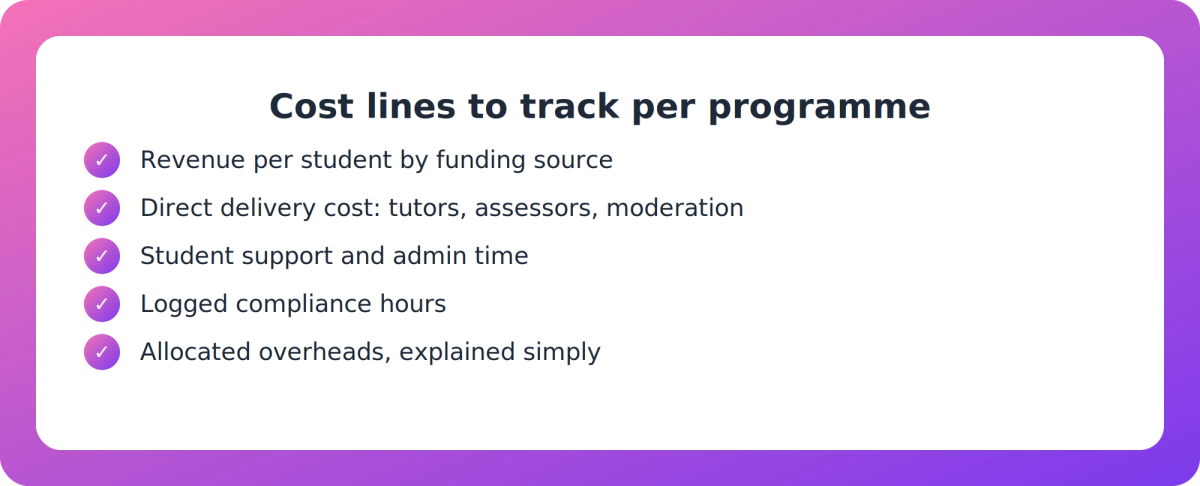
For each programme, the minimum useful view is:
- Revenue per student (TEC funding, fees, any other income), by funding source.
- Direct delivery cost: tutors, assessors, moderation, materials, placement or employer-liaison time.
- Student support and administration time, from enrolment to completion.
- Allocated overheads, using a method you can explain to a board in two minutes.
The point is not precision. It's a defensible number that moves when reality moves.
Put compliance effort in the cost base
Compliance is usually treated as overhead, absorbed somewhere between the quality manager's salary and a few late nights. That's the problem. If it isn't attributed, you can't tell which programmes are expensive to keep in good standing.
The shape of NZ quality assurance is changing. Per secondary sources (Technical Institute, Supahuman) that you should check against NZQA's own pages, iQAF went live in January 2026, NZQA has stopped starting new EERs, and from July 2026 non-university tertiary providers must complete an annual self-review. Those same sources say a provider without a quality management system meeting Rule 4(2) of the Quality Assurance of Tertiary Education Providers Rules must build one before 1 January 2027 and produce it to NZQA on request.
Whatever the fine print, the direction is clear: quality assurance becomes a recurring, annual workload rather than an occasional event. Track it as a standing line, with hours attached.
What to measure
Start simple. Ask your team to log, for one quarter, the hours spent on self-review evidence, moderation, standards updates and funder reporting. Then split them by programme. You'll probably find the effort isn't evenly spread, and that one or two people hold most of the knowledge. That's key-person risk showing up as a cost line.
Four pressures moving the number
1. Revenue levers are narrow but real. Budget 2025 funded the Student Loan Scheme to let providers increase fees by up to 6% in 2026 (TEC). Whether you can use that depends on your market and your programmes, which is another reason to know programme-level cost.
2. Funding is tight and risk appetite is low. TEC's 2026 Plan Guidance signals that providers with strong delivery track records are well placed, particularly for growth. Your cost and outcome data is part of making that case. The 2027 investment round plans were due 3 July 2026, so check where yours landed.
3. The reform adds cost lines nobody has priced. Eight Industry Skills Boards began formally on 1 January 2026 with a standard-setting role. They'll be funded through public funding, optional industry levies and fees for quality assurance services. We found no amounts. Treat ISB fees as an unknown, not a zero.
4. Work-based learning is moving. Those divisions moved from NZIST to an ISB in January 2026 and then transfer to polytechnics, wānanga or PTEs, with the Ministry of Education saying the transition runs to the end of 2027. TEC's list of receiving organisations includes PTEs such as BCITO Limited, MITO Limited and NZMA. If you're a receiver, or competing with one, your forward margin picture shifts.
One regulatory note. The PTE Rules 2026 replace the PTE Registration Rules 2025 and the PTE Enrolment and Academic Records Rules 2022, and remove the annual fee. Non-funded PTEs file financial returns every two years unless NZQA directs otherwise. That relaxation is stated for non-funded PTEs only. If you're funded, don't assume it applies to you.
Model scenarios, not assumptions
Some of the biggest variables are simply unknown. We didn't find ISB fee levels, and we didn't find the outcome of NZQA's mid-2026 consultation on four proposed quality criteria. Planning around a guess is how margin gets squeezed quietly.
Build three simple cases for each major programme: a base case, a case with ISB quality assurance fees at a plausible level, and a case where compliance effort grows by a set percentage. You don't need to predict which one happens. You need to know which programmes break first.
A word on AI, since boards ask. NZQA guidance asks providers to support staff to understand generative AI in teaching, learning and assessment and to review academic integrity policies regularly. We found no NZQA or TEC rule requiring or prohibiting AI in PTE back-office operations, and no official PTE adoption data. So keep claims modest. Treat it as a question about where your staff hours go, which your programme-level view will answer first.
A first step this month
Pick your three largest programmes. Build revenue, direct cost, support time and logged compliance hours for each. Do it roughly, in a spreadsheet, and put it in front of your leadership team.
Then ask which programme you'd grow if TEC allocation stayed flat, and which you'd quietly stop if compliance effort rose by a quarter. If you can't answer, you've found the real gap.
Key takeaways
- No public benchmark exists for PTE cost per student or margin, so your internal calculation is the reference. Frame it that way to your board.
- Calculate cost per student by programme, not provider-wide, and include compliance effort as a tracked cost line.
- iQAF's annual self-review (per secondary sources, verify with NZQA) makes quality assurance a recurring workload, not a periodic event.
- ISB quality assurance fees, work-based learning transfers and the quality criteria consultation are unknowns. Model scenarios rather than assume.
- Under flat TEC allocation and lower risk appetite, knowing which programmes earn their keep is what makes growth decisions credible.
Our take
The sector talks about reform as a compliance event. For a CEO it's mainly a cost-visibility event. Rules, fees and funding settings will keep shifting, and you can't control that. What you can control is whether you can see the effect on each programme within weeks rather than at year-end.
We'd go further: a provider that can't state its cost per student by programme isn't really choosing where to grow. It's guessing, with good intentions. The PTEs that come through 2027 in the best shape will likely be the ones that did the unglamorous costing work early.
FAQ
Is there a sector benchmark for PTE cost per student in New Zealand?
Not that we found. There is no public, authoritative data on average PTE cost per student or operating margins. Treat any figure you see as an internal calculation, and use your own programme-level data as the reference.
Does the removal of the annual fee under the PTE Rules 2026 lower my costs?
The PTE Rules 2026 remove the annual fee and replace the 2025 registration rules and the 2022 enrolment and academic records rules. NZQA states the biennial financial return relaxation for non-funded PTEs only, so funded PTEs shouldn't assume it applies to them.
How should I budget for ISB quality assurance fees?
As an unknown. ISBs will be funded through public funding, optional industry levies and fees for quality assurance services, but we found no amounts. Model low, mid and high scenarios and see which programmes remain viable in each.
Can I raise fees to protect margin?
Possibly. Budget 2025 funded the Student Loan Scheme to let providers increase fees by up to 6% in 2026 (TEC). Whether it's sensible depends on your programme-level cost and what your market will bear.