Under the Standards for RTOs 2025, "we moderate" is no longer a defensible answer. The question you now have to answer is whether two trainers, looking at the same evidence, reach the same competency call. RTO assessment moderation consistency is a skill your team practises. It is not a form your team signs.
Why this lands on your desk
Inconsistent judgement between trainers is your problem first. You see it in the learner who passes with one assessor and is marked not yet competent by another, long before an auditor sees anything.
The regulatory ground has also shifted. The Standards for RTOs 2025 have been in effect since 1 July 2025 and are outcome-based. ASQA has said its previous approach to assessment doesn't fit them, and that providers can supply different forms of evidence to show they meet the standards. That moves your question from "did we follow a process?" to "can we show our assessors reach consistent, defensible decisions?"
There is scrutiny behind it, too. ASQA's 2025-26 risk priorities led with non-genuine providers, and its research notes that some RTOs issue qualifications to students who haven't demonstrated competency. Whatever the wording of future priorities, assessment judgement is a visible risk area, and you answer for it.
Moderation and validation are not the same job
Keep these two apart, because blurring them is how "we moderate" becomes an empty answer.
Validation is the formal, periodic review of assessment. Secondary sources (VET Resources, eSkilled and others) report that it is required at least once every five years per training product, more often where risk, change or feedback point to a need. They also report that it must be independent of design and delivery, and that assessment tools should be reviewed before use. Those are secondary reports. Confirm the detail against ASQA's Assessment Practice Guide before you build a schedule on them.
Moderation, as we're using it here, is the ongoing work of making trainers' judgements line up. Here is the honest bit: our research found no authoritative source setting a required format for moderation, and didn't find the 2025 Standards defining it separately. ASQA has published 19 Practice Guides, all now final, and that is where to check what it expects.
That gap is useful. Nobody has prescribed your moderation design, so you can build one that works rather than one that merely files neatly.
Build calibration as a practised skill
A paperwork event asks "was a sample reviewed and a form completed?" A practised skill asks "when our trainers judge the same evidence cold, how often do they agree, and what do we do about the times they don't?"
That second question is measurable. It also produces something you can show a regulator who accepts different forms of evidence: a record of decisions, disagreements, resolutions and changes made as a result.
A calibration cycle you can run this quarter
This is a design suggestion, not a regulatory requirement.
- Pick a unit of competency with known friction. Start where learners or trainers have already flagged inconsistency, not where the paperwork is due.
- Judge independently. Give two or more trainers the same de-identified learner evidence. Each records a decision and a short reason before anyone talks.
- Compare and dig into the gaps. Where calls differ, find out why. It might be an ambiguous criterion, an under-specified benchmark or a different reading of the evidence.
- Fix the tool or the benchmark. If the disagreement came from the assessment, change the assessment. Add annotated exemplars of "competent" and "not yet" so the next trainer starts closer to the standard.
- Record it and repeat. Keep the decisions, rationale and changes. Run it again after the fix to see whether agreement improved.
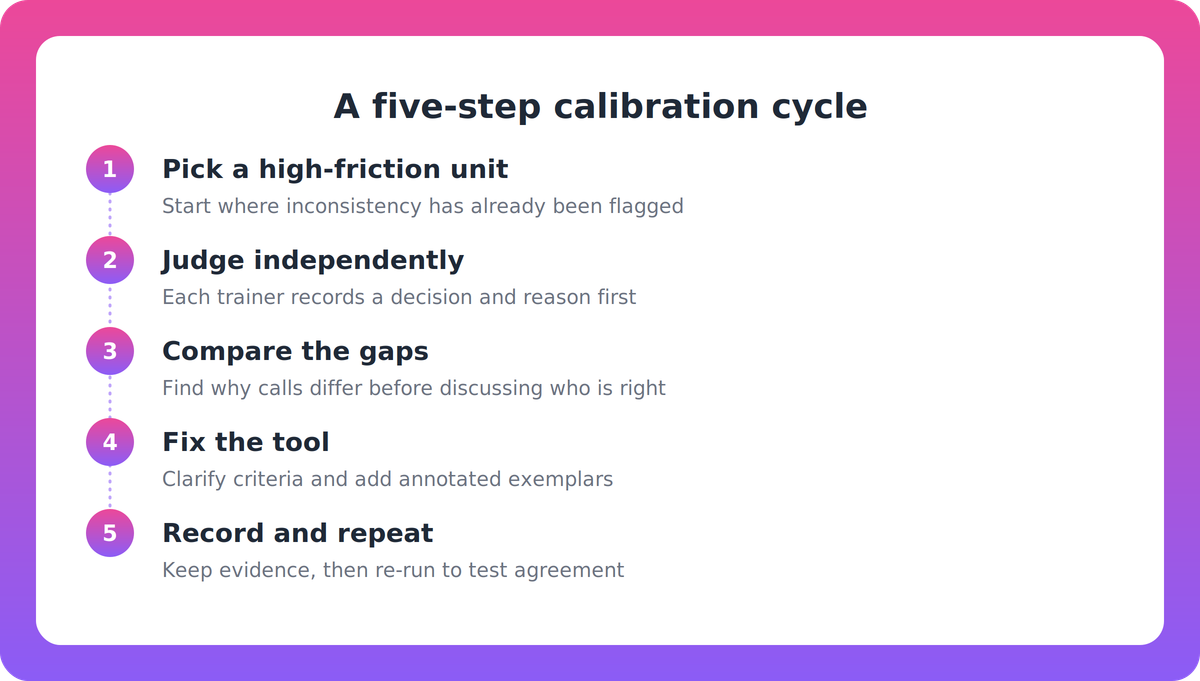
The value is in step 4. Most inconsistency is a design fault in the tool or the benchmark, not a fault in the trainer. If you treat disagreements as trainer errors, people will hide them. If you treat them as information about the assessment, they surface.
Protect it against trainer turnover
Calibration decays. The Productivity Commission's Report on Government Services 2026 says VET teacher outflow exceeded inflow in eight of nine reference years. A secondary summary (CAQA) cites a national shortage and an ageing workforce, but those figures need checking against the PC report before you quote them.
Jobs and Skills Australia's VET Workforce Study (October 2024) adds a caution: trainers and assessors are hard to count because of their dual professional status. So don't assume a precise figure for how many assessors you're competing for. Assume your team changes, and plan for it.
A one-off moderation day then isn't enough. Three habits help:
- Make calibration part of onboarding. A new trainer judges benchmark evidence alongside experienced colleagues before assessing live learners.
- Keep sessions short and frequent. Forty-five minutes on one tricky unit beats a full-day event nobody can attend.
- Protect the hours. Moderation competes with delivery for the same trainer time. An Industry Skills Australia study (transport and supply chain only) found technological change is raising the time and cost of maintaining vocational currency. In that sector at least, currency and consistency draw on the same limited hours. Put calibration on the workload plan, or it will be the first thing dropped.
Key takeaways
- Under the outcome-based Standards for RTOs 2025, the defensible question is whether trainers reach the same call on the same evidence, not whether a moderation process exists.
- Keep moderation (consistency of judgement) separate from validation (formal, periodic, independent review). Confirm validation timing and independence against ASQA's Practice Guides.
- Our research found no authoritative required format for moderation, so the design is yours. Be honest about that with your team.
- Treat disagreement between assessors as information about the assessment tool, then fix the tool.
- Trainer outflow has exceeded inflow in eight of nine reference years, so build calibration into onboarding and workload, not into an annual event.
Our take
Most RTOs can show a moderation record. Fewer can show that their trainers agree. We think the second is the stronger position, because it's the one that holds up when ASQA is looking at whether qualifications reflect demonstrated competency.
The uncomfortable part is that measuring agreement will expose disagreement. We'd rather you find it in a Tuesday calibration session than in a learner complaint or an audit.
A first step for this week: choose one unit, give two trainers the same de-identified evidence, and ask for independent decisions with reasons. Don't discuss it until both are written down. What you learn from the gap is your real starting point.
FAQ
Do the Standards for RTOs 2025 define moderation?
Our research found no authoritative source setting a required format for moderation, and did not find the 2025 Standards defining it separately from validation. Check ASQA's Practice Guides for current expectations. Until then, treat moderation as a practice you design to demonstrate consistent judgement.
What is the difference between moderation and validation?
Validation is a formal, periodic review of assessment. Secondary sources report it is required at least once every five years per training product, independent of design and delivery. Moderation, as used here, is the ongoing work of aligning trainers' judgements. Confirm validation requirements against ASQA's Assessment Practice Guide.
How do I show consistency under an outcome-based standard?
ASQA has said providers can supply different forms of evidence to show they meet the standards. Records of independent assessor decisions, how disagreements were resolved, and what you changed in the tool or benchmark show consistency in action rather than process alone.
How do I keep judgement consistent when trainers keep leaving?
Build calibration into onboarding, run short, frequent sessions on high-friction units, and protect the time in workload plans. The Productivity Commission's RoGS 2026 reports teacher outflow exceeding inflow in eight of nine reference years, so calibration needs rebuilding repeatedly, not once.