RTO consolidation in Australia is usually framed as a pricing question. It is really a testing question. Before you scale or sell, a buyer, ASQA and your board will each probe the same three things: regulatory standing that survives a change of ownership, a compliance function that isn't one person, and a delivery model that doesn't rely on a scarce, ageing trainer workforce.
One caveat first. We found no authoritative public data on RTO deal volumes, valuations or buyer activity, so we won't claim a measured "wave". What we can say is that the tests above are real, documented and yours to prepare for.
Why this lands on your desk
You hold the CEO relationship with ASQA. The Annual Declaration on Compliance goes to CEOs, and ASQA's 7 May 2026 Statement of Regulatory Expectations on Fit and Proper Person Requirements and notification of material change puts ownership and governance changes squarely in scope for any scale-up or sale.
You also answer to the board or owners for margin and regulatory standing. A deal exposes both. Buyers will ask about audit history, validation discipline and who the compliance function actually depends on.
And you can't easily buy your way out of trainer supply. That makes it a growth constraint, not a rostering problem.
Protect regulatory standing first
The 2025 Standards for RTOs took effect on 1 July 2025. They have three parts: the Outcome Standards, the Compliance Standards (which include the Fit and Proper Person Requirements) and the Credential Policy.
The May 2026 statement matters most for anyone planning a change of ownership or governance. A secondary source says non-compliance may lead to a finding against the 2025 Standards and further regulatory action. We could not verify the exact notification triggers and timeframes, so read ASQA's statement directly. Don't rely on a summary, including this one.
Then check your own house:
- Are the people in your governance and control structure documented, with their Fit and Proper Person evidence current?
- Could you describe, today, which proposed changes would count as material?
- Do you know when you would need to notify ASQA, and who owns that decision?
If the honest answer is "it depends who you ask", fix that before a buyer asks the same question.
Make the compliance function outlast any one person
Key-person risk is the quiet discount in most RTO deals. If one compliance manager holds the audit history, the validation calendar and the relationship knowledge, a buyer will price that in. So will your board.
Validation is the clearest place to show discipline. Under the 2025 Standards, every training product on scope must be validated at least once every five years, and more often where risks, product changes or feedback arise (per Knowledge Foundry, a secondary source). A current, documented validation record is evidence you can hand to a buyer or a regulator without a story attached.
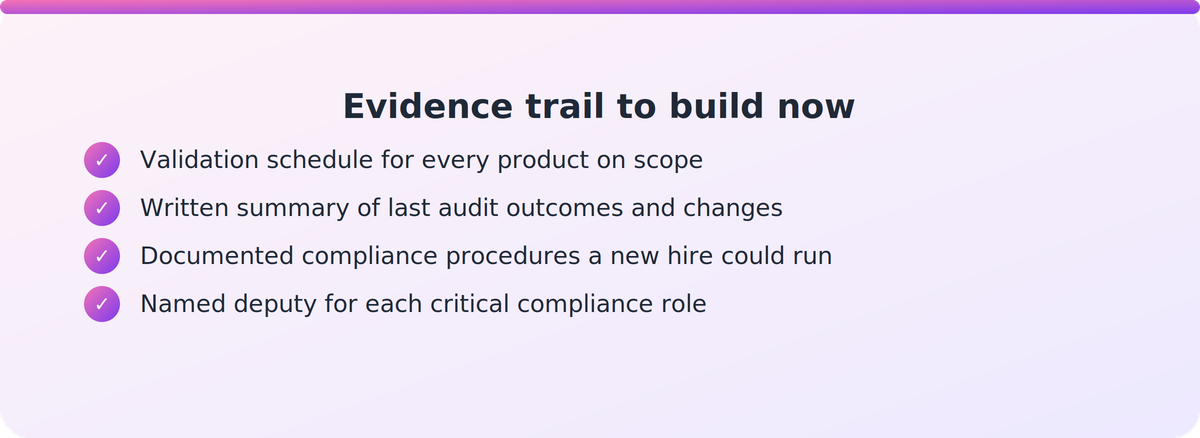
An evidence trail you can build this quarter
- A validation schedule covering every product on scope, with outcomes recorded.
- A written account of your last audit outcomes and what changed afterwards.
- Compliance procedures documented well enough that a competent new hire could run them.
- A named deputy for each critical compliance role.
Audit outcomes are only indicative. Treat any single set of published figures as context, not a trend, and don't build a deal narrative on them.
Know whether the ACCC regime touches your deal
The ACCC's mandatory and suspensory merger regime applies to deals completing from 1 January 2026, but only above specified thresholds. According to law firms Ashurst and MinterEllison, a notifiable acquisition completed without clearance or a waiver is automatically void and carries penalty risk.
BDO summarises the main test as combined Australian turnover above $200 million, plus either $50 million turnover for each of at least two merging businesses or a global transaction value above $250 million.
Roll-ups need extra care. MinterEllison describes a three-year look-back that counts cumulative revenue from acquisitions of the same or substitutable services, at A$50 million, or A$10 million for a very large acquirer. If your plan is to stack several small acquisitions, the thresholds may be tested over the whole sequence, not deal by deal.
Whether your deal meets any threshold depends on the parties' turnover. That is a question for a lawyer, early.
Don't build growth on a thinning trainer pool
Jobs and Skills Australia found VET teachers in shortage nationally, and in every state and territory for two years. The workforce is highly casualised, almost 50% are over 50, and pay trails other education sectors. The Productivity Commission's Report on Government Services 2026 found VET teacher outflow exceeded inflow in eight of nine reference years.
AUSMASA projects VET trainer employment growth of 9% from 2025 to 2030 and 19.2% by 2035. Demand is rising against a supply problem.
For a buyer, an acquired RTO is only as scalable as its trainers. Ask yourself how many of your delivery hours rest on a handful of senior, casual trainers, and what happens to enrolments if two of them leave. A delivery model that is less dependent on individuals is an asset. So is evidence that you've already worked on it.
Treat AI as a governance item, not a growth story
You're being asked what AI means for the business. ASQA's 5 Principles for the Responsible Use of AI in VET (30 July 2026) turn that into a governance question: governance, human oversight, information security, student equity and alignment with the requirements of the training product.
A sector publication says the principles add no new regulatory requirements and help providers interpret existing obligations, including the 2025 Standards. So don't treat AI as a valuation lever. Treat it as a test of how well you govern. AI use that is documented and overseen is something you can show a buyer or ASQA. AI use that nobody owns is a liability that could surface in due diligence.
Key takeaways
- Buyers, ASQA and your board will test regulatory standing, compliance resilience and delivery capacity, not just price.
- Read ASQA's 7 May 2026 statement on Fit and Proper Person Requirements and material change directly, and confirm your notification triggers.
- Document validation (at least every five years per product) and make compliance work independent of any one person.
- The ACCC regime applies only above thresholds, including a three-year look-back for roll-ups. Get legal advice early.
- Trainer supply is a documented constraint. Any AI use should be written down and overseen.
Our take
The CEOs who sell or scale well won't be the ones with the best pitch. They'll be the ones who can open a drawer and show clean evidence. Regulatory standing, validation, succession in compliance, workforce planning and AI oversight are all tedious to document and expensive to reconstruct under deadline.
We'd also resist the temptation to talk about a consolidation "wave". The public data isn't there. Plan for your own situation, not for a trend you can't measure.
FAQ
What should an RTO CEO do first when considering a sale or acquisition?
Read ASQA's 7 May 2026 Statement of Regulatory Expectations on Fit and Proper Person Requirements and material change notification, then get regulatory and legal advice early. Exact triggers and timeframes should be confirmed with ASQA directly.
Does the ACCC merger regime apply to RTO deals?
Only if thresholds are met. BDO describes the main test as combined Australian turnover above $200 million plus either $50 million turnover for each of at least two merging businesses or a global transaction value above $250 million. Roll-ups face a three-year look-back, so take legal advice.
How often must training products be validated under the 2025 Standards?
According to Knowledge Foundry, a secondary source, at least once every five years for every product on scope, and more often where risks, product changes or feedback arise.
Do ASQA's AI principles create new compliance obligations?
A sector publication says they add no new regulatory requirements and help providers interpret existing obligations, including the 2025 Standards. They cover governance, human oversight, information security, student equity and alignment with the training product's requirements.
Here is a first step. Ask your compliance lead which three things would stop working if they resigned tomorrow. Then write those down this week.