No single product category covers training material and assessment alignment software. RTOs choose between three types: a learning or student management system with mapping functions, pre-written resource packs with mapping documents, or an AI authoring platform that builds materials and assessments from one shared mapping. ASQA endorses none of them, and qualified people stay accountable.
What software links training materials to assessments in an RTO?
Buyers searching this term find three different kinds of product. They solve different problems, so the first job is deciding which problem you have.
Type 1: LMS or student management systems with mapping functions
These platforms manage delivery, enrolment and records, and add a mapping layer on top. aXcelerate, for example, describes pulling unit components from training.gov.au and mapping assessment items to them. The mapping sits alongside your existing records.
The trade-off: they usually map content you already have. They don't write the learner guide or the assessment tool for you. (This description comes from vendor content.)
Type 2: Pre-written resource packs with mapping documents
Resource vendors sell ready-made learner guides, slides and assessment tools, with a document showing how unit requirements map to each. Compliant Learning Resources is one example, mapping unit requirements to the learner guide, PowerPoint and assessment tools (again, vendor content).
This is fast to start. The risk is fit. A VET Resources case study describes a non-compliance finding where tools bought from a vendor weren't contextualised to the RTO's cohort.
Type 3: AI authoring platforms
These generate training materials and assessments together from one shared mapping, so the two are built from the same source. VETos is one example. This category is the newest, and the research found no independent reviews or audit outcomes for any AI authoring platform. Treat claims as claims until you've tested them.
What does ASQA expect, and does it endorse any software?
The Standards for RTOs 2025 came into effect on 1 July 2025. Standard 1.3 reads: "The assessment system is fit-for-purpose and consistent with the training product" (ASQA Practice Guide – Assessment, v1.0, June 2025).
That's an outcome. The research found no ASQA software accreditation, endorsement or requirement. Any vendor implying otherwise should be asked for the source.
Secondary sources add detail. Assessment Ally, a consultancy, says Standard 1.3 means reviewing assessment tools before use against the Principles of Assessment and the Rules of Evidence. Knowledge Foundry says each training product must be validated at least once every five years by credentialled people. Verify both against ASQA's 2025 Standards FAQs (version 3) before you build a process around them.
What should the tool produce as audit evidence?
A tool is only useful if it helps you show an auditor the line from unit requirement to learning resource to assessment task. Validators check that the mapping document accurately reflects the assessment tool and how it covers the unit (Specialised VET Services).
Ask to see these outputs:
- A mapping matrix that separates knowledge, skills and performance evidence, and shows where each resource and task covers each requirement.
- A pre-use review record showing who checked the mapping and when.
- Version history or change logs, so the matrix matches the tool as it exists today, not as it was first drafted.
- An exportable format a validator can open without your software.
- Clear links between learner materials and assessment tasks.
ASQA's older "Spotlight On" series, written under the 2015 Standards, lists records to keep from validation: participants, sample pool, tools, samples and outcomes. Check that against current guidance before relying on it.
How do you test it on a unit you deliver?
No standard certification scheme exists for this software. The most reliable comparison is practical: run a real unit through each option you're considering.
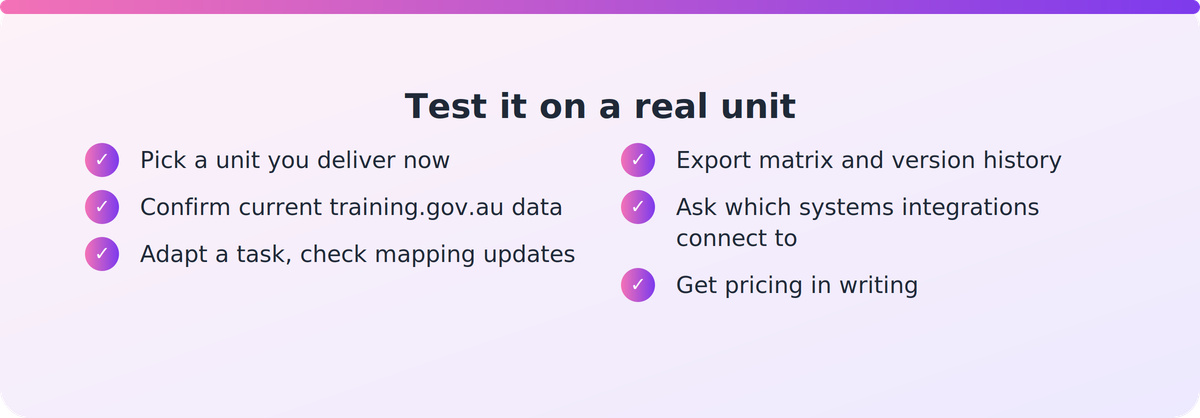
- Pick a unit you deliver now, ideally one with a mixed cohort or an awkward delivery mode.
- Check the data source. Does it use current training.gov.au data, and handle both traditional and ASK-format units?
- Change something. Adapt a task, then see whether the mapping updates or someone has to rebuild it by hand.
- Look for gaps. Is a missed criterion visible while you work, or only after review?
- Export everything. Can you get the matrix, change history and materials out in formats your systems accept (Word, SCORM, LMS)?
- Ask what "integrations" means. Get the exact systems named.
- Check context. Does it handle your industry, cohort and delivery mode, including ESOL and LLN adaptations, or is it generic?
- Get the price in writing, plus a trial on your own unit.
Also check scope. Some tools only map. Some generate. Delivery, enrolment and marking belong to an LMS or student management system, so you may need one of those regardless.
Who stays accountable when AI generates and maps the materials?
You do. The RTO, through qualified, accountable people. AI can assist with drafting and mapping, but pre-use review under Standard 1.3, validation under Standard 1.5 and every competency decision stay with humans.
Look for role-based review and approval in the tool, and a plain statement from the vendor that qualified assessors validate and sign off. If a product suggests a compliance check replaces that, walk away. Mapping accuracy is something a person has to confirm.
Where VETos is a fair fit
VETos describes itself as an AI authoring platform, not an LMS. According to the vendor, it generates assessment tools, learner guides, SCORM packages, session plans, assessor guides, mapping documents and training and assessment strategies from one mapping to your scope, held from training.gov.au data. It says superseded units are flagged and that the mapping updates when a task is adapted for ESOL or LLN learners. These are vendor claims, not independently verified.
Each tool comes with an exportable mapping matrix covering traditional and ASK-format units, with version history kept as an evidence trail. Exports include editable Word, print-ready InDesign (.idml) and SCORM. The sites don't say which systems the integrations tier connects to, and they don't describe delivery, enrolment or marking, so it doesn't replace an LMS or student management system.
The signup page lists a 14-day free trial and Stand-alone, Integrated and Multimedia tiers, with an estimated annual licence of $42,500 after the trial. Confirm pricing directly. No independent reviews, audit outcomes or ASQA endorsement were found. You can see the product at vet.supahuman.com and test it on a unit of your own.
Key takeaways
- There's no single category. You're choosing between an LMS/SMS with mapping, resource packs with mapping documents, or an AI authoring platform.
- ASQA's Standard 1.3 asks for an assessment system consistent with the training product. It doesn't accredit or endorse software.
- A good tool helps you produce a mapping matrix, a pre-use review record and version history. It doesn't produce compliance by itself.
- Test on a unit you deliver: change a task, export the evidence, and check the context fit.
- Pre-use review, validation and competency decisions stay with qualified, accountable people, whatever you buy.
Our take
Start with the problem, not the product name. If your gap is records and delivery, you need an LMS. If you need a fast start on a unit and can tolerate generic content, packs can work. If your pain is building materials and assessments that stay aligned across a portfolio, an authoring platform is worth a trial. Whichever you choose, the proof is a real unit, an edited task and an exported matrix that a validator would accept. Be sceptical of any vendor, including us, that can't show you that.
FAQ
What software links training materials directly to assessments in an RTO?
There are three types: LMS or student management systems with mapping functions, pre-written resource packs with mapping documents, and AI authoring platforms that generate materials and assessments from one shared mapping. No standard category or certification exists, so compare them on a unit you deliver.
Does ASQA require or endorse any software for this?
No. The research found no ASQA software accreditation, endorsement or requirement. Standard 1.3 of the Standards for RTOs 2025 asks that the assessment system is fit-for-purpose and consistent with the training product. How you achieve that is up to you.
What audit evidence should the tool help produce?
At minimum, a mapping matrix that separates knowledge, skills and performance evidence, a pre-use review record showing who checked what and when, version history, and a clear line from each unit requirement to a specific task and benchmark.
Who is accountable if AI generates and maps the materials?
The RTO, through qualified people. Pre-use review, validation and competency decisions stay with accountable humans. AI can assist with drafting and mapping, but it doesn't replace validation or sign-off.
How do I test a tool before buying?
Run a unit you actually deliver. Check the training.gov.au data source, adapt a task and see whether mapping updates, export the evidence, and ask exactly which systems any integrations connect to. Get pricing in writing.