Moderation changes practice only when you run it as your main lever on inconsistent assessment, not as a compliance event. With iQAF live and NZQA no longer starting external evaluation and review, annual self-review leans harder on what you can show has changed. Meetings that end in decisions, owners and follow-up checks give you that evidence.
Why this lands on your desk
You own assessment consistency across trainers. Moderation is the one routine forum where two trainers' different judgements on the same evidence can surface and be corrected, ideally before an external moderator finds them.
The accountability has shifted too. NZQA's integrated Quality Assurance Framework (iQAF) went live on 1 January 2026. NZQA stopped starting new external evaluation and review processes and consistency reviews, and those already underway will be completed. Providers now submit an annual self-review summary report and meet NZQA to discuss the improvement plan.
That meeting is about improvement. "We held moderation meetings" is a weak answer to it. "We found trainers marking this task differently, decided on a shared benchmark, and re-checked a sample six weeks later" is a strong one.
There is a further signal. NZQA has consulted on a rating system to replace EER categories (Highly Effective, Effective, Not Effective). It would be assessed against four weighted criteria, one of which is assessment practice. Consultation closed on 7 September 2026 and I found no final decision, so treat it as direction of travel, not settled rules. Even so, assessment quality looks likely to be judged directly.
External moderation is the floor, not the system
Providers with consent to assess must take part in national external moderation. It exists to make assessment decisions for NZQA-managed standards consistent nationally. The updated NZQA Rules took effect on 19 January 2026, and the Consent to Assess Rules 2026 require you to show how you will meet, and then comply with, the Quality Assurance of Tertiary Education Providers Rules to keep your consent.
The complication is that standards now sit under different Industry Skills Boards (ISBs). There are eight, established on 1 January 2026, and each sets its own requirements. The examples in the public material show how much they vary:
- Manufacturing and Engineering ISB: requires providers to keep their own internal moderation systems and take part in its national external moderation, covering pre-assessment, post-assessment and on-site moderation.
- Muka Tangata: says it applies a risk-based approach. Its page still showed 2025 focus areas when I checked, so confirm what is current.
- Services ISB: publishes a 2026 National External Quality Assurance Plan.
The practical move is to build one register of external expectations, listing each standard-setting body you assess against and what it asks of you. Treat that register as the minimum. Then run a single internal moderation system on top that doesn't change shape depending on which ISB a programme sits under.
A meeting structure that ends in decisions
Most moderation minutes record attendance, a few comments and "actions noted". Nobody reads them because nothing in them demands a response. Change the output, and the meeting changes with it.
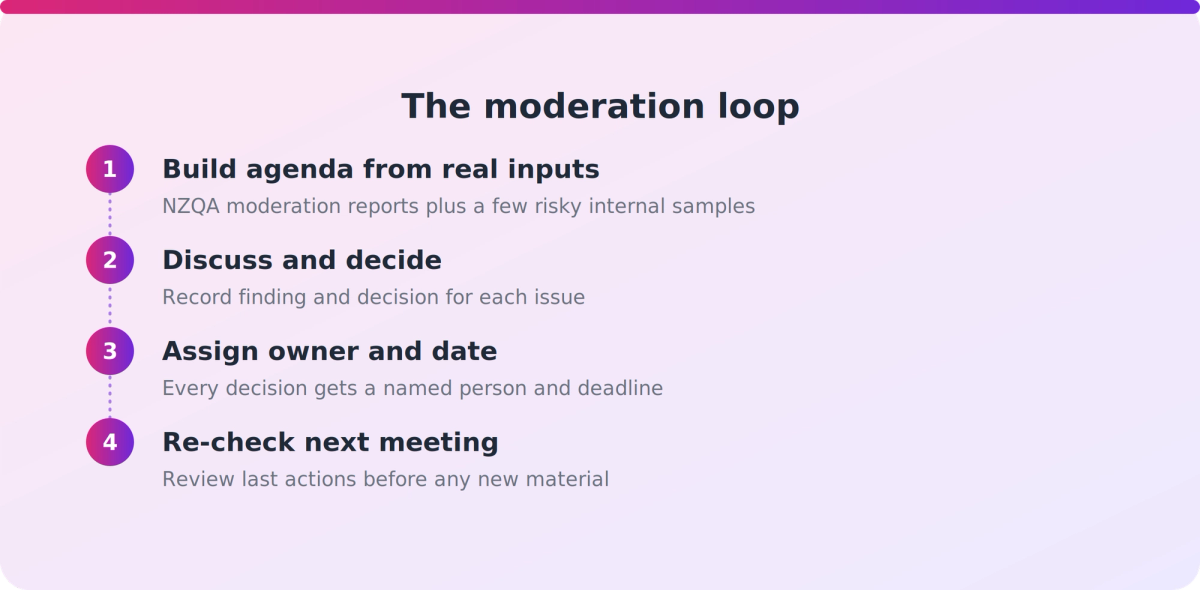
Build each agenda from real inputs. NZQA's online moderation application lets you access moderation reports, manage moderation plans, submit materials at any time during the year and track progress on a dashboard. Those reports are a ready source of agenda items. Add one or two internal samples, chosen because you suspect trainers are judging them differently.
Then run the same four-step loop every time.
The decision log
For every issue discussed, record five things: what we found, what we decided, who owns it, by when, and how we'll check it worked. If an item can't fill all five, it is either not an issue or not ready for the meeting.
"Trainers interpreted the sufficiency requirement differently" is a finding. "Aroha will draft an annotated benchmark example by the 20th, and we'll re-moderate five samples next meeting" is a decision.
Close the loop first
Open every meeting by reviewing last time's actions, before any new material. This one habit does the most to change trainer behaviour, because people learn that what is agreed will be asked about again.
Feed the self-review, don't wait for it
The decision log is also your self-review evidence, collected as you go. Once a quarter, read it across and ask three things:
- Which issues keep recurring, and with which standards or trainers?
- Which decisions demonstrably changed practice when you re-checked?
- Which decisions stalled, and why?
The answers become the substance of your annual self-review summary report and the improvement plan you discuss with NZQA. You are no longer reconstructing the year from memory in the weeks before submission. If you are building a broader evidence habit, the same logic applies to trainer currency: record it as it happens, not afterwards.
Protect trainer time
This has to be lean. TEC's 2026 rate examples show a 10% VET decrease for all work-based delivery, with one work-based example showing a net 7% decrease. Trainer hours are not getting looser, so a moderation process that adds paperwork will be quietly abandoned.
A few ways to keep it tight:
- Time-box meetings and cap the agenda at three issues.
- Moderate samples, not everything, and choose them on risk.
- Use one decision-log template across all programmes.
- Reuse the NZQA moderation reports you already have rather than generating new material.
Fewer items with real follow-through beat a long agenda that ends in nothing.
Our take
The temptation under iQAF is to read the end of EER as relief. We read it the other way. There is less external inspection, so more of the proof of quality has to come from inside the organisation, and moderation is the best-placed process to supply it.
Our position: stop measuring moderation by whether it happened and start measuring it by whether judgements converged afterwards. A modest, well-run meeting that demonstrably moves two trainers onto the same standard is worth more than a thorough one that changes nothing. Where the final rating model lands, we can't say, but a provider with a clean record of findings, decisions and re-checks will be well placed under any version of it.
Key takeaways
- iQAF has been live since 1 January 2026. Annual self-review and the improvement-plan discussion with NZQA now carry more weight, so moderation evidence must show change, not just attendance.
- Eight ISBs set their own external moderation requirements. Keep one register of them and treat them as the minimum.
- Run internal moderation that ends in a decision log: finding, decision, owner, date and check.
- Build agendas from NZQA moderation reports and open each meeting by reviewing last time's actions.
- The proposed rating model, which includes assessment practice as a criterion, is not final. Treat it as direction of travel only.
- Keep meetings lean. Funding pressure means trainer time is the constraint.
FAQ
Does internal moderation matter more now that EER has gone?
It carries more of the weight. NZQA has stopped starting new external evaluation and review processes, and providers now submit an annual self-review summary report and discuss their improvement plan with NZQA. Internal moderation is a primary source of evidence for that conversation.
Do I still need to take part in national external moderation?
Yes. Providers with consent to assess must take part in national external moderation, which exists to keep assessment decisions for NZQA-managed standards consistent nationally. The ISBs also set their own requirements for the standards they oversee, so check each one.
How do I handle different ISB moderation requirements?
List every standard-setting body you assess against and record what each requires. Meet those as a floor, then run one internal moderation process across all programmes. The Manufacturing and Engineering ISB, for example, expects providers to keep their own internal moderation systems.
Will assessment practice be rated directly?
Possibly. NZQA has consulted on a rating system with four weighted criteria, including assessment practice. Consultation closed on 7 September 2026 and I found no final decision, so prepare for it without treating it as settled.
What should a moderation meeting actually produce?
A decision log. Each item should record the finding, the decision, a named owner, a due date and a way to check the result. If a meeting produces only attendance and general comments, it won't change practice.
Before your next meeting, pull the last three sets of minutes and count how many actions were later checked. That number tells you whether you have a moderation process or a record of meetings.