Most PTEs don't hire because enrolments grew. They hire because an obligation did. Each new rule, data specification or reporting counterparty gets absorbed by a person, and that role rarely goes away. If operations headcount is rising faster than enrolments, look at your processes before you look at your pipeline.
Why this lands on your desk
You own the cycle: enrolment records, Single Data Return (SDR) submissions to TEC, financial returns and board reporting. When any piece of that changes, the quickest response is to add capacity. You then answer for the cost.
That cost now carries more weight. TEC expects funded PTEs to be financially viable in their own right, separate from their owners. Financial information is required from every PTE receiving more than $50,000 in TEC funding. Statements are reviewed by an independent Chartered Accountant if funding is under $5 million, and audited at $5 million or more.
So operating cost per enrolment is a viability number, not just an efficiency metric. Every role added to absorb a process problem shows up in it.
The change stack you are absorbing
No single change here is unmanageable. The trouble is that they arrive together:
- Reporting has moved. TEC's SDR page says SDR and Indicative Enrolment Collection submissions are supported on the Data Exchange Platform (DXP), with Data Specifications for SDR 2026 v3.1 and a 2026 generic enrolment form. Before 2025 the specifications sat in the Ministry of Education's SDR Manual. Check TEC's page for current submission dates.
- The rules have been re-issued. The Private Training Establishment Rules 2026 replace the PTE Registration Rules 2025 and the PTE Enrolment and Academic Records Rules 2022, and remove the annual fee. They set minimum enrolment records: national student number, domestic or international status, programme, and start and finish dates. Non-funded PTEs file financial returns biennially unless NZQA says annually.
- Quality evidence now lives inside your organisation. NZQA says the rules were re-issued to reflect the removal of External Evaluation and Review (EER) and its replacement with self-review. A registration application must include a quality management system under the Quality Assurance of Tertiary Education Providers Rules 2026. Some provider commentary cites a July 2026 start for annual self-review and a 1 January 2027 deadline for a compliant system. Verify both on nzqa.govt.nz before you plan around them.
- The sector is being restructured. Ten regional polytechnics and eight Industry Skills Boards became operational on 1 January 2026, replacing Workforce Development Councils. Te Pūkenga is transitional until it is disestablished on or before 31 March 2027.
- Work-based learning is moving to PTEs across 2026 and 2027. TEC says existing work-based PTEs cannot expand work-based provision without its specific permission. The 2026 funding determinations also changed the EFTS definition for work-based learning.
Each item creates recurring work: new mappings, new reconciliations, new evidence requests. Recurring work with no redesign behind it becomes a job description.
Run the hours audit before the next change lands
Here is the uncomfortable part. No official NZ data shows how PTE administrative staffing scales with enrolments, or how much time goes on manual reporting. I can't tell you your ratio is bad. The link between these changes and headcount growth is an inference, so treat it as a hypothesis to test in your own building.
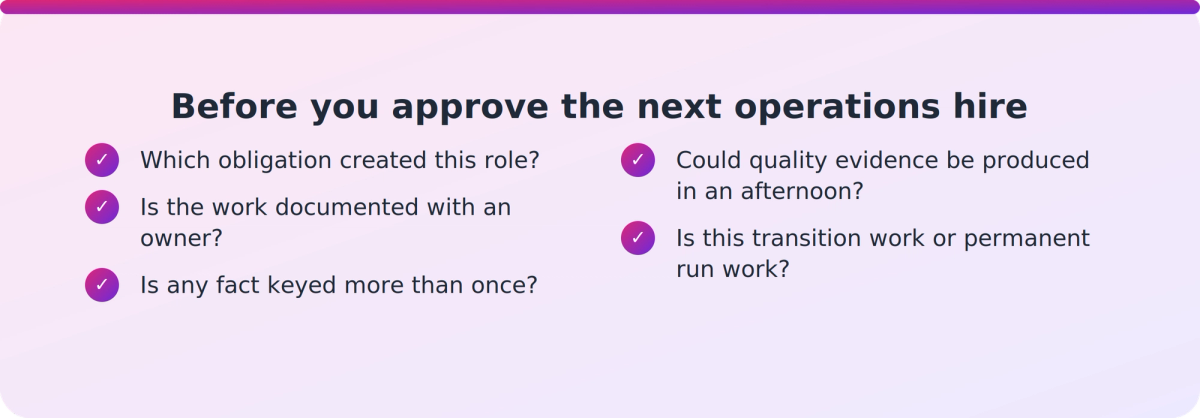
The test is simple. Pick your last three hires or backfills in operations, finance and student administration. For each one, ask what obligation or task created the need.
Three questions to put to your team
- Is the work repeatable or heroic? If the SDR submission depends on one person who knows which spreadsheet to trust, you have a key-person risk dressed up as a process.
- Is the same fact keyed more than once? A student's start date entered in the student record, the funding file and the board report is three chances to disagree and one person to reconcile them.
- Could you produce quality evidence in an afternoon? Under self-review, a records request you answer in days rather than minutes tells you where the hours are hiding.
Track the hours per task for one reporting cycle. Even rough numbers will show where capacity is going.
What redesign looks like in practice
Redesign doesn't need a programme office. It needs a few disciplined habits.
Map the minimum record once. The PTE Rules 2026 define the minimum enrolment record. Make that the single source and trace every downstream report back to it. Anything that can't be traced is a candidate for deletion.
Write down the cycle. Document the SDR run, the financial return and the board pack as steps with owners, inputs and checks. If only one person can describe a step, that step is your first risk.
Separate one-off transition from permanent run. Re-mapping data to new counterparties after the VET reform is transition work. Staff it with fixed-term capacity or project time, not permanent headcount.
Gate every new hire with a process question. Before approving a role, ask what would have to be true for this work to take half the time. Sometimes the answer is nothing, and you hire. At least you'll know it was a decision.
What we don't know
Some of this is genuinely unsettled. Submission dates and the exact timing of self-review obligations should come from TEC and NZQA directly. A claim circulating that PTEs are losing domestic enrolments faster than the rest of tertiary appears only in a vendor blog and is unverified, so don't build a plan on it. Your own numbers matter more than anyone's anecdote.
Our take
The headcount trap is a design failure that looks like growth. Regulators and funders will keep adding obligations. That is the permanent condition of the sector, and a team that grows by one role per obligation will eventually price itself out of viability.
The operations leaders who come through the restructure well will be the ones who treated 2026 as the year to make records, evidence and reporting repeatable, rather than the year they staffed up around them. Hiring is sometimes right. It should be a choice, not a reflex.
Key takeaways
- Operations headcount tends to follow obligations, not enrolments, so test whether your hires trace back to a process gap.
- No official data benchmarks PTE admin staffing against enrolments. Audit your own hours rather than borrowing a ratio.
- TEC's viability expectations make cost per enrolment a survival measure for funded PTEs, not just an efficiency one.
- Self-review moves quality evidence inside your organisation, so retrievability and shared knowledge become operational risks.
- Separate transition work from permanent run work before you approve any new role.
FAQ
Does NZ use AVETMISS for reporting?
No. AVETMISS is an Australian standard. NZ reporting runs on the Single Data Return (SDR), which the Ministry of Education and TEC use for funding, performance monitoring including against Investment Plans, publishing performance information and statistical reporting.
Where do SDR submissions happen in 2026?
TEC's SDR page says SDR and Indicative Enrolment Collection submissions are supported on the Data Exchange Platform (DXP), with Data Specifications for SDR 2026 v3.1. Check TEC's page for current submission dates.
What are the financial reporting obligations for PTEs?
Under the PTE Rules 2026, non-funded PTEs file financial returns biennially unless NZQA says annually. TEC requires financial information from every PTE receiving more than $50,000 in TEC funding. Statements are reviewed by an independent Chartered Accountant under $5 million in funding, and audited at $5 million or more.
Is EER still in place?
No. NZQA says the PTE Rules 2026 were re-issued to reflect the removal of External Evaluation and Review and its replacement with self-review. Confirm current timing and quality management system requirements on nzqa.govt.nz.
One thing to do this week
Take your last operations hire and write down the obligation that created the role. Then ask whether a redesigned process would have changed the answer. If it would, you have found your first audit target.