Your sign-off queue isn't a compliance control. It's a single point of failure that happens to look like one. Under iQAF, the fix isn't reviewing faster. It's designing approval so content owners confirm what they know, you judge what genuinely needs judgement, and the trail shows both.
Why this lands on your desk
NZQA's integrated quality assurance framework (iQAF) went live in January 2026. From 1 January, NZQA stopped starting new EER processes and consistency reviews. Providers now submit an annual self-review summary report and meet NZQA to discuss their improvement plan.
The Quality Assurance of Tertiary Education Providers Rules 2026 replaced the 2022 rules on 19 January 2026. They require an up-to-date quality management system (QMS), annual self-review, reporting to NZQA, monitoring, sub-contracting requirements and retention of assessment records.
The QMS scope is wide: risk management, academic integrity, programme and micro-credential management, assessment and moderation, complaints, discipline and appeals, compliance with the Act and NZQA rules, and Pastoral Care Code requirements. All of that routes to one inbox, and the inbox is yours.
The ground also keeps moving. NZQA calls its Pastoral Care Code guidance "a living document". Terminology has shifted from WDCs to ISBs. A document you approved last quarter can be stale this quarter, so approval has to be a repeatable process, not a one-off event.
Why reviewing faster won't fix it
The usual response to a bottleneck is to clear the queue harder. That treats the symptom.
A queue conceals risk. A policy sitting unreviewed looks the same as a policy nobody has thought about in two years. And when every document needs your eyes, you can't give substantive attention to the ones that matter. You skim the lot.
Assurance is now continuous and provider-led. A system that depends on one person's throughput can only be as current as that person's calendar.
Three design moves that take you out of the critical path
1. Give every document an owner and a review date
Each part of the 2026 Rules has documents and records behind it: the QMS, the self-review, monitoring, sub-contracting, assessment records. Each needs an identifiable owner and a date it will next be checked.
Ownership means the person closest to the content is accountable for its accuracy. You own the standard they're measured against. That's a different job from checking everyone's homework.
2. Tier approvals by what is changing
Not every change deserves the same scrutiny, and NZQA's own rules already draw those lines. The 2026 Programme Approval rules reduce requirements for approvals relating to qualifications made up entirely of skill standards. They also remove the need for ISB endorsement for Type 2 changes. Consent to Assess now requires applicants to show how they'll meet the 2026 QA Rules, and to comply with them to keep consent.
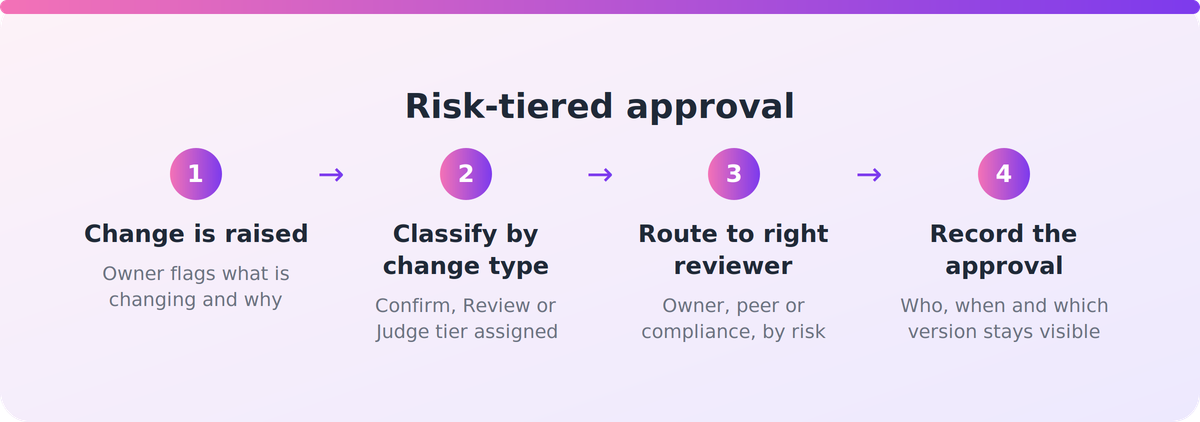
Which change needs which level of review is now a rules-based question. Here is one way to tier it. This is a design suggestion, not an NZQA instruction:
- Confirm: the owner attests the change is accurate (a corrected reference, updated contact details, a minor wording fix).
- Review: a peer or subject lead checks it (a revised assessment guide, an updated procedure).
- Judge: compliance makes the call (a new policy, anything touching NZQA rules, the Pastoral Care Code or sub-contracting arrangements).
Most of your queue probably belongs in the first two tiers. Only the third needs you.
3. Make the trail visible
NZQA's proposed quality descriptors (Highly effective, Effective, Not effective) would weight and score each criterion using evidence NZQA already holds and the provider knows about. Consultation ran from 10 August to 7 September 2026. These are proposals, not final rules, and NZQA says it would develop Rules if needed, depending on the consultation outcomes.
I wouldn't wait on a date. If scoring draws on evidence you know about, then who approved what, when, and against which version becomes part of your story. Build that habit now and you're ready whichever way the final rules land.
Schedule the sweeps instead of relying on a sharp eye
Terminology is a good test case. NZQA's rule changes shifted terminology from WDCs to ISBs, and the government's VET Amendment Bill establishes eight Industry Skills Boards to lead standard-setting. Any policy, programme document or evidence map still naming Workforce Development Councils is out of date.
That conclusion is our inference from NZQA's terminology change, not an NZQA directive. But the lesson holds. A routine, assigned sweep for outdated references beats hoping one reviewer spots them in a busy week.
Guidance drift deserves the same treatment. A secondary source, Kiwi Pathway, reports that NZQA updated its self-review and attestation guidance on 7 September 2026. It also says self-review reports should be readily available to learners, staff and the public, including on the provider's website. We couldn't confirm that on an NZQA page, so check NZQA directly before acting on it. Put "confirm what is actually required" on the sweep list.
Our take
A compliance manager who approves everything has built a dependency, not a control. The strongest QMS is one where ownership is clear, risk decides the depth of review, and you can show your working at any point in the year.
That means giving up some sign-offs. It feels risky. But a queue that quietly ages is riskier than a confirmation by the person who wrote the document, recorded and visible.
A first step for this week: export your current queue and tag every item Confirm, Review or Judge. Count how many land in Judge. That number is the real size of your job.
Key takeaways
- iQAF makes assurance continuous: no new EER processes since 1 January 2026, with annual self-review and an NZQA discussion of your improvement plan.
- The 2026 QA Rules require a current QMS across a wide scope, which is too broad for one person to review substantively.
- Tier approvals by change type: owner confirmation, peer review, or compliance judgement.
- Give every document an owner and a review date, and keep a visible record of who approved what.
- Schedule sweeps for outdated references (WDC to ISB) and for guidance changes, and verify unconfirmed claims with NZQA directly.
FAQ
What is a compliance approval bottleneck in a PTE?
It's when every policy, programme document and evidence map must pass through the compliance manager before it's current. Under iQAF and the 2026 QA Rules, which require an up-to-date QMS year-round, a stalled queue becomes a continuing risk rather than a pre-review problem.
Which documents still need the compliance manager's judgement?
NZQA doesn't prescribe this, so it's a design decision. A sensible line puts new policies and anything affecting NZQA rules, the Pastoral Care Code or sub-contracting with compliance. Routine corrections and updates can be confirmed by the content owner.
Do the proposed quality descriptors change how I should approve documents?
They're proposals only, and consultation closed on 7 September 2026. But NZQA would score criteria using evidence it holds and the provider knows about. Clear ownership and a traceable approval record are worthwhile now, whatever the final rules say.
How do I handle terminology changes like WDC to ISB?
NZQA's rule changes shifted terminology from WDCs to ISBs. Treat it as an assigned, recurring check across policies, programme documents and evidence maps. That's our inference, not an NZQA instruction, so it's worth confirming the current wording with NZQA.